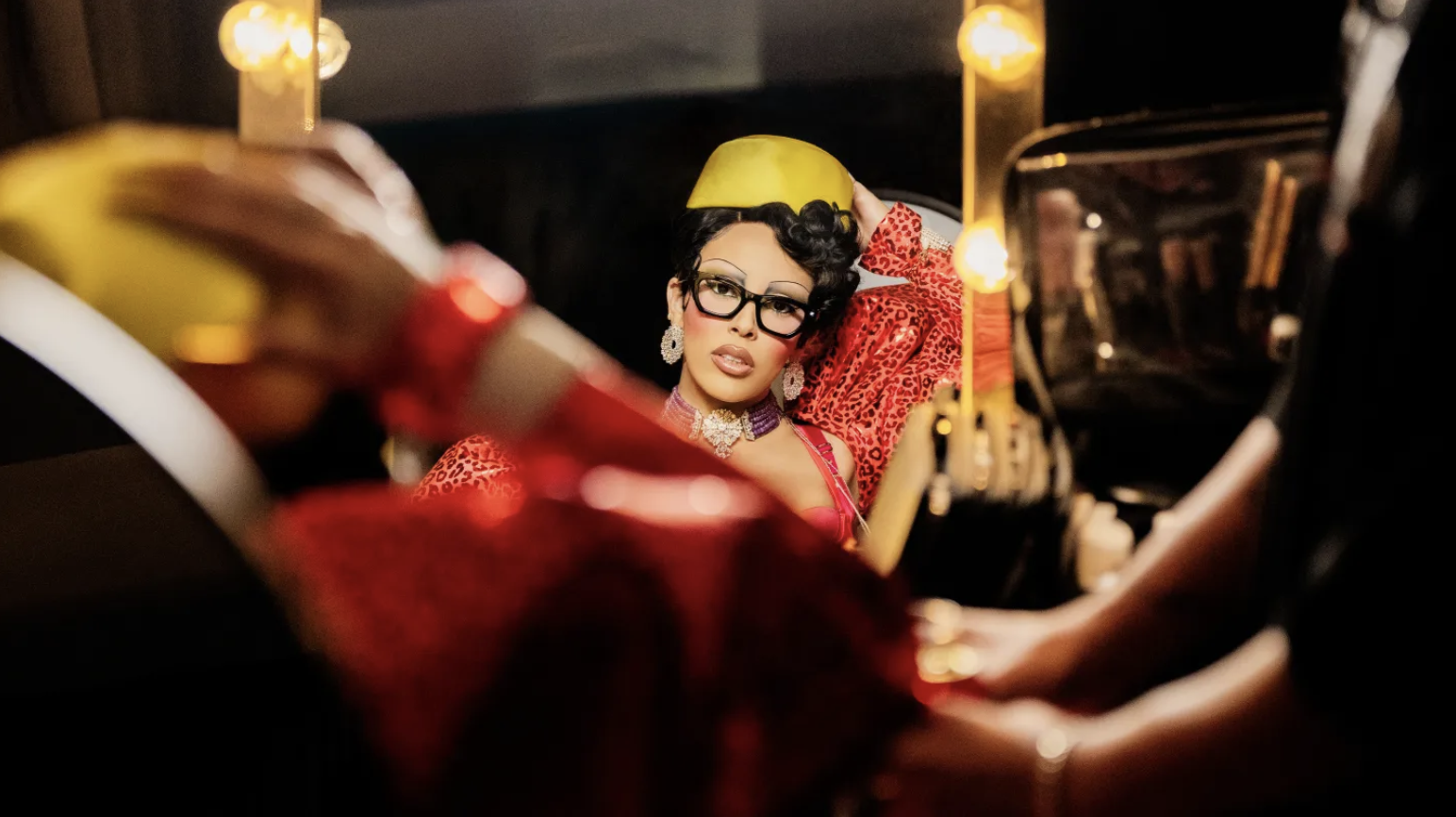
Doja Cat is pictured on a stop amid her Tour Ma Vie while wearing Ray-Ban Meta. Courtesy of Ray-Ban Meta
Welcome to the next edition of On The Record, thoughtful analysis on culture, entertainment, tech, fashion, music, sport, and brands. Here's a round-up of key conversations and campaigns that caught my attention over the past fortnight.
The fortnight's clearest lesson is that growth no longer buys safety. English football has never brought in more money, yet the Independent Football Regulator found that 94% of clubs across the top five tiers lost money in 2025/26 and two-thirds could not survive 90 days without new owner funding. HMV's like-for-like sales are up 15% and it is still leaving Oxford Street after its landlords proposed doubling the rent. Universal Music Group grew first-half revenue by 5.3% and parted with the heads of Def Jam and Republic anyway, Nike paired a $2.5bn savings plan with a new China design team, and Saint Laurent lost the designer who tripled its revenue. Fenty Beauty sold $450m of make-up in a year, and LVMH is still selling its half. Running alongside that is a contest over who controls the audience once it shows up: Phoebe Bridgers locks phones in pouches, Doja Cat films her tour on Ray-Ban Meta glasses, Spotify renewed Joe Rogan for his ad sales rather than his exclusivity, and WME and Live Nation are rebuilding around creators who already control their own channels. The organisations that came through the fortnight strongest were the ones that control the moment itself, the room, the footage or the relationship, and size on its own protected nobody.

⚽ SPORT, POWER & GOVERNANCE
Two-Thirds of English Clubs Say They Couldn't Last 90 Days Without Their Owner ⚽
📌 The Independent Football Regulator has used its statutory powers to demand club accounts, and its first State of the Game report confirms what the pyramid has long suspected. Across the top five tiers of men's football, 94% of clubs lost money in 2025/26, League One wages rose 71% in four years, and more than 60% of EFL and National League clubs are technically insolvent on a book-value basis. Culture Secretary Lisa Nandy told BBC Breakfast the report "absolutely blows the doors off the state of English football". The report is a draft open for consultation until 8 December 2026, and the regulator has given the Premier League and EFL room to agree a new distribution deal, warning it will use its own powers if they can't.
94% of clubs across the top five tiers of English men's football made a loss in 2025/26 (IFR, Inside World Football)
29% of clubs said they could not survive more than 30 days without new owner funding, and 66% not beyond 90 days (IFR, Inside World Football)
League One clubs need 72p of external financing for every £1 of revenue, against 33p in the Premier League (IFR, Inside World Football)
💡 Twenty-eight clubs needed 12 or more owner injections in a single year. A monthly top-up is now the operating model for a sizeable share of the pyramid. Every shirt sponsor, stadium naming partner and local broadcaster on a multi-year deal with one of those clubs is backing a business whose runway depends on one person's next bank transfer. The regulator's diagnosis puts the blame on distribution, and parachute payments in particular, so expect it to lean on the Premier League before it squeezes individual owners. Clubs have until May 2030 to show they hold "appropriate financial resources", and on this evidence a large part of the pyramid would fail that test today. 📉
Read the full report: https://sotg.footballregulator.org.uk/api/media/file/IFR%20State%20of%20the%20Game%20Report.pdf?from=header
NWSL Turns Its Salary Cap Into a Youth Development Fund 🌱
📌 With no academy system and no reserve league, NWSL clubs have had little financial reason to develop teenagers who might sign elsewhere. A new Player Development Rule, reported by ESPN and already in use, lets a club register a prospect from under-15 level, fund her training and log at least 200 hours of supervised development over two years. In return it earns up to 80% salary cap relief when she signs her first professional contract, running until her 23rd birthday.
Up to 80% salary cap relief for the developing club, through the player's 23rd birthday (ESPN, via Just Women's Sports and The People's Pitch)
At least 200 hours of supervised development over two years required to qualify (ESPN, via Just Women's Sports and The People's Pitch)
Roughly half that relief still goes to the developing club if the player signs with a rival NWSL team (ESPN, via The Daily W; single-sourced)
💡 Men's football pays for development in cash, through transfer fees and FIFA training compensation, which the rule's age-23 cut-off deliberately mirrors. The NWSL pays in cap room, a currency the league prints itself and that costs owners nothing up front. That only works in a closed league with a hard cap, where space under the ceiling is the scarcest thing a club can hold. Compare the IFR report in this edition, where open-pyramid clubs spend their way towards promotion and development is the first thing to go. The real test is whether clubs treat this as a pipeline or a cap loophole, and that answer only arrives when the first registered prospects turn professional. ⚽
Tyler, The Creator Takes Over Barcelona's Shirt for El Clásico 🎨
📌 Barcelona will face Real Madrid at Spotify Camp Nou on 25 October with GOLF WANG across the chest where the Spotify logo usually sits. Tyler, The Creator's takeover, launched on 15 October, is the ninth special-edition artist shirt from Spotify's deal with the club, following Drake, Rosalía, The Rolling Stones, Karol G, Coldplay, Travis Scott, Ed Sheeran and Olivia Rodrigo. The collaboration also includes a limited apparel collection, a short film directed by Tyler and Copa De Golf, an event in Barcelona mixing music, football and fashion.
Ninth artist takeover of Barcelona's shirt under the Spotify partnership (Footy Headlines, Spotify)
Kit debuts in El Clásico against Real Madrid on 25 October 2026 (Footy Headlines, Spotify)
💡 Nine editions in, this is a format. Spotify pays for some of the most valuable inventory in club football and then hands the logo space to an artist, which tells you what it thinks the shirt is for: a release slot in front of one of sport's biggest global audiences. The artist gets reach no album campaign could buy, Barcelona gets a collectable shirt each season, and Spotify becomes the place where music and football culture meet without needing its name on the front. Tyler is a sharper choice than most on the list, because GOLF WANG is a fashion label in its own right and he has been to Barcelona matches as a fan, so the shirt reads as his own idea of the club. 🌼
Pharrell Dresses Real Madrid Again, and None of It Is for Sale 🧳
📌 Football's travel day has become a runway, and Real Madrid has handed its own to Louis Vuitton for a second season. The 2026-27 travel wardrobe, designed under menswear creative director Pharrell Williams, includes a reversible Monogram jacket, knitwear, polos, a black cashmere coat and personalised leather goods, worn by players including Kylian Mbappé, Vinícius Júnior and Jude Bellingham for team travel and major occasions. Louis Vuitton replaced Zegna as the club's formalwear partner in June 2025, and the pieces are bespoke for players and staff, with no retail release planned.
Second season of the Louis Vuitton partnership, which began in June 2025 when it replaced Zegna (Footy Headlines, Louis Vuitton)
No public retail release planned for the 2026-27 collection (Footy Headlines, Louis Vuitton)
💡 Read this against Barcelona's Tyler shirt and El Clásico has two opposite theories of fashion. Barcelona sells: an artist edition every season that fans can buy and wear. Madrid withholds: the only place to see the Monogram jacket is on Mbappé or Bellingham walking off a team plane, which turns every arrival into a Louis Vuitton campaign the brand never has to shoot. For the brand, a squad of global stars photographed every week is reach no runway can deliver, and keeping the clothes off sale protects the exclusivity luxury depends on. Both clubs are using culture to extend their reach, but only one is asking fans to pay for it. ⚽
Foot Locker Signs On With the Champion Knicks and Takes the Deal to the Boroughs 🏀
📌 Four months after the Knicks won their first NBA title in 53 years, Foot Locker has signed a multi-year deal as the team's official athletic footwear retailer from the 2026-27 season. It gets retail space inside the Knicks Team Store at Madison Square Garden's Chase Square, pop-ups at select home games, in-arena branding, a theme night and promotions tied to wins. The launch was the Fan Express, a mobile tour stopping in Downtown Brooklyn, Jamaica Avenue in Queens, Fordham Road in the Bronx, Harlem and 34th Street.
Knicks won the 2026 NBA Finals, the franchise's first title in 53 years (ESPN, NewsOne)
Foot Locker retail space inside the Knicks Team Store at MSG's Chase Square (Sole Retriever, Sneaker News)
💡 The Fan Express route is the smartest part of the deal. Brooklyn, Queens, the Bronx and Harlem each have their own sneaker culture and their own Foot Locker high streets, and a title-winning Knicks fanbase is really a collection of those neighbourhoods. Going to them before the season starts recognises that, where an arena activation mainly reaches whoever can afford a seat at the Garden. Sneaker News compares the deal with Nike's single-brand Kobe store at the Lakers' arena, and a retailer that sells every brand can ride the Knicks moment whichever shoe the next big release turns out to be. 🗽
Prada Linea Rossa Helps Diego Poncelet Become the Fastest Skateboarder on Record 🛹
📌 A closed mountain road in Quebec's Charlevoix region produced a new Guinness World Record on 22 September, confirmed on 15 October: Spanish downhill skater Diego Poncelet hit 151.83km/h (94.34mph), beating the mark set on the same road in 2017 by the late Pete Connolly, to whom Poncelet dedicated the run. Prada Linea Rossa was an official project partner, developing aerodynamic shoes and gloves with shock-absorbing insoles, and Red Bull, which sponsors Poncelet, released the footage.
151.83km/h (94.34mph), a Guinness World Record for fastest standing skateboard speed (Guinness World Records, Surfer Today, Red Bull)
Previous record of 146.73km/h (91.17mph), set by Pete Connolly on the same road in 2017 (Surfer Today; single-sourced)
💡 Prada Linea Rossa grew out of the group's America's Cup sailing programme, and its credibility as performance wear depends on showing up where failing kit gets punished. A 150km/h run on a skateboard is about as unforgiving as product testing gets, and this is the second record Prada has backed alongside Red Bull, after Sandro Dias. Each one gives the line a real-world proof point a runway can't, at a fraction of the cost of a mainstream sports sponsorship. That is how a fashion house earns standing in a world it wasn't born into. The audience is small, but in performance wear the niche that trusts the product sets the tone for everyone else. 🏁
🎶 MUSIC, LIVE & CULTURE
Licensing Bias Costs London's Black and South Asian Music Scene Up to £141m a Year 🎶
📌 Nine years after the Met scrapped Form 696, the risk-assessment form that asked promoters about the ethnic make-up of their audiences, a two-year study has found the pattern it was accused of encoding still shapes who gets to put on a show in London. The Race Equality in Music Event Licensing (REMEL) report, published by Black Lives in Music, found Black and South Asian-led events are cancelled, restricted or shut down at higher rates than white-led events, with afrobeats, dancehall, R&B and hip-hop treated as high-risk while pop, indie and rock face little scrutiny. Its 19 recommendations include an independent review of licensing, appointed by the Home Office and the GLA, and annual publication of council licensing decisions.
£127m to £141m in estimated live music spending lost each year in London (REMEL, via Black Lives in Music, PA and Music Week)
More than £650m in spending at risk over five years (REMEL, via PA and Music Week)
46% of police-affected cases reported a complete venue closure (REMEL, via Black Lives in Music; single-sourced)
💡 Form 696 was withdrawn in 2017 and the behaviour carried on without the paperwork. The problem sits in discretion, and no single form created it. That discretion lands hardest on Temporary Event Notices, the cheapest and most flexible route for a new promoter, and the report found those are refused more often in London's most diverse boroughs. The genres being squeezed at borough level are the same ones labels, festivals and brands rely on for their next arena act and their next headline partnership, and many of those careers start in one-off nights that need a TEN to open. Mandatory publication of licensing data is the recommendation that matters most, because a decision a promoter can see is a decision they can challenge. 🎟️
UMG Cuts Label Leadership While Revenue Keeps Growing 💿
📌 A cost programme launched in 2024 reached the top of Universal Music Group's labels last week. Def Jam chairman-CEO Tunji Balogun will leave by the end of the year, Republic chairman and co-CEO Jim Roppo is departing, reportedly for Warner Records, and Interscope-Geffen-A&M presidents Sam Riback and Nicole Wyskoarko are going, alongside Polydor Label Group president Ben Mortimer in the UK. Island's co-CEOs take wider roles across UMG's East Coast labels, and the company says it is "bringing in new skills and technology".
€250m (about $270m) in targeted annual savings from the restructuring announced in 2024 (Music Week, Music Business Worldwide)
First-half 2026 revenue of nearly $7.2bn, up 5.3% year on year (Variety; single-sourced)
💡 Revenue is up and the cuts are at chairman level, so this is a structural decision made from strength. UMG is moving its front-line labels onto shared departments, so the job of a label boss shrinks from running a company to running a roster, and fewer of those jobs are needed. Variety's reporting puts it down to streaming growth levelling off and attention moving to social platforms, where breaking an artist depends less on a label's own marketing machine. The cost is institutional taste: Def Jam was built on its leaders' ears, and it was at Def Jam in 2005 that Jay-Z signed a teenage Rihanna. This edition's Fenty story is an odd rhyme. 🎙️
Britons Spend More Than Twice as Much on an Immersive Night Out as on a Gig 🎟️
📌 UK consumers spent £206bn on experience-related categories in 2025, according to Grant Thornton's first Experience Economy Index, 11.7% of all consumer spending, up from 9.5% in 1997 and forecast to reach 13% by 2031. The sharpest growth sits in immersive formats such as ABBA Voyage, Frameless and The Crystal Maze LIVE, which drew 17.3 million UK adults over the past year and generated £3.9bn in GVA. The same research finds buyers increasingly fussy about how they are charged.
£210 median spend per immersive experience, against £125 for a festival and £88 for a gig (Grant Thornton Experience Index 2026; single-sourced)
60% of UK adults say they are less likely to buy tickets for an event that uses dynamic pricing (Opinium for Grant Thornton; single-sourced)
51% think more events should restrict phones and devices (Opinium for Grant Thornton; single-sourced)
💡 The immersive premium comes from control. ABBA Voyage built its own arena for one show and has run it since 2022, so the operator owns the venue, the bar, the merch and the calendar, and 55% of immersive attendees make a night of it with an overnight stay. A gig promoter rents the room for one night and has to claw back margin through the ticket, which is exactly where dynamic pricing lands, and six in ten buyers say that puts them off. The appetite for phone restrictions points the same way: audiences will pay for a night designed around them and resent one designed around yield. Live music has the demand, but at most levels it doesn't own the whole night. 🎶
Phone-Free Arenas Are Spreading, and the Footage Is the Point 📵
📌 Arena audiences are being asked to hand over their phones, and they are still buying tickets. Phoebe Bridgers' Lost Tour, which opened in Indianapolis on 15 September, seals every phone, smartwatch and recording device in a locked pouch for the length of the show, across North American arenas this autumn and the UK, Ireland and Europe from late November. Harry Styles went phone-free for his one-off Manchester show earlier this year, and Bob Dylan has run pouch-only tours for years.
The Lost Tour requires phones, smartwatches and recording devices to be sealed in Yondr pouches at every show (Scene Music Media, Hoodline)
Harry Styles collected phones and handed out disposable cameras at his One Night Only show at Manchester's Co-op Live, later released as a Netflix special (Kosmofoto, The Concert Chronicles)
Museum visitors who photographed objects remembered fewer of them, and fewer details, than those who only looked (Linda Henkel, Psychological Science, 2014)
💡 Phone bans get sold as wellbeing, and audiences seem to want them: 51% of UK adults told Grant Thornton more events should restrict phones (see the Experience Index entry). The commercial logic is control. Bridgers reportedly played eight new songs at her Madison Square Garden pop-up with no phones in the building to film them, and Styles' Manchester night reached most fans as a Netflix special, worth more because nobody in the crowd had posted it first. At arena level, a shaky vertical clip used to be free marketing for the artist and is now a leak of the most valuable footage of the night. The Henkel finding applies to brands too: once the photo exists, people stop bothering to remember, so an activation built to be posted risks being the one nobody recalls. 🎤
Goldenvoice Sold Out a One-Off $499 Dance Festival, Then Let Apple Music Stream It Free 🌵
📌 Goldenvoice's one-off format, which gave classic rock Desert Trip in 2016 and heavy metal Power Trip in 2023, reached electronic music this month. Head Trip brought Calvin Harris, Swedish House Mafia, Skrillex, Peggy Gou b2b Four Tet and Dom Dolla b2b KETTAMA to the Empire Polo Club in Indio on 10 and 11 October, with one stage, no overlapping sets and Floating Points' Sunflower Sound System running throughout. Apple Music livestreamed the main-stage sets for free, describing it as its first festival partnership of this scale.
In-person tickets started at $499 and sold out (MacRumors, MacTrast)
One stage, no overlapping sets, across two days (Resident Advisor, Goldenvoice)
Third Goldenvoice one-off at the site, after Desert Trip (2016) and Power Trip (2023) (IQ, Resident Advisor)
💡 "One time only" works for the same reason one stage does: both remove choice, and that turns a lineup into an event. Strip out the clashes and the scarcity, and the $499 ticket stops being a question of who's playing and becomes a question of whether you were there. That makes the free stream an addition rather than a threat, since the people in Indio paid for presence and everyone else got the sets. For Apple Music, it's a well-judged way into dance culture: it has a dedicated global head of dance, and attaching its name to the scene's biggest weekend while making it free to watch builds credibility in a genre whose fans care more about selectors than platforms. 🎧
HMV Leaves 363 Oxford Street Again as Landlords Move to Double the Rent 💿
📌 Three years after a comeback that seemed to prove physical music retail still had a place on Britain's busiest shopping street, HMV will close its Oxford Street flagship in March 2027. Landlords proposed doubling the rent, on top of a bill for substantial renovation works, at a site HMV first opened in 1921 and lost to administration in 2019, when an American sweet shop moved in. HMV says it is looking for a new West End site, and the business itself is growing.
Like-for-like sales up 15% across the group in the first nine months of 2026 (HMV, via ITV News and IanVisits)
Shop and online revenue forecast to pass £240m in 2026, up from £212m in 2025 (HMV, via ITV News and IanVisits)
113 UK stores, including six Fopp shops, plus eight in Europe (HMV, via ITV News; Music Week reports over 100)
💡 A growing retailer being priced off the street says more about the landlord's model than the tenant's health. The rent ask arrives as plans to pedestrianise Oxford Street move forward, and it reads like a bet on the footfall that scheme is meant to bring. The heritage at 363 is real, but it doesn't appear on a rent roll, and a 1921 address is worth more to HMV's story than to its P&L. With like-for-likes up 15%, a new West End flagship is a chance to build a store around signings and live sessions, the paid-for, in-person side the Experience Index figures in this section say people value. 💿
New 7,000-Capacity Warehouse Ironworks Opens in the Royal Docks 🏭
📌 East London has a new large-format room. Ironworks has opened on a former 19th-century shipyard and ironworks site at Thames Wharf in the Royal Docks, with 7,000 capacity, around 150,000 sq ft of indoor and outdoor space and a terrace over the Thames. It comes from LWE and PROJEKT, teams whose credits include Printworks, The Cause and Tobacco Dock. Jamie Jones headlined opening night, and Eric Prydz and Charlotte de Witte have already sold out.
7,000 capacity across roughly 150,000 sq ft indoors and out (Time Out, Mixmag, Resident Advisor)
Operators have committed dedicated ticket access for local residents, local jobs and pitches for independent food traders (Mixmag; single-sourced)
💡 The opening season is all proven headliners, and that's how a 7,000-capacity room pays its way. Operators with Printworks and Tobacco Dock on their CV get licensed for scale, and the resident tickets and local hiring are what that licence costs in a regeneration zone. The risk-taking in London dance music still happens in rooms a fraction of this size, the ones that run on Temporary Event Notices and that the REMEL report in this section found are refused most often in the city's most diverse boroughs. A big new warehouse is good news for the top of the market, while the next Jamie Jones is coming up through the bottom of it. 🔊
Doja Cat Films Her Tour Documentary on Ray-Ban Meta Glasses 🕶️
📌 Ray-Ban Meta's tour partnership with Doja Cat is turning into content. Ma Vie World Tour, a 12-minute short directed by Quinn Whitney Wilson and filmed almost entirely on Ray-Ban Meta smart glasses from the point of view of Doja and her crew, premieres on YouTube on 23 October. The glasses have been part of the Tour Ma Vie show itself, with custom pairs co-designed by Doja and her creative director Brett Alan Nelson, and she fronted Ray-Ban Meta's global campaign last year.
Custom Ray-Ban Meta frames co-designed for the show and worn on stage, including at The O2 in London on 29 May (OptikNow, Ray-Ban Meta)
12MP camera built into the frames for hands-free, first-person capture (OptikNow; single-sourced)
💡 Set this next to the phone-free arena entry and the pattern is the same: artists are taking the camera back. Bridgers removes it from the crowd, while Doja moves it to her own face, so the footage belongs to her and her partner and not to 20,000 phones. For Meta, a tour film shot on its glasses is about the most persuasive product demo it could ask for, because hands-free, eye-level footage is exactly what smart glasses promise. The risk sits with the format: a documentary that doubles as an ad only works if the access feels real, and that's what the 23 October premiere has to prove. 🎬
👜 BRAND, CULTURE & CAMPAIGNS
Nike Builds Its First China-Only Line as It Launches a $2.5bn Savings Plan 👟
📌 A slide in China has pushed Nike to do something it has rarely done: design from scratch for a single market. Local Creation Collections, created by a Shanghai team formed about four months ago, launches on 12 November across Nike Sportswear and Jordan Streetwear, with more than 20 pieces drawn from time with local running crews, art events and street-style communities, as well as Michael Jordan's off-court tailoring. It follows a first quarter in which revenue fell 4% to $11.2bn and Greater China declined again, and comes alongside Elliott Hill's new Pace programme, which targets around $2.5bn in savings through fiscal 2031, realigns the business into three geographies and adds a new campus in India to support "enterprise capabilities".
More than 20 pieces from a Shanghai-based Local Product Creation team formed about four months before launch (WWD, Modaes)
$11.2bn first-quarter revenue, down 4% reported, with Nike Direct down 8% and wholesale down 1% (Nike, Pulse 2.0)
About $2.5bn in cumulative savings targeted through fiscal 2031, while Converse revenue fell 28% to $263m (Nike, Pulse 2.0)
💡 The two announcements pull in opposite directions, and that's deliberate. Pace centralises, with three regions and an India campus for "enterprise capabilities", which points to shared services and technology rather than a new consumer market. The China line decentralises the one thing global scale does badly, which is knowing what young shoppers in a specific city want to wear, and Nike's head of Local Creation for Greater China says the product "doesn't have to be super loud". Cut the back office and localise the front is Hill's model, and the channel numbers follow the same logic, with Direct shrinking faster than wholesale as Nike rebuilds its retail partnerships. The test is speed, because a team four months old is up against domestic brands that have designed for China all along, and investors will be judging the results every quarter. 📉
Jay-Z's MarcyPen Closes In on LVMH's Half of Fenty Beauty 💄
📌 The brand that changed how the beauty industry thinks about shade range may be about to change hands at well below its 2021 valuation. MarcyPen Capital Partners, the investment firm co-founded by Jay-Z, is reportedly nearing a deal to buy LVMH's 50% stake in Fenty Beauty, with Rihanna keeping the other half. Puck reported the talks were close at the end of September and that a deal could be signed within weeks, though no price has been disclosed and MarcyPen has declined to comment. LVMH has been exploring a sale since October 2025, and Make Up For Ever and Fresh are reportedly also under review.
About $450m in net sales in 2024 (Reuters, via Beauty Independent and TheGrio)
Valued at $1bn to $2bn by people familiar with the sale, against a $2.8bn Forbes estimate in 2021 (Reuters, via Beauty Independent and TheGrio; Forbes figure single-sourced)
LVMH's perfumes and cosmetics sales fell 3% to €8.17bn in 2025 (Personal Care Insights; single-sourced)
💡 Fenty's 40-shade launch in 2017 worked so well that it became the industry minimum, and a breakthrough every competitor can copy stops being an advantage. What can't be copied is Rihanna, and LVMH never owned her: her half of the business and her face stayed with her throughout. For a group that measures beauty brands against Dior and Guerlain, a $450m business whose value rests on a partner it doesn't control was always going to end up on the sale list. For MarcyPen, the same stake comes with a founder Jay-Z signed to Def Jam in 2005 and a firm that already backed Savage X Fenty. It is buying a relationship at a beauty-brand price. In 2021 LVMH bought half of Jay-Z's champagne house, Armand de Brignac, so this deal reverses the roles. 🥂
Anthony Vaccarello Leaves Saint Laurent, and the House's Film Studio Loses Its Founder 🎬
📌 Kering has confirmed that Anthony Vaccarello has left Saint Laurent after ten years as creative director, with his all-gold spring 2027 show in Paris on 29 September now his last for the house. He took over from Hedi Slimane in 2016, built the brand into a business of more than €3bn and took it well beyond clothes, launching Saint Laurent Productions in 2023 and the Babylone bookstore and gallery in Paris. No successor has been named, and Chloé's Chemena Kamali, who spent seven years as his women's design director, is widely tipped. If appointed, she would be the house's first female creative director.
Revenue tripled to €3.3bn under Vaccarello, before falling to €2.6bn in 2025 amid the luxury slowdown (AFP, via The National and The Star)
Saint Laurent Productions had three films in competition at Cannes, including Emilia Pérez (W Magazine, Saint Laurent)
💡 A fashion house running a film studio was a bet on cultural standing that only a creative director with ten years of credit could make, and the question now is whether it outlasts him. Kering chief executive Luca de Meo is 18 months into an overhaul, and the growth plan set out for Saint Laurent covers menswear, jewellery, women's daywear and leather goods, the categories that drive margin. Productions and Babylone appear nowhere on that list. Kamali would be the continuity pick, someone who knows the house's codes from the inside, and her appointment would show whether Kering wants another cultural architect or a designer who can get revenue back above €3bn. 👜
SKIMS Turns Its Stores Into One-Hour Delivery Hubs With DoorDash 🛍️
📌 Delivery apps are moving well beyond takeaway, and SKIMS is the first brand to offer its full range on DoorDash, with more than 23,000 styles delivered from its stores, typically in under an hour. The service was announced in September, and Kim Kardashian fronts the campaign that went live last week.
More than 23,000 SKIMS styles available, with average delivery under an hour (Chain Store Age, DoorDash)
SKIMS plans 55 stores by the end of 2026 and more than 100 by the end of 2027 (Chain Store Age; single-sourced)
💡 A shapewear brand born online is opening physical stores at speed, and putting every one of them on DoorDash means each store earns twice, as a showroom and as a local fulfilment point inside an app millions already open for dinner. Shapewear and underwear suit the model better than most fashion, because customers know their size, buy repeatedly and rarely need a fitting room. For DoorDash, which has been building its retail business since 2021, a brand with Kim Kardashian's reach is a marketing shortcut into the category. 🛵
📺 MEDIA, STREAMING & PLATFORM
Hollywood's Agencies and Live Nation Race to Become the Creator Economy's Back Office 📺
📌 When talent owns its own channel, the old agency job of opening doors to networks shrinks, and the industry's biggest players are each placing a different bet on what replaces it. WME has launched Creator Labs, a team inside its digital division that builds and runs YouTube channels for clients from first idea to sponsorship sales, starting with former MSNBC host Joy Reid's channel, which has passed 500,000 subscribers since its 2025 launch. In the same week, Live Nation unveiled Creator Nation, a company it is bankrolling to buy creator-management firms, led by Select Management Group founder Scott Fisher and Timeline Management founder Alexis Fisher, with first acquisitions due in the coming months. Both follow UTA's 2024 rebrand to UTA Creators and the $250m holding company CAA formed with TPG in June.
11 hires across WME's Creator Labs and Creator Sales teams, with plans to add eight more (Tubefilter, WERSM, The Publish Press)
Live Nation's Sponsorship & Advertising division earned $1.3bn in 2025, up 11%, at a 64% operating margin, its highest of three segments (Live Nation, via Music Business Worldwide; single-sourced)
$250m committed by CAA and TPG to a holding company acquiring creator-driven businesses (Tubefilter, TheWrap)
💡 WME's digital co-head Ben Davis framed it himself: "Our clients now own their distribution, so how does the role of an agent change." Four answers are now on the table: UTA built around creators who started online, CAA is buying the businesses outright, WME is selling production and monetisation to people whose fame began elsewhere, and Live Nation is buying the managers. Live Nation's is the most revealing, because its sponsorship arm already works with more than 1,500 brands at a 64% margin, creator brand deals plug straight into that machine, and it owns the room, as Timeline has already shown by putting the Secret Lives of Mormon Wives cast on stage. Turning an online following into ticket sales is the step no agency can take alone, and WME cut 30 staff in March, so its 11 hires look like an agency moving people from the old model to the new one. 🎟️
Spotify Renews Joe Rogan Without Exclusivity, Because It Now Sells the Audience Everywhere 🎙️
📌 In 2020, Spotify's Joe Rogan deal was about pulling an audience onto its platform. The renewal announced on 8 October, like the one before it, leaves the show free to go anywhere. The new multi-year licence keeps The Joe Rogan Experience available across other platforms, with Spotify continuing to handle licensing and ad sales. Spotify hasn't disclosed terms, and The Wall Street Journal reports they are similar to the 2024 deal, which it estimated at around $250m.
18 million followers on Spotify, the platform's most-followed podcast since the partnership began in 2020 (Spotify, via Variety and Music Business Worldwide)
No. 1 in Edison Research's US Top 50 Podcasts for Q2 2026 (Music Business Worldwide; single-sourced)
Exclusive to Spotify under the 2020 deal and non-exclusive since 2024, with Spotify running distribution and ad sales (Music Business Worldwide, Variety)
💡 What Spotify is paying for has changed completely in six years. In 2020 it bought exclusivity to force listeners onto its app, and now it pays to sell the advertising around a show its rivals also carry. That makes Spotify an ad network for the biggest audience in podcasting, wherever that audience listens. That's the same logic as its Partner Program, expanding into more than 35 new markets, which pays video creators a share of revenue on Spotify without asking them to leave anywhere else. Next to TikTok's microdramas and WME's Creator Labs in this edition, the pattern holds across the sector: platforms have stopped buying audiences outright and started buying a share of whatever those audiences earn. 📻
Netflix Hands Its First Live Football Tournament to IMG ⚽
📌 The 2027 Women's World Cup will be the first Netflix production that runs for a month rather than a night. The tournament, in Brazil from 24 June to 25 July, streams exclusively on Netflix in the US and Canada, where it holds rights to both the 2027 and 2031 editions, and Netflix has appointed IMG as production partner for all 64 matches and more than 100 hours of studio programming, in English and Spanish in the US and English and French in Canada. IMG will also produce Netflix's live coverage of the draw on 11 December.
All 64 matches plus more than 100 hours of studio programming, produced by IMG (Inside World Football, TV Technology)
Exclusive US and Canadian rights for the 2027 and 2031 Women's World Cups (Inside World Football, theScore)
First Women's World Cup held in South America (Inside World Football, FIFA)
💡 Netflix built its live sport around single nights: a boxing card, a Christmas Day NFL game, a fight it can promote for weeks. A tournament with several matches a day for a month is a different operation, and hiring the capability rather than learning on the job is the right call. The bigger change is the clock. The 2023 tournament in Australia and New Zealand gave US viewers early-morning kick-offs, while Brazil sits an hour ahead of the US East Coast in July, so this time the games land in waking hours. Add a recommendation engine that puts the tournament in front of subscribers who have never watched a women's match, and a documentary habit of turning players into characters, and a market with its own growth curve gets the conditions it has been missing in North America. 📺
TikTok Doubles Down on Creator-Led Microdramas With Made By Us 📱
📌 Short-form scripted series are becoming TikTok's answer to the streamers' prestige slates. The platform has signed its second major microseries partnership, with Made By Us Studios, to co-produce creator-led shows exclusive to TikTok and PineDrama, its dedicated microdrama app. First up are Player, a romantic revenge thriller starring and executive produced by Hannah Stocking, and The Knock, a genre series starring Adam Rose. The deal follows TikTok's partnership with Issa Rae's HOORAE, whose latest series runs to 68 episodes and about an hour in total, with poppi and Sol de Janeiro written into the plot.
Screen Time, HOORAE's first TikTok series, has passed 580 million views across TikTok and PineDrama, the most-viewed show on both (Tubefilter, TheWrap)
PineDrama launched in January 2026 as TikTok's standalone microdrama app (Tubefilter; single-sourced)
💡 The brand integrations are the business model hiding in plain sight. A 68-episode series with a soda brand and a fragrance brand written into the story is closer to a sponsored soap opera than a streaming show, and TikTok controls the platform, the audience data and the ad inventory around it. Creators like Stocking bring an audience that already watches them daily, so TikTok gets scripted content that arrives with its own following. Next to WME's Creator Labs in this edition, the direction is clear: creators are becoming studios, and platforms want to own the screen where they premiere. 🎞️
🤖 TECH, AI & ACCOUNTABILITY
Gap Hands Its Catalogue to AI Stylists, 30 Years After Its First Website 🤖
📌 Fashion shoppers increasingly start with a problem ("a wedding next month, comfortable, not underdressed") rather than a product, and Gap Inc. is now building for that. In the week of its 30th online anniversary, the group launched conversational shopping agents on the Old Navy and Banana Republic websites and apps, put Gap merchandise into AI outfit recommendations on the styling app Alta Daily, widened access to all four of its brands on the AI fashion platform Daydream, and signed up to Google's Universal Commerce Protocol, which will let shoppers buy Gap products through AI Mode in Google Search and the Gemini app. A week earlier, it opened The House, an artist residency and quarterly Bay Area live music series inside its San Francisco headquarters.
Gap launched its first e-commerce website in 1996 (Retail Dive, Digital Commerce 360)
Capital expenditure forecast to reach $650m in fiscal 2026, up from $470m the year before (Gap Inc. CFO Katrina O'Connell, via Digital Commerce 360; single-sourced)
45% of purchases consumers regretted after using AI were apparel and footwear (SmartCustomer survey, via Retail Dive; single-sourced)
💡 A shopper typing "five outfits for New York, two dinners, under $500" is handing over the most valuable data in retail: occasion, budget and timing in one sentence. When that conversation happens inside Gemini or Alta, Gap gets the order but the platform keeps the intent. That is why the in-house agents on Old Navy and Banana Republic matter more than the partnerships. In apparel, a confident recommendation in the wrong size becomes a return, so Gap's early sign-up to a sizing protocol for shopping agents is the least glamorous and most commercially important part of the rollout. The House is the other half of the same bet: if discovery moves into someone else's chat window, the brand has to earn its cultural standing somewhere it controls, and a headquarters full of Bay Area musicians and makers is a start. 🧵
Amazon Pays $1bn for Permission to Keep Building Data Centres 🏗️
📌 Local resistance to AI data centres has become a cost of doing business, and Amazon has put a price on it. Under a programme called Built Together, it will spend more than $1bn over five years in US communities that host its data centres, on community college costs, new training centres, energy upgrades for schools and homes and locally chosen projects. It will also stop using non-disclosure agreements with government agencies and utilities on new projects and report energy and water use publicly every year, as AWS chief executive Matt Garman warned that more than 100 data centre moratoriums are under consideration across the US.
More than $1bn over five years for host communities, on top of more than $1bn over the past three years (Amazon, via The Next Web and GV Wire)
More than 100 data centre moratoriums under consideration across the US (AWS CEO Matt Garman, via The Next Web and GV Wire)
71% of Americans would oppose an AI data centre in their community, up from 65% in March (Quinnipiac poll, via GV Wire; single-sourced)
💡 Dropping the NDAs matters more than the money. Secrecy has been the flashpoint in local fights, because councils that signed confidentiality deals couldn't tell residents who was building what, or how much power and water it would use, and dropping them concedes that the old approach was costing more in delays and moratoriums than it saved. The $1bn needs scale to read properly: GV Wire reports the biggest tech companies will spend more than $750bn on capital expenditure this year, with Amazon the largest builder. Seen that way, this is a licence-to-operate fee, the same trade the Ironworks operators made with resident tickets and local jobs in the Royal Docks, at roughly a thousand times the scale. 🔌

🎧 Why Being Private Is New Balance’s Secret Weapon
A Different Take with Linda Boff (Forbes) | Host: Linda Boff | Guests: Chris Davis, CMO and Brand President, New Balance; Ronnie Fieg, Kith; sneaker journalist Matt Welty | 15 min | Spotify, Apple Podcasts, YouTube
📌 Why It Matters: New Balance is one of the few sportswear giants without shareholders to answer to every quarter, and this episode argues that private ownership is the strategy itself. Chris Davis explains how that freedom lets the brand take a long view on collaborations, including why some are made in small numbers because of the craft involved, with no hype machine behind them.
✅ Worth Your Time Because: in 15 minutes it reframes three stories in this edition. Nike’s Pace plan is a five-year cost programme reported to the market every quarter, and New Balance’s CMO describes the opposite operating model. Head Trip’s “one time only” and the phone-free arenas both trade on scarcity. The chapter “Scarcity Without The Hype Machine” (from 8:38) is the clearest explanation you’ll hear of the difference between scarcity built into the product and scarcity built into the marketing. Ronnie Fieg, whose Kith collaborations helped make New Balance cool again, gives the partner’s view, which brand case studies usually leave out.

Monday 20 October to Sunday 2 November 2026
🏀 The Knicks open their title defence against the Philadelphia 76ers (20 October) - the first game since the franchise's first NBA title in 53 years, with Foot Locker newly installed as official footwear retailer.
⚾ The World Series begins on Fox (23 October) - with a potential Game 7 on 31 October, baseball's biggest stage runs straight into Halloween weekend.
🕶️ Doja Cat's Ma Vie World Tour short premieres on YouTube (23 October) - a 12-minute tour film shot almost entirely on Ray-Ban Meta glasses, and a live test of whether branded access can still feel like access.
⚽ El Clásico at Spotify Camp Nou (25 October) - Barcelona wear Tyler, The Creator's GOLF WANG shirt against a Real Madrid side dressed off the pitch by Louis Vuitton.
🏆 The 70th Ballon d'Or at the London Palladium (26 October) - the first time the ceremony has left Paris, 70 years after Stanley Matthews won the first one, with Harry Kane, Jude Bellingham and Declan Rice on the shortlist.
📵 Phoebe Bridgers plays three phone-free nights at the Intuit Dome in Los Angeles (30 October to 1 November) - the Lost Tour's North American finale, and the biggest test yet of an arena audience handing over its phones for a whole weekend run.