
Welcome to the next edition of On The Record, thoughtful analysis on culture, entertainment, tech, fashion, music, sport, and brands. Here’s a round-up of key conversations and campaigns that caught my attention this week.
This week's stories share a quiet but consistent logic: the question of who controls the conditions under which culture is made, distributed and monetised is moving from philosophy into contract. Spotify and Universal Music Group's licensed AI remix tool, TikTok's renewed deal with UMG, and Amazon Ads' real-time creator compliance monitoring on Twitch all represent the same structural shift - platforms are building the infrastructure to govern creative output, and rights holders are negotiating the terms of that governance rather than resisting it. The tension between control and creativity runs through the week's brand stories too: Burberry and Palace x Nike demonstrate what cultural authority looks like when it is earned through long-term ecosystem investment rather than campaign spend, while the Charlize Theron Times Square stunt and the print market's rehabilitation both signal that physical, unrepeatable presence carries a scarcity premium that digital saturation cannot replicate. Beneath it all, the week's audience economy stories - Caitlin Clark outselling LeBron, The Guardian's reader-funded $81m, DuckDuckGo's post-Google surge - point to the same conclusion: audiences are making active choices about who they trust and who they fund, and the institutions that have invested in that trust are beginning to collect.

Sync Culture Rewrites Music Discovery as Off Campus Sends The Beaches Viral 🎵
The Prime Video hockey-romance drama Off Campus has produced one of the most significant sync-driven streaming events in recent memory, with Canadian rock band The Beaches seeing an 888 per cent surge in streams across platforms following the placement of "Edge of the Earth" in Episode 2. The track - originally released in 2023 - hit 5.53 million streams in a single week, with the band's entire catalogue receiving a 75 per cent boost. The result underlines how premium streaming drama has become one of the most powerful, and unpredictable, discovery engines available to artists outside the traditional radio and playlist infrastructure.
- "Edge of the Earth" generated 5.53 million streams in seven days following the Off Campus placement
- Overall streaming surge across all platforms: 888 per cent
- G Flip's "Bed on Fire" saw a 4,263 per cent spike from the same show, illustrating the breadth of sync impact
The sync deal is no longer a footnote in an artist's career - it's becoming the defining moment of discovery. As algorithmic playlists flatten differentiation, the emotional context of a well-placed scene does what no Spotify pitch can: it gives a song a story. For labels, publishers and unsigned artists alike, the value of a premium drama placement is now rivalling, and in some cases exceeding, a traditional radio campaign. The question isn't whether sync matters - it's whether the industry's licensing infrastructure is moving fast enough to capture that value at scale. 🎬
OOH of the Week: Charlize Theron Scales a 100-Foot Times Square Rock Wall to Launch Apex 🧗
To mark the Netflix launch of survival thriller Apex, Charlize Theron performed a live rock-climbing stunt on a custom-built 100-foot vertical wall rigged directly beneath a Times Square billboard on 24 April 2026. Dressed in full climbing gear, Theron scaled the structure herself in front of a crowd that had no advance warning, translating the film's central premise - a climber hunted by a serial killer - into a piece of live, unrepeatable street theatre. The activation is one of the more structurally coherent out-of-home stunts in recent memory: the medium, the message and the talent were inseparable.
- 100-foot custom rock wall rigged above Times Square, New York City, 24 April 2026
- Theron trained for nearly three months with professional climber Beth Rodden to perform her own stunts in the film
- Apex is a psychological survival thriller streaming on Netflix
What separates this from a standard billboard buy is the absence of artifice - Theron did the training, did the stunts in the film, and then did the climb in public. That consistency collapses the distance between marketing and product, making the stunt credible rather than merely spectacular. In an era where audiences are increasingly sceptical of talent-led campaigns that feel transactional, the willingness to commit physically - and verifiably - shifts the story from promotional to editorial. Out-of-home rarely earns organic reach at this scale; this one did because it was genuinely worth watching. 🎬
Burberry Moves from Pitch to Stands with A Good Sport Campaign 🏟️
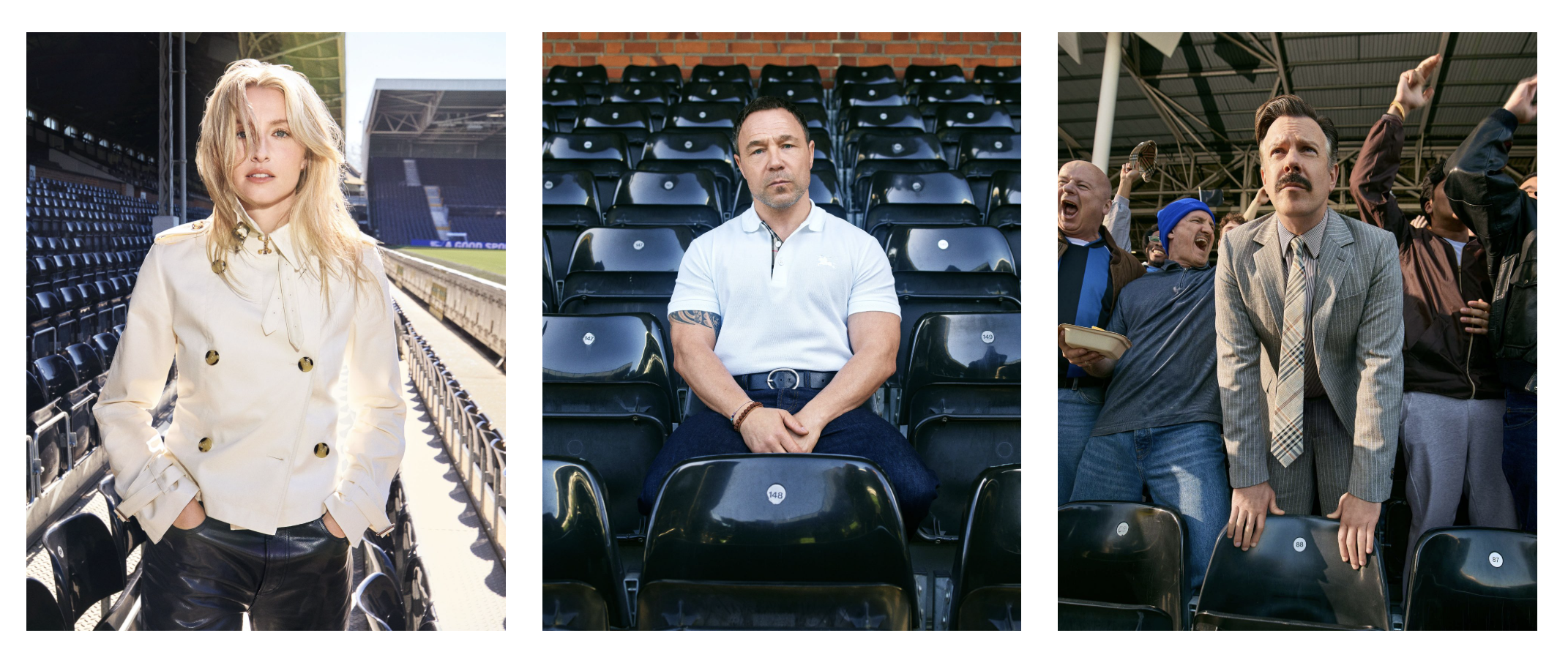
Timed to the FIFA World Cup 2026, Burberry has launched "A Good Sport" - a campaign rooted in British football culture that repositions the house's heritage codes within the ritual and camaraderie of match day. Shot from the perspective of fans rather than players, and set to Bloc Party's "Banquet", the film places Premier League talent alongside film, television and fashion figures in recognisable matchday settings: stands, touchlines, burger vans and Sunday league sidelines. For creative director Daniel Lee, it continues a deliberate strategy of anchoring Burberry in distinctly British social experiences, with the World Cup providing both the cultural moment and the commercial platform to do so at scale.
- Cast includes Declan Rice, Eberechi Eze, Leah Williamson, Son Heung-min, Jason Sudeikis, Romeo Beckham, Jodie Turner-Smith, Stephen Graham, Rosie Huntington-Whiteley and Neelam Gill
- Collection spans trench coats, Harrington jackets and House Check scarves reimagined through a football lens, with the new Primrose bag and Knight Runner sneaker making their debut
- Campaign set to Bloc Party's "Banquet" - a track that carries its own weight of British cultural memory
The fan-perspective framing is the critical creative decision here. By shooting from the stands rather than the pitch, Burberry sidesteps the aspirational distance that undermines most luxury-sport crossovers and instead positions itself inside the experience rather than above it. The World Cup timing sharpens that logic - heritage British brands face a narrow window to claim cultural territory before the tournament becomes saturated with global campaign spend, and Burberry has moved early with a cast and a visual language that feels earned rather than opportunistic. 🏴
Print's Commercial Rehabilitation Accelerates as Luxury Brands Reinvest in Physical Media 📰
Contrary to the dominant narrative of print's terminal decline, the global print market is expanding - driven not by mass-market recovery but by a structural repositioning of the medium as a luxury and trust signal. Niche and luxury titles now account for roughly 35% of total print circulation, up from 8% in 2011 and less than 5% in the 1990s, with fashion, travel and automotive leading the shift. As AI-generated content accelerates digital sameness and platform referral traffic continues to collapse, physical media is acquiring scarcity value - functioning less as advertising real estate and more as a credibility signal that mass digital channels can no longer replicate.
- Niche and luxury titles now represent approximately 35% of total print circulation, up from 8% in 2011 (source: The Bespoke Word)
- Brand recall for print advertising stands at 77%, compared to 46% for digital ads (Newsworks / Canada Post Neuromarketing Study, 2025/26)
- 82% of Gen Z report trusting print more than digital advertising, with 71% citing greater authenticity in print catalogues and magazines (WifiTalents / MediaVoices, 2026)
The rehabilitation of print isn't nostalgia - it's a rational response to a deteriorating digital attention economy. When every brand can generate content at scale and platform algorithms reward volume over quality, the constraint of print becomes its advantage: it is finite, considered and costly to produce, which is precisely what signals investment and intent to a discerning audience. For luxury and niche brands in particular, the question is no longer whether print belongs in the mix but whether the titles they choose carry the cultural authority to justify the placement. A page in the right magazine is now functioning as brand infrastructure, not media spend. 🖸️
Palace x Nike x England Turns World Cup into a Three-Way Cultural Statement 🎬⚽
Palace Skateboards, Nike Football and the England national team have released a World Cup campaign film that reframes English football identity as cultural mythology rather than conventional kit marketing. Directed at a fast, gritty pace, the film traces football fandom from contemporary Sunday league life back through iconic World Cup moments before landing on an audacious reveal - Stonehenge as a primitive goal - delivered with the deadpan confidence that has defined Palace's creative output from the start. Wayne Rooney anchors the film with a recital of Shakespeare as pre-match motivation; Jill Scott leads a cast of hundreds through generational football memory. A full collection drop is forthcoming, with release details to be confirmed.
- Campaign stars Wayne Rooney - England's all-time leading scorer - and Jill Scott, with a cast of hundreds of England supporters
- The collaboration is grounded in Manor Place, a new Palace x Nike cultural hub in South London, signalling long-term investment rather than a seasonal arrangement
- Full Palace x Nike x England World Cup collection release date to be announced
What makes this campaign structurally significant is not the celebrity casting but the credibility architecture behind it. Palace and Nike have spent years building this partnership through shared community investment and multiple drops rooted in genuine heritage, which means the England collaboration doesn't arrive as an opportunistic World Cup grab - it lands as the logical culmination of a relationship the industry has been watching develop. For brands and rights holders, it is a case study in how to earn the cultural permission to make something ambitious: you cannot shortcut the groundwork, and the groundwork is what makes the film believable. 🎨
Nintendo's Pictonico! Turns Your Camera Roll into Playable Comedy 🎮📸
Nintendo has launched Pictonico! on iOS and Android - a free-to-start mobile game that pulls real photos from a user's camera roll and inserts them directly into rapid-fire absurdist minigames. Cousins at birthday parties find themselves dodging zombies; holiday group shots become carnival obstacle courses; selfies are recast into ballet performances and slapstick skydiving sequences lasting only seconds each. The concept sits squarely in Nintendo's tradition of hardware-agnostic experimentation - from the Game Boy Camera to WarioWare to Tomodachi Life - but arrives at a moment when user-generated, socially shareable content is the primary currency of mobile engagement.
- Pictonico! launched 28 May on iOS and Android as a free-to-start title
- Up to 80 minigames planned across downloadable volumes; initial release contains a smaller demo set with additional packs available via optional purchase
- All photo processing happens on-device; Nintendo states images are not uploaded to company servers
The cultural intelligence in Pictonico! is in understanding that the most shareable content is content people already appear in. By making the player's own social circle the star of the game, Nintendo sidesteps the cold-start problem that has undermined much of its mobile output - the reason to share isn't the game, it's your face in the game. In a mobile landscape saturated with polished competitive titles, deliberate absurdity and personal specificity are a more differentiated strategy than production value. The privacy-first, on-device processing decision also removes the main friction point that would otherwise limit adoption, particularly among parents. Nintendo isn't trying to compete with its own console ecosystem here - it's building a viral content engine with a game attached. 🕹️
Caitlin Clark Outsells LeBron James as WNBA Merchandise Economy Reaches New Scale 🏀
Caitlin Clark has surpassed LeBron James in basketball jersey sales, ranking second overall behind only Stephen Curry since entering the WNBA in 2024 - a commercial milestone that would have been unthinkable for a women's basketball player just three years ago. The Indiana Fever guard's rise has coincided with a reported 1,000% year-on-year increase in WNBA player-specific merchandise sales, a figure that reflects not just Clark's individual draw but the broader commercial infrastructure now forming around women's basketball. Two seasons in, Clark is no longer a story about potential - she is a proven merchandise and media asset operating at a scale the league has never previously generated.
- Clark ranks second in overall basketball jersey sales since 2024, behind Stephen Curry and ahead of LeBron James
- WNBA player-specific merchandise sales up a reported 1,000% year-on-year
- Clark holds multiple WNBA records from her first two seasons, alongside the NCAA Division I all-time scoring record
The Clark effect is structurally significant beyond the headline numbers. What her merchandise performance demonstrates is that women's sport can generate individual star economics - not just league-level growth - which is the unlock that changes how sponsors, broadcasters and investors model return. When a single athlete can outsell generational NBA talent at retail, the conversation shifts from "emerging category" to "proven platform", and the pricing, rights values and partnership structures that follow are recalibrated accordingly. The brands and leagues that moved early on women's basketball are now sitting on appreciating assets. Those that waited are paying a premium to catch up. 📈
The Guardian Posts Record $81m US Revenue as Reader-Funded Model Proves its Thesis 📰
The Guardian's US operation generated more than $81m in revenue in its most recent fiscal year - its highest figure since launching in the market 15 years ago - driven by reader donations rather than advertising dependency. The result arrives at a moment when legacy publisher models are under sustained pressure from platform referral collapse and digital ad fragmentation, making The Guardian's trajectory a significant counterpoint to the broader narrative of publisher decline. Strategic investment in US political news coverage has been central to the growth, with American readers demonstrating a sustained willingness to financially support editorial operations they trust.
- $81m+ in US revenue for the most recent fiscal year ending 31 March - a record since the US launch 15 years ago (source: internal company presentation obtained by Axios)
- Growth driven primarily by reader donations rather than advertising income
- US expansion strategy centred on political news demand and audience trust
The Guardian's US performance is the clearest live evidence that the reader-funded model is not simply a fallback for publishers who have lost advertiser confidence - it is a viable primary commercial architecture when editorial trust is genuinely established and consistently maintained. At a moment when X and Facebook referral traffic to publishers has collapsed by 70% and 63% respectively, The Guardian's ability to convert direct audience loyalty into revenue without platform dependency is the structural advantage every publisher is trying to build. The lesson is not that donations work - it is that trust, built deliberately over time, creates a monetisable asset that algorithmic platforms cannot disrupt. 📊
Google's AI Search Overhaul Drives Users to DuckDuckGo as Opt-Out Demand Surges 🔍
Google's announcement of a sweeping AI-first overhaul to Search - transforming the search box into a conversational engine that answers questions directly before returning links - has triggered a measurable consumer backlash, with users migrating to privacy-focused alternative DuckDuckGo at a rate not seen since the platform's antitrust-era testimony. DuckDuckGo reported US app installs up 18.1% week-on-week between 20-25 May, peaking at 30.5% on 25 May, with iOS installs peaking at 69.9% growth - figures corroborated by third-party analytics firm Apptopia, which recorded a 29% increase in average daily US downloads over the same period. The backlash is not anti-AI per se - it is anti-compulsion, with users specifically gravitating toward DuckDuckGo's AI-free search page and its explicit promise of user control.
- DuckDuckGo US app installs up 18.1% week-on-week on average 20-25 May, peaking at 30.5%; iOS installs peaked at 69.9% growth (source: DuckDuckGo)
- Visits to DuckDuckGo's AI-free search page averaged 22.7% week-on-week growth, peaking at 27.7% on 24 May
- Google's AI Mode has surpassed one billion monthly users with queries more than doubling every quarter since launch, per Google VP of Search Elizabeth Reid
The structural tension here is not between AI and no-AI - it is between platforms that treat AI as a default users must accept and those that treat it as a feature users can choose. Google's scale means it can absorb this backlash numerically, but the sentiment it is generating - that the product has been taken away from the user and replaced with something they did not ask for - is the kind of trust erosion that compounds slowly and corrects slowly. DuckDuckGo's growth is less significant as a market share event and more significant as a signal: when consumers feel they have lost control of a utility they rely on daily, they will seek alternatives, and the brands that offer genuine optionality will capture that demand. 🧠
Amazon Ads Brings AI Sentiment and Compliance Monitoring to Twitch Sponsorships 🕹️
Amazon Ads has introduced two new measurement tools for Twitch: Chat Sentiment Analysis, which uses AI-powered language processing to evaluate audience chat messages during sponsored live streams, and Campaign Assist, which processes real-time audio transcriptions to assess whether creators are accurately delivering brand talking points, matching brand tone and upholding campaign values. Together, the tools represent a significant shift in how platform advertising infrastructure positions the relationship between brands and creators - moving from post-campaign performance reporting toward live compliance monitoring.
- Chat Sentiment Analysis evaluates audience chat messages in real time during sponsored Twitch streams using AI language analysis
- Campaign Assist processes live audio transcriptions to assess creator alignment with brand talking points, tone and campaign values
- Both tools are part of Amazon Ads' expanding measurement suite for Twitch sponsorships
The framing here is measurement, but the function is surveillance. By introducing real-time audio monitoring of creator output against brand briefs, Amazon Ads is formalising a compliance layer that fundamentally redefines what a sponsorship agreement looks like on a live platform. Creators have historically operated within broad brand safety guardrails while retaining editorial latitude - the authenticity that makes them commercially valuable in the first place. Tools that monitor whether that latitude is being exercised in brand-approved directions create a structural tension: the more tightly brands enforce message control, the more they erode the organic credibility that justified the influencer investment. The industry should watch carefully whether this capability normalises brand compliance as a standard metric, and what that does to the creator economy's central value proposition. 👁️
Spotify Launches Narrated Magazine Articles, Extending Its Ambition Beyond Music and Podcasts 🎧
Spotify has launched a narrated long-form article format, making more than 650 pieces from publications including Rolling Stone, The Atlantic, Vogue, Variety, Billboard, GQ, Wired, Vanity Fair and Pitchfork available as audio content from 26 May. The articles sit within Spotify's existing audiobook allowance for Premium subscribers, with individual pieces available to free users for $1.99. Narration uses a mix of human and AI voice, with digitally narrated content clearly labelled. The move extends Spotify's content ambition well beyond music streaming into a territory - long-form journalism - that publishers have largely failed to monetise at scale in audio form.
- More than 650 articles available at launch across publications including Rolling Stone, The Atlantic, Vogue, Wired and Pitchfork
- Available within Premium users' monthly audiobook allowance; individual articles priced at $1.99 for free users
- Narration uses a mix of human and AI voice, with digital narration clearly labelled
The strategic logic here is about time-of-day and context capture - Spotify wants to be the audio layer across commutes, exercise, cooking and rest, not just the music and podcast layer. By pulling long-form journalism into that ecosystem, it is competing directly with publishers' own audio ambitions while simultaneously offering those publishers distribution they cannot replicate independently. For media brands, the calculation is familiar: Spotify's reach is real, but so is the risk of audience disintermediation. The more seamlessly Spotify integrates editorial content into its discovery and recommendation engine, the less readers need to visit the source. Publishers are licensing their way into another platform dependency - and the $1.99 per article pricing for free users suggests the value is being captured at Spotify's end, not theirs. 📖
Universal Music Group and TikTok Renew Global Licensing Deal with Expanded AI Protections 🎵
Universal Music Group and TikTok have announced a new multi-year strategic licensing agreement, building on their 2024 partnership and extending TikTok's access to UMG's recorded music and publishing catalogues. The deal expands commercial opportunities for UMG artists and songwriters through enhanced marketing campaigns, e-commerce tools and artist development initiatives - but the most structurally significant element is the renewed commitment to AI protections, including a joint agreement to remove unauthorised AI-generated music from the platform and strengthen artist and songwriter attribution. The agreement arrives at a moment when the music industry's relationship with AI is moving from philosophical debate into contractual infrastructure.
- New multi-year deal extends TikTok's access to UMG's full recorded music and publishing catalogues globally
- Agreement includes expanded e-commerce tools, marketing campaigns and artist development initiatives
- Joint commitment to remove unauthorised AI-generated music from TikTok and improve artist attribution - an extension of protections first established in the 2024 deal
The AI clause is where the real story sits. By embedding the removal of unauthorised AI-generated music and improved attribution directly into a platform licensing agreement, UMG and TikTok are establishing a contractual precedent for how human artistry is protected at scale on social platforms - not through regulation, but through commercial negotiation. For the wider industry, this is significant: it signals that AI protections are becoming a standard deal term rather than an aspirational principle, and that platforms with genuine music dependency have commercial incentive to enforce them. The question now is whether this model travels - to other platforms, other labels, and ultimately into the policy frameworks that will govern the next phase of AI and music. 🎶
Spotify and UMG Strike Landmark Deal Allowing Licensed AI Covers and Remixes 🎛️
Spotify and Universal Music Group have announced a landmark licensing agreement enabling Spotify to launch a new generative AI tool that allows fans to create covers and remixes of songs from participating artists and songwriters. The tool will launch as a paid add-on for Spotify Premium users, with revenue flowing directly back to the artists and songwriters whose work underpins the AI-generated output. Framed explicitly around consent, credit and compensation, the deal represents the most structurally coherent attempt yet by a major streaming platform and label to bring fan creativity inside a licensed, monetised framework rather than leaving it to proliferate unregulated across social platforms.
- Tool will launch as a paid Spotify Premium add-on, creating an additional income stream for participating artists and songwriters on top of existing royalties
- Agreement covers both recorded music and music publishing rights - a dual-rights deal that addresses the full copyright stack
- Announced alongside a broader multi-label initiative with Sony Music Group, Warner Music Group, Merlin and Believe to develop artist-first AI music products with Spotify
The architecture of this deal matters more than the product itself. By building the tool on a foundation of opt-in participation, explicit licensing and direct revenue share, Spotify and UMG are establishing a template for how generative AI and music rights can coexist commercially - one that stands in direct contrast to the unlicensed AI training disputes that have dominated the industry conversation. If the tool gains traction, it reframes fan creativity from a copyright liability into a revenue-generating asset, and positions Spotify as the platform that solved the problem the rest of the industry has been arguing about. The question is whether participating artists will see meaningful returns, or whether the commercial logic will concentrate value at the platform and label layer as it typically does. 🎶
TikTok Shop's Small Business Economy Surges 66% as Platform Rewrites Retail Discovery 🛍️
US small businesses on TikTok Shop increased sales by 66% in 2025 compared to the prior year, with more than 215,000 sellers - defined as those with under $15m in annual revenue - now actively trading on the platform, up 25% year-on-year. The growth has occurred alongside, not despite, a simultaneous influx of major brands including Ulta Beauty, Sally Beauty and Disney, suggesting TikTok Shop is operating as a genuinely expansive retail ecosystem rather than a zero-sum marketplace. The platform generated an estimated $14bn in US sales in 2025 - larger than Wayfair, Etsy and eBay combined - with beauty and personal care accounting for roughly 19% of that total.
- US small business TikTok Shop sales up 66% in 2025 year-on-year; 215,000+ small businesses actively selling, up 25% (source: TikTok Shop / GlobalData)
- 67% of consumers use TikTok Shop for product discovery, ahead of Amazon at 57%; 72% of brands discovered on the platform in the past 12 months were small businesses
- TikTok Shop generated an estimated $14bn+ in US sales in 2025, exceeding Wayfair, Etsy and eBay (source: Charm.io)
The structural significance of TikTok Shop's small business numbers is not the growth rate - it is what the growth model reveals about where retail is heading. Founder-led video and livestream content is outperforming traditional product listing because it solves the trust problem that e-commerce has never fully resolved: when the person making the candle or the bag appears on screen and speaks directly to the buyer, the transaction carries social proof that no algorithm-driven recommendation can replicate. TikTok Shop is not just a sales channel - it is a discovery infrastructure that is reorganising how new brands find their first customers, and how those customers find brands they would never have encountered in a traditional retail environment. 🎥

🎙️ Zane Lowe on a Decade at Apple Music, AI, and Why Great Songs Still Matter - Rolling Stone Uncut, hosted by Neil Griffiths
Why It Matters: Apple Music's global creative director sits down for a rare extended interview to reflect on ten years at the intersection of music discovery, artist trust and platform power - themes that cut to the heart of nearly every story in this edition.
✅ Worth Your Time Because: Lowe is one of very few people operating at the precise juncture of artist development, streaming economics and cultural tastemaking - and he rarely speaks at length about the mechanics of what he does. This conversation covers how he builds trust with the world's biggest artists, what AI is doing to the music discovery landscape, and why emotional connection - not algorithmic efficiency - remains the irreducible core of why music matters commercially and culturally. For anyone working at the intersection of brand, music and platform strategy, this is unusually candid territory from someone who has spent a decade inside the machine.

(Monday 2 June - Sunday 8 June 2026)
🎚️ SXSW London continues through Friday 6 June in Shoreditch - in its second year, SXSW London returns with an expanded programme spanning music, film, conference and visual arts, with Michelle Obama, Brian Eno and the Russo Brothers among the keynotes. Whether it has addressed the concerns raised by its debut - surface-level sessions, a £1,560 delegate pass, a speaker lineup that failed to match the price point, and a brand-heavy atmosphere that felt more corporate activation than cultural gathering - remains to be seen. The UK has a rich ecosystem of established industry events; for SXSW London to earn genuine relevance here, integration with that ecosystem rather than positioning above it will be the test.
🏎️ Monaco Grand Prix, 5-7 June - Formula 1's most glamorous weekend returns to the Principality, as much a luxury brand and cultural moment as a sporting event. One of the few remaining tentpole occasions where sport, fashion, hospitality and media genuinely converge at scale.
🎬 Tribeca Film Festival opens Wednesday 3 June in New York City - the 25th anniversary edition opens with Questlove's Earth, Wind & Fire documentary, followed by a live performance from Earth, Wind & Fire and The Roots at the Beacon Theatre. Runs to 14 June.
⚽ FIFA World Cup 2026 opens Thursday 11 June - close enough to dominate the agenda this week as final squad announcements land, brand activations flood every channel, and global media spend hits peak saturation. The commercial and cultural shadow is already here.
🎾 Roland-Garros enters its final weekend - the French Open concludes with the women's final Saturday 7 June and men's final Sunday 8 June, one of the last major global sports moments before the World Cup consumes the conversation.