
Welcome to the next edition of On The Record, thoughtful analysis on culture, entertainment, tech, fashion, music, sport, and brands. Here’s a round-up of key conversations and campaigns that caught my attention this week.

🎵 BBC Introducing Faces Backlash Over AI-Generated Track Spotlight
BBC Introducing faced criticism this week after Midlands artist Papi Lamour revealed live on air that their Black History Month track was entirely AI-generated, despite being praised by the host as pitch perfect and sonically amazing. The decision frustrated emerging musicians who argued that spotlighting fully synthetic work on a platform designed to champion grassroots talent undermines years of training, investment, and creative labour. The moment comes as artists and industry bodies warn that unregulated AI threatens copyright, compensation, and the long-term viability of professional musicianship. BBC Introducing stated that tracks are judged purely on musical merit, while the BPI reiterated its call for AI to support rather than supplant human creativity.
Key facts and stats:
Lamour admitted that all vocals and instrumentation in the featured track were created using AI software.
Songwriter Mollyxo highlighted that she has spent 20 years building her craft before seeking BBC Introducing support.
Over 1,000 musicians, including Kate Bush, Damon Albarn and Annie Lennox, contributed to a silent protest album earlier this year criticising government AI plans.
Paul McCartney publicly urged the UK government to strengthen protections, warning that AI could allow anyone to rip off creators without payment or consent.
💡 As AI-generated tracks enter mainstream pipelines, platforms built to elevate human creativity must rapidly redefine their criteria or risk erasing the very talent they were designed to support. 🎧
🎫 UK to Ban Ticket Resale Above Face Value
📌 The UK government will introduce legislation making it illegal to resell concert and live event tickets above their original face value, following sustained pressure from artists and fan groups. The move targets industrial-scale touting, including bots that bulk-buy tickets before relisting them at inflated prices. The government says the shift will save fans millions and disrupt a shadow resale economy that has grown across major platforms. For brand, culture, and entertainment professionals, it signals a regulatory reset aimed at restoring trust, fairness and accessibility across the live experience economy.
£112 million in annual savings projected for fans
900,000 additional tickets expected to be bought at primary sale prices each year
£37 average reduction in resale-market ticket prices
💡 A clampdown of this scale could reshape demand patterns and fan access, creating new expectations for transparency and fairness across all live entertainment touchpoints. 🎟️
👀 The Algorithm Allegedly Has A Gender Preference
LinkedIn users are running their own experiments… and the results are raising eyebrows.
Women switching their profile gender to male are reporting different ads, more senior role recommendations, and noticeably better reach. None of this has been formally confirmed by LinkedIn. But the pattern mirrors what multiple independent audits have already proven about job-ad algorithms more broadly.
Below is what the verified research says, and why these user-run experiments feel so familiar.
Recent user-led tests suggest that changing a profile’s gender from female to male may alter the ads, job recommendations, and visibility the account receives. While these individual experiments cannot confirm LinkedIn’s system behaviour, they closely resemble documented findings from major audits of job-ad delivery algorithms, which consistently show gendered steering. Peer-reviewed studies demonstrate that automated ad-distribution systems tend to show women fewer high-paying or leadership-oriented opportunities, even when profiles are identical.
Accurate, verified stats from published studies:
Facebook job-ad delivery audit (University of Southern California, 2019): High-paying jobs were shown disproportionately to men, even when ads were targeted neutrally to “all adults”.
Ad Delivery Algorithm Study (Ali et al., 2019, AAAI): Ads for construction jobs reached over 90 percent men, while ads for supermarket cashier roles reached over 85 percent women despite identical targeting.
Global Witness audit (2021): Tech and STEM job ads were shown to significantly more men, while social-care ads were delivered predominantly to women, again with gender-neutral targeting.
LinkedIn’s own 2022 internal research (publicly published): Recruiters are more likely to open male profiles, with women receiving fewer recruiter outreach messages in fields like tech and consulting, even when qualifications match. (This finding reflects recruiter behaviour, not LinkedIn’s algorithm directly.)
💡 Algorithms don’t invent bias, they inherit and scale the one already baked into the labour market.
Goldman Sachs Buys Talent Agency of Tiger Woods, Caitlin Clark ⚡
Goldman Sachs’ private equity arm has acquired a majority stake in Excel Sports Management, with existing leadership retaining equity and continuing to operate the business. The agency represents around 750 athletes across major US sports, including Tiger Woods, Caitlin Clark and Nikola Jokić, reflecting how soaring media deals have boosted the value of athlete representation. The move strengthens Goldman’s footprint in the sports ecosystem, from franchise sales to athlete endorsements, despite increasing scrutiny on financial firms’ cross-ownership ties within leagues. It signals continued consolidation across talent, media and investment, as sports representation becomes a high-growth commercial asset.
Excel valuation reported at close to $1 billion (Financial Times)
CAA recently sold for $7 billion while Endeavor went private in a $25 billion deal
Excel represents 750 clients across baseball, basketball, football and golf
💡Big finance is doubling down on athlete representation as sports IP becomes one of the most valuable cultural assets in the global media economy. 📈
🏀 Target Drops WNBA Merch Line With The Wild Collective
Target has launched an exclusive WNBA-licensed apparel line with fashion label The Wild Collective, spanning league-wide pieces and team-specific designs across six franchises. The collection features statement jackets, reworked jerseys, and streetwear-led silhouettes crafted in women’s or unisex cuts. The drop follows a wave of non-traditional brands tapping into surging WNBA demand, with recent partnerships including LEGO’s collaboration with A’ja Wilson and Angel Reese’s deals with Juicy Couture and Victoria’s Secret. The range is now available online and in select Target stores.
Six teams included: Lynx, Sky, Liberty, Fever, Valkyries, Aces
Multiple recent brand deals with WNBA stars cited in the last two months
💡 Women’s basketball continues to become a fashion and commercial engine, attracting brands far beyond traditional sportswear. ✨
Kering looks beyond Gucci as new CEO outlines 18-month overhaul 🔧
In a memo seen by the Financial Times, Kering’s new chief executive Luca de Meo warned staff that the Group must reduce its over-dependency on Gucci after Q3 revenues fell 10 percent and Gucci declined 18 percent. His 18-month turnaround programme, dubbed ReconKering, sets out cost cuts, lease renegotiations, inventory reductions and pricing resets to stabilise the business and reposition the wider portfolio within three years. With Gucci still accounting for around half of Group sales and Chinese demand weakening, the strategy signals a shift towards balancing the brand mix and restoring profitability across Saint Laurent, Bottega Veneta and Balenciaga.
Analysts note investor concern around the long timeline, particularly after Kering shares fell 3.5 percent following publication of the memo. Others question whether reducing reliance on Gucci is prudent given its historic profit contribution in stronger years. The move comes as Kering faces elevated leverage of roughly 4x EBITDA and net debt of around 9.5–10.5 billion euros, creating a sharper contrast with low-debt peers like LVMH and Hermès.
Gucci down 18 percent in Q3 2025
Group revenue down 10 percent in Q3 2025
Net debt approx. 9.5–10.5 billion euros by end-2024
Kering shares fell 3.5 percent after the FT story
💡 A diversified brand engine, not a Gucci-centric one, is becoming essential as luxury’s geography, leverage demands and consumer psychology shift. ✨
🎵 Music Icons Protest Against AI Music
📌 Paul McCartney has stepped into the AI copyright fight with a protest track that is, quite literally, almost silent. His first new recording in five years, featured on the LP Is This What We Want?, is made up of studio hiss, faint clatters and a slow fadeout – a symbolic warning of what happens when creative work is mined freely to train AI models. The album, backed by Kate Bush, Sam Fender, Hans Zimmer and the Pet Shop Boys, spells out a message to the UK government: do not legalise unlicensed music scraping. The campaign lands as ministers consider new text and data mining exceptions under heavy pressure from US tech giants, while artists argue the proposals risk gutting the economic and cultural foundations that allow new musicians to build careers. With AI-generated tracks already topping charts and racking up millions of streams, the call for guardrails is becoming impossible to ignore.
The UK’s creative industries generate £125bn for the economy each year (UK Government).
US tech firms have committed more than £30bn of UK investment in the past year, primarily in datacentres (UK Government).
A fully AI-generated band recently hit 1 million Spotify streams (Guardian).
8 of the top 10 viral Spotify tracks in the Netherlands last week were AI-generated and allegedly boosted by bot farms (Reddit r/music).
💡 The protest isn’t anti-tech, it’s a signal that without clear consent and compensation, AI threatens to mute the very creativity it depends on. 🎧
🧵 Fashion Leaders Gloomy About 2026
📌 According to the latest State of Fashion report from McKinsey and The Business of Fashion, industry sentiment is slipping as tariffs and shifting consumer behaviours reshape the landscape. The findings show that 46 percent of fashion executives expect conditions to worsen in 2026, making tariffs the sector’s biggest drag. While economic optimism declines, structural shifts continue: second-hand fashion grows more mainstream, luxury brands pull back from price-led strategies, and AI-assisted shopping earns higher satisfaction rates from consumers. The report signals an industry preparing for slower growth, tighter operations, and a new emphasis on resilience.
46 percent of executives expect worsening conditions in 2026
85 percent of consumers report higher satisfaction with AI-assisted shopping
Resale adoption continues to rise globally
💡 Fashion’s challenge for 2026 is balancing operational resilience with meaningful innovation, as value-led consumption and AI-driven behaviours reshape demand patterns. ✨
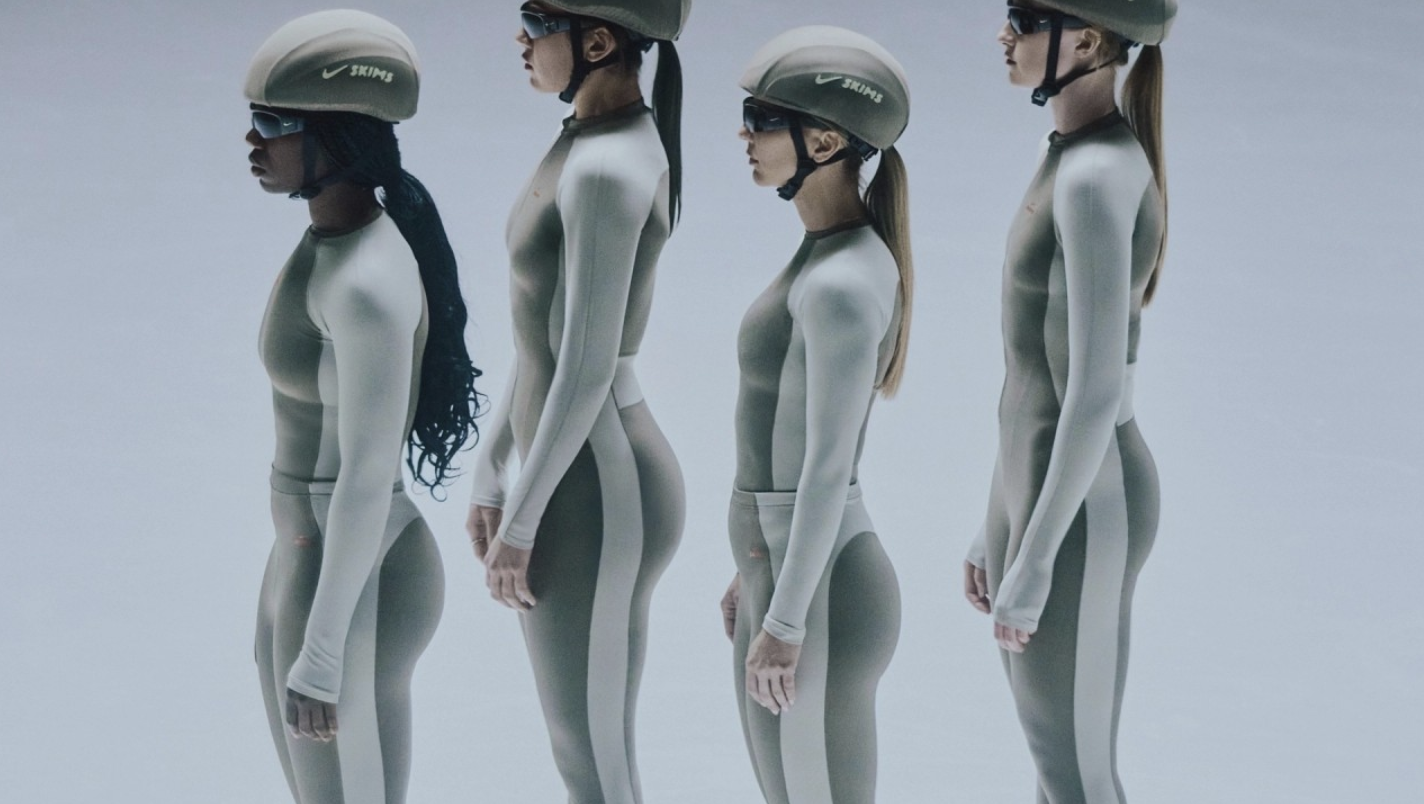
NikeSKIMS Pushes the Edges of Sport Style With Drop 2 ❄️
📌 NikeSKIMS returns for the season with Drop 2, expanding its system of dress across seven collections and 65 silhouettes, plus new accessories including socks, waist packs and training gloves. The drop builds on its debut by introducing new materials, seasonal colourways and added versatility that moves seamlessly from studio to street. Core collections Shine, Matte and Airy return with evolved fits, Dri-FIT functionality, and mesh-inspired layering pieces, while Woven Nylon debuts as a cold-weather third layer anchored by a new Wrap Coat. A holiday campaign spotlights elite speed skaters Maame Biney, Kamryn Lute, Kristen Santos-Griswold and Courtney Sarault, captured across stills and motion, emphasising power, precision and the strength of modern femininity.
7 collections in the drop
65 silhouettes spanning apparel and accessories
💡The drop underscores how performancewear and fashion continue to converge, with women’s sport driving both aesthetic direction and commercial momentum. ✨
🌸 Sky Sports ditches new women’s TikTok account after viewers brand it sexist
📌 Sky Sports has shut down its new TikTok channel aimed at young female sports fans just three days after launch, following widespread backlash over its tone and aesthetic. Social media users criticised the “Halo” account as condescending, patronising and sexist, arguing it reinforced stereotypes rather than expanding inclusion. Branded as “Sky Sports’ lil sis,” the channel featured pastel graphics, sparkly overlays and captions like “How the matcha + hot girl walk combo hits,” sparking parodies across TikTok. Sky acknowledged the misstep in a weekend statement, saying it had “listened” and would halt all activity on the account.
Three days after launch, Sky shut down Halo following criticism across TikTok, Reddit and X.
Content included stylised clips using pink, sparkly fonts and “girlie” captions which many viewers said perpetuated stereotypes.
Viral parody videos quickly flooded TikTok, using the Halo aesthetic to mock the approach.
💡 Efforts to “reach Gen Z women” fall flat fast when brands rely on aesthetic clichés instead of genuine cultural understanding. ✨

BBC crisis: right-wing coup or bias crackdown?
The BBC is in meltdown: both the Director General Tim Davie and the Head of News Deborah Turness have quit in the same weekend after a leaked memo accused the corporation of systemic political bias - an edit of Donald Trump’s speech ahead of the January 6th riots at heart of the memo.
The President has now piled in, threatening a billion dollar lawsuit.
So what is really going on? Was this a right-wing coup against public service broadcasting - or the consequence of genuine bias inside the BBC?
And could this crisis now reshape the future of impartial news - not just at the BBC, but across Britain’s media?
The BBC chairman Samir Shah has apologised for an “error of judgement” over the edit of the president’s speech and said that the corporation had taken action on other areas that had been highlighted in the memo - and would take further action if necessary.
On this episode of The Fourcast, Krishnan Guru-Murthy is joined by the political editor of the Sunday Telegraph Camilla Turner and the editor of Prospect magazine Alan Rusbridger.

🏈 NFL Thanksgiving Triple-Header – USA (national broadcast) – 27 Nov A full day of marquee matchups with celebrity halftime performances, driving huge live engagement.
🏀 NBA Cup – Group Stage Finale – USA (various arenas) – 28 Nov High-stakes in-season tournament games boost mid-season basketball visibility.
⚽ UEFA Champions League – Matchday 5 – Europe – 25–26 Nov Penultimate round of the league phase, ensuring heavy midweek football attention.
⚽ England Lionesses vs China (Friendly) – Wembley Stadium, London – 29 Nov A standout home fixture spotlighting women’s football.
📚 Hay Festival Winter Weekend – Hay-on-Wye, Wales – 26–30 Nov Literary and ideas-led programming marking a key cultural moment in the winter calendar.
🎤 An Evening with Annie Leibovitz – Barbican Centre, London – 24 Nov Rare live conversation with the legendary photographer.
🎹 Hania Rani: Non Fiction – Barbican Centre, London – 25–26 Nov World premiere piano concerto exploring history, memory and conflict.
🎭 Cabaret & Dress-Up Special: Wicked: For Good – Barbican Centre, London – 24 Nov Cosplay-encouraged musical film event tapping into fan culture.
👶 Wicked: For Good – Parent & Baby / Members’ Screenings – Barbican Centre – 1 Dec Niche but vocal audiences for targeted community engagement.
🗿 Edward Allington: Making Poetry with Solid Objects – British Museum, London – ongoing Sculptural intervention enlivening the museum’s antiquities collections.
🌍 Emergency Exits: Independence Movements – Imperial War Museum London – ongoing Powerful exhibition examining late-colonial conflicts and liberation struggles.
🎨 Ming Wong in Conversation (Friday Late) – National Gallery, London – 28 Nov An after-hours artist talk reframing Old Masters through performance and film.
🖼️ Kerry James Marshall: The Histories – Royal Academy of Arts, London – ongoing A landmark exhibition by one of the most important living painters.
🌅 Turner & Constable: Rivals & Originals – Tate Britain, London – from 27 Nov Blockbuster pairing of Britain’s defining landscape artists.
🎭 Theatre Picasso – Tate Modern, London – ongoing Exploring Picasso’s fascination with staged identity and performance.
🟩 Tate Modern Lates – Tate Modern, London – 28 Nov After-hours programme with talks, tours and live performance.
👜 Marie Antoinette Style – V&A, London – ongoing Lavish fashion exhibition blending history, costume and pop-cultural references.
👗 Peter Copping (Lanvin) in Conversation – V&A, London – 24 Nov Designer-led insight into contemporary couture.
🎬 The Costume House: Inside Cosprop – V&A, London – 27 Nov Behind-the-scenes look at one of film and TV's premier costume makers.
🛍️ Young V&A Winter Market – Young V&A, London – 29–30 Nov Showcase of emerging young designers and makers.
🎄 Christmas in New York Concert – Carnegie Hall, NYC – 24 Nov Festive pop–gospel performance marking the start of NYC’s holiday season.
🩰 George Balanchine’s The Nutcracker – New York City Ballet, Lincoln Center – 29–30 Nov A defining annual production anchoring New York’s winter culture calendar.
🦕 Impact: The End of the Age of Dinosaurs – AMNH, NYC – ongoing Big-ticket science exhibition exploring the asteroid impact and extinction.
📷 Man Ray: When Objects Dream – The Met, NYC – ongoing Major exhibition of surrealist photography and objects.

THE BBC: A NATIONAL INSTITUTION AT A CULTURAL CROSSROADS
A public broadcaster, a political football, and an algorithm-age survivor trying to future-proof its DNA.
The BBC isn’t simply a media organisation. It’s a century-old piece of national infrastructure - part broadcaster, part cultural memory bank, part global soft-power engine.
But right now, it sits at the intersection of three high-pressure forces: platform-era fragmentation, political polarisation, and a funding model built for a Britain that no longer exists.
To understand where the BBC goes next, we need to understand the scale of what it actually does - and why the fight over its future is turning into a proxy battle over identity, truth, power, and culture.
1. THE FULL SCOPE: MORE THAN MOST PEOPLE REALISE
For all the criticism the BBC attracts, few people understand the breadth of its public-service remit.
National + Global:
BBC One, BBC Two, BBC Three, BBC Four
BBC News, World Service (one of the UK’s most effective soft-power tools)
Flagship programmes across drama, comedy, natural history, documentaries
Regional + Local:
39 local radio stations across England
Dedicated nations programming for Scotland, Wales, NI
Local newsrooms, investigative teams, regional current affairs
Partnerships that support local journalism (e.g., shared reporters with local papers)
Education + Culture:
Children’s content (CBBC, CBeebies)
Bitesize: one of the biggest digital education brands in the UK
Arts, science, history, culture - across TV, audio, digital
Digital + On-Demand:
BBC iPlayer - still one of the UK’s most-used streaming platforms
BBC Sounds - podcasts, live radio, music mixes
Online news, explainers, fact-checking, investigative long-reads
It’s not just a broadcaster - it’s public infrastructure. Other media companies can disappear; the BBC is built to anchor national life.
2. THE LICENCE FEE DEBATE: A FUNDING MODEL FROM ANOTHER ERA
The licence fee is the BBC’s defining strength - independence from advertisers, investors and political donors - but also its biggest vulnerability.
The challenge:
Fewer people watch linear TV
Younger audiences default to TikTok, YouTube, Netflix
More households say they “don’t need a TV licence” because they don’t watch live broadcast
Inflation erodes funding while expectations rise
The argument for replacing the licence fee:
Regarded as outdated and regressive
Unpopular among younger, streaming-first households
Difficult to enforce and politically sensitive
The argument for keeping (or modernising) it:
A universal funding model creates universal access
Keeps the BBC free from corporate influence
Ensures minority programming, regional output, children’s content and investigative journalism exist
The debate isn’t really about money. It’s about identity: Do we still believe in universal public media? Or do we pivot to a fully commercialised landscape where algorithms decide cultural value?
3. GOVERNANCE, ETHICS & THE PERCEPTION PROBLEM
The BBC board isn’t just a regulatory formality - it’s the institution’s political pressure point.
The governance dilemma:
Board appointments are made by government ministers
This opens the BBC to accusations of political interference, regardless of who’s in power
Every party claims bias when the BBC challenges their narrative
Every political cycle brings fresh scrutiny and public distrust
The ethics challenge:
The BBC must be scrupulously impartial - in an era where audiences increasingly demand media that affirms their worldview
Editorial mistakes become weapons for political actors
Social media amplifies every misstep into a national controversy
The BBC’s job is harder than ever: Maintain impartiality in a post-impartial world.
4. THE POLITICS: WHERE POPULISM MEETS BROADCASTING
Across Western democracies, public broadcasters have become targets for populist movements. The BBC is no exception.
Whether it’s Nigel Farage in the UK, right-wing commentators in the US, or broader culture-war dynamics, the BBC is frequently framed as:
“elite”,
“biased”,
“out of touch”,
or “politically captured”.
In reality, attacks on public media often reflect a broader global trend: discredit the referee, and you control the game.
If trust in public broadcasting drops, polarised media fills the gap - and that’s a win for political actors who thrive in fractured information environments.
5. THE FUTURE OF BROADCASTING: ALGORITHMS, STREAMING & THE BATTLE FOR ATTENTION
Broadcasting is no longer a single industry - it’s a multi-platform content ecosystem shaped by:
algorithmic feeds
generative AI
global streaming giants
micro-content
the collapse of shared viewing habits
The BBC must evolve across three fronts:
1. Digital-First Delivery
Not just iPlayer. Not just Sounds. A fully integrated, mobile-led, personalised media experience - without losing the universality principle.
2. Cultural Relevance for Younger Audiences
If Gen Z and Gen Alpha don’t have a BBC habit, the institution loses future influence.
3. Global Competition
The BBC is competing with companies whose budgets dwarf entire public-service broadcasters. Creativity, speed, risk-taking and local authenticity will be the survival tools.
6. SO WHAT DOES THE BBC BECOME?
A rebuilt BBC for the 2030s could be:
Platform-agnostic
Digital-first but universally accessible
Politically independent but fiercely accountable
Locally rooted but globally ambitious
A public-service algorithm - not a nostalgia project
Or it could become smaller, more commercial, more fragmented, more marginal. The direction depends on political will, funding reform, and the BBC’s ability to reinvent itself without shedding its mission.
THE TAKEAWAY
The BBC’s future isn’t guaranteed.
Its survival sits at the intersection of cultural taste, political temperament, generational attitudes, economic reality, and technological change.
But even in a world of endless content, the BBC still does something no algorithm, influencer network or streaming giant can replicate:
It creates shared cultural experience. It documents national life. It holds power to account. It makes the UK visible to itself.
That matters. And the next few years will determine whether the BBC remains national infrastructure - or becomes a relic of a broadcast era we’ve already scrolled past.

🎨 The UK’s creative industries generate £125 billion a year, accounting for 5.7 percent of national output.
🎧 Over 1,000 musicians contributed to the silent protest album challenging proposed UK AI copyright changes.
🎫 New UK ticket-resale rules are expected to save fans £112 million annually, with 900,000 more tickets bought at primary prices.
🤖 Facebook job-ad audits found 90 percent of mechanic roles shown to men and 79 percent of preschool-teacher roles shown to women.
💼 Goldman Sachs’ acquisition values Excel Sports Management at close to $1 billion, representing around 750 athletes.
👗 46 percent of fashion executives expect 2026 to worsen, while 76 percent cite tariffs as the sector’s biggest challenge.