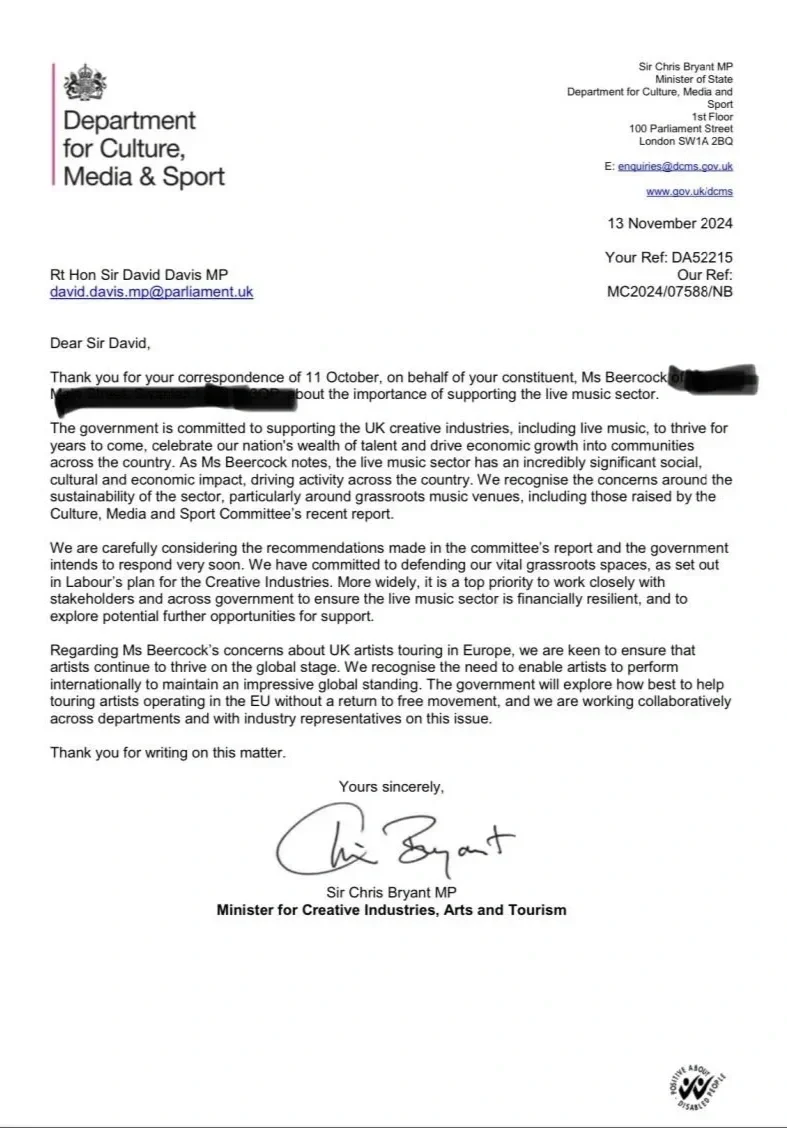
My correspondence with DCMS, November 2024. The ministerial reply arrived one day before the government published its response declining the VAT proposal.
Britain rejected a VAT cut for grassroots venues, told the music industry to fund itself, then taxed the rescue fund. Read from anywhere else in Europe, the sequence is a case study in how to lose a talent pipeline.
Walk into any 300-capacity venue in the UK tonight and 16p of every £1 handed over at the door goes straight to the Treasury, before the sound engineer, the support act, or the electricity bill sees a penny. Music Venue Trust calls it the highest tax on new and emerging music anywhere in the world. Nobody in government is seriously disputing the claim. Over the past two years they have simply made a series of choices around it, and the choices tell a story in three acts.
Act one: the cut that never got costed
The loudest tax argument in Britain right now belongs to hospitality. Tom Kerridge's #VATstheproblem campaign wants VAT on the sector halved from 20% to 10%, closer to the European average of around 12.8%. Ireland charges 9%. Germany charges 7% on food. The urgency is real: roughly a quarter of hospitality businesses are losing money and pubs are closing at around two a day.
The problem is the shape of the fix. Tax Policy Associates modelled the blanket cut and found McDonald's would gain an estimated £432m, with pub group Mitchells & Butlers taking a further £246m, while the roughly 45% of hospitality businesses sitting below the £90,000 VAT registration threshold would see no benefit at all. A flat instrument rewards scale. That is what flat instruments do.
Music asked for something more precise, and asked first. In May 2024 the Culture, Media and Sport Committee proposed a temporary VAT cut on gig tickets scaled by venue capacity: small rooms get the relief, arenas do not. MPs benchmarked it against the 10% European average rate on tickets. Promoters told the Committee it would change the risk profile of every grassroots show in the country on day one.
That November, the government said no. Not "we ran the numbers and they do not work." The response stated there were no plans for the cut and no plans to commission the economic analysis MPs had requested. The one instrument designed around how the sector actually works was declined before it was priced. In the same document, the government pointed to a better mechanism: a voluntary industry levy on arena and stadium tickets, which it called the quickest and most effective way to fund the grassroots sector, noting that France had already legislated a statutory version.
Act two: the industry delivers
The industry did what it was asked. In January 2025 the LIVE Trust's £1 levy on arena and stadium tickets launched, redistributing money from the biggest shows to the smallest rooms. Coldplay committed 10% of their 2025 UK tour earnings. Harry Styles pledged £1 from every ticket on his Wembley stadium run. London's O2 Arena promised a six-figure donation plus a contribution every time a new artist headlines. Alongside it, government funding arrived with a guest list: a Music Growth Package worth up to £30m over three years, and £1.4m in export grants split between 68 acts this March through the Music Export Growth Scheme.
Credit where due, MEGS has a genuinely strong record. By the BPI's numbers, every £1 of government money has returned £14, an estimated £73.5m across 23 rounds, with alumni including Dave and Ezra Collective. Nobody serious wants it cut. But a grant reaches the venues and artists who apply, win, and appear in the press release. A tax change reaches all of them, automatically, permanently, invisibly. There is no photocall for a VAT rate. There are 68 names in a MEGS announcement.
Act three: the Treasury taxes the rescue
Then, this May, The Telegraph reported that of the £6m the levy has raised, £1.2m has gone to HM Treasury through VAT on those tickets. LIVE Trust estimates a further £200,000 will follow from Harry Styles' Wembley run alone. The fund the government endorsed as the answer to the crisis is being taxed at the same rate as the crisis. The official defence is that exempting the £1 contribution could "create inconsistencies across the tax system."
That defence lasted about a month. In June the chancellor cut VAT on children's tickets to theatres, cinemas, concerts and family attractions from 20% to 5% for the summer. Carve-outs in ticket VAT are clearly available when government wants them. Mumford & Sons' Ben Lovett had already made the wider point: taxing a fund built to help the government protect its own cultural economy defeats the point of the fund.
Follow the full sequence. The government refused to cut the tax. It refused to cost the alternative. It endorsed the levy. It now taxes the levy, while cutting the same tax elsewhere. A government that does all of that in twenty months has become a beneficiary of the closures it says it wants to stop.
The pipeline maths
Here is why the sequence is expensive, and why it should worry anyone building a music business in Europe rather than only UK policy watchers. The UK is the third-biggest music market in the world and the second-biggest exporter of recorded music. Every arena headliner and every global streaming story started in a small room in front of a small crowd. Music Venue Trust counts 801 of those rooms left. More than half made no profit last year, average margins sit at 2.5%, and the sector lost over 6,000 jobs in twelve months, with 175 towns and cities no longer receiving regular touring shows at all.
The erosion is already visible where the money is. The BPI estimates UK acts now account for around 8 to 9% of global streams, below the roughly 10% they have averaged in recent years. That gap is the pipeline problem expressed as market share: fewer rooms, fewer first shows, fewer acts ready to travel, a smaller slice of every playlist in every market. Grassroots venues are the research and development department of a live industry worth over £6bn, feeding a recorded export business the whole streaming economy draws on, and the UK taxes them like a retail unit. Mark Davyd put it to Parliament in blunter terms: 16% of every pound at a grassroots venue goes straight to the Treasury, a tax on research and development that hits artists hardest of all.
Where this lands
The countries the UK competes with for talent, catalogue, and touring revenue have made different choices. The European average VAT rate on tickets is half Britain's. France legislated the levy the UK left to goodwill, and then Britain taxed the goodwill. The next test arrives now: the voluntary levy's adoption deadline passed at the end of June with take-up well short of the 50% target ministers set, and government has repeatedly said it is prepared to legislate. Whatever it decides, the pattern to watch is the same one that has run through all three acts: whether Britain treats its grassroots as infrastructure to protect, or as revenue to collect. Until that answer changes, Britain will keep funding the photocall and taxing the pipeline, and the streams data suggests the rest of the world is not waiting to find out how that ends.
Sources: Music Venue Trust Annual Report 2025; Culture, Media and Sport Committee, Grassroots Music Venues report (May 2024) and Government Response (November 2024); The Telegraph investigation via DJ Mag and NME (May 2026); Access All Areas (May 2026); Department for Business and Trade, Music Export Growth Scheme announcement (March 2026); BPI; Tax Policy Associates; Startups.co.uk.