• Work Overview
  • About
  • Partnerships
  • Testimonials
  • On The Record
  • Linkedin

Vicky Elmer

(née Beercock) | VP of Global Communications & Marketing | Brand, Culture, Reputation

  • Work Overview
  • About
  • Partnerships
  • Testimonials
  • On The Record
  • Linkedin

European Football Breaks €38 Billion Barrier - But Can the Game Keep Its Soul?

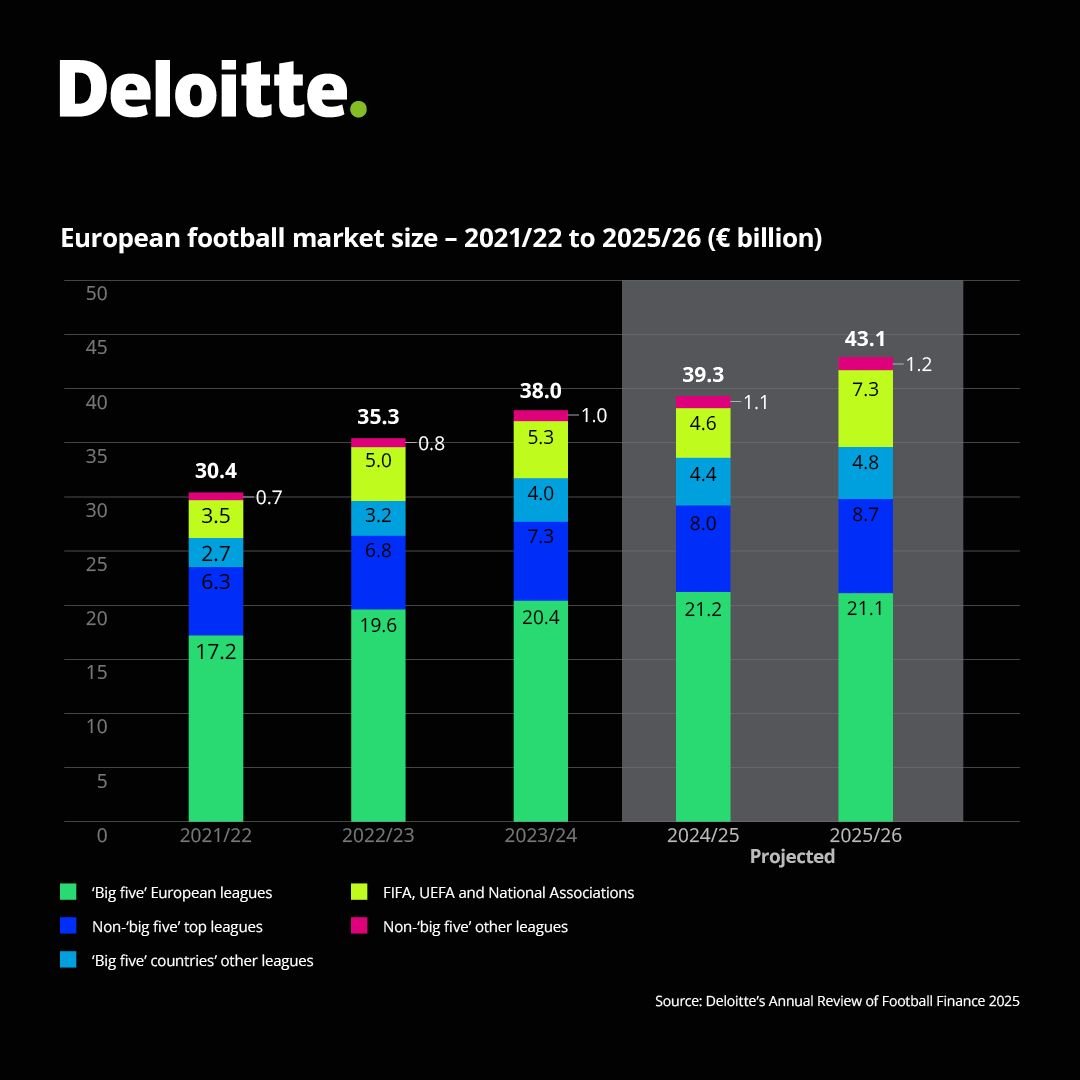
European football has surged past a major financial milestone. According to Deloitte’s newly released 2025 Annual Review of Football Finance, the continent’s football industry generated a record-breaking €38 billion (£32.2bn) in revenue during the 2023/24 season, reflecting an 8 percent year-on-year increase.

But that growth pales in comparison to what is happening in the women’s game. The Women’s Super League (WSL) recorded a 34 percent rise in revenue, with every club surpassing £1 million for the first time. That is over four times the growth rate of the men’s game, highlighting women’s football as one of the fastest-growing segments in global sport.
⚽ Key Statistics Driving Football’s Future:

  • €38 billion: Total revenue generated by the European football market in 2023/24 (+8 percent YoY)

  • Over €20 billion: Combined revenue from the 'Big Five' leagues (Premier League, Bundesliga, LaLiga, Serie A and Ligue 1), passed for the first time

  • More than £2 billion: Premier League clubs’ commercial revenue reached a record high

  • £1 billion: Championship clubs’ total revenue, up 28 percent, driven by club mix and broadcast income

  • £1 million or more: Revenue reported by every Women’s Super League club (+34 percent YoY)

📈 Growth Meets Identity: A Cultural Crossroads

These figures tell a story beyond business performance. They signal that football is not only thriving financially but undergoing a cultural transformation. As clubs attract greater investment and build international fanbases, there is an urgent need to protect their roles as community institutions.

Football clubs are part of the social fabric. They represent history, identity and belonging. As Timothy Bridge of Deloitte emphasises, they must be treated as community assets, not just commercial entities.

The test ahead is clear: clubs must pursue commercial growth while maintaining authenticity and supporting the fans who have sustained them for generations.

🚀 Women’s Football: A Game-Changer in Every Sense

The standout story in the Deloitte report is the WSL’s 34 percent growth. Compared to the 8 percent growth of the overall European football market, it is a remarkable signal of momentum.

This surge reflects more than revenue. It speaks to cultural change. The women's game is now attracting major sponsors, growing broadcast audiences and inspiring a new generation of players and fans.

Women's football is no longer developing in the shadows of the men's game - it is carving its own path, with a distinct identity and increasing commercial value. The numbers show it, but the movement behind them is even more powerful.

🧭 Looking Ahead: Growth With Purpose

European football is thriving, but its long-term success depends on how that growth is managed. Commercial momentum must not come at the cost of local relevance, affordable access or the spirit of the sport.

Sustainable investment should focus on:

  • Grassroots and youth development

  • Fair distribution of resources

  • Growing women’s football equitably

  • Safeguarding supporter engagement and club culture

⚖️ Final Word

Football’s record-breaking revenues in 2023/24 reflect its global pull. But the true strength of the sport lies in its ability to unite, to inspire and to reflect society. If the next chapter in football’s evolution is to be successful, it must be written with integrity, inclusivity and cultural awareness.

categories: Impact, Sport
Monday 06.16.25
Posted by Vicky Beercock
 

Protecting the Beat: Why AFEM’s AI Principles Could Shape the Future of Music Creation

The music industry stands at a critical crossroads. The rise of generative AI is transforming how music is made, distributed, and consumed - but not without raising urgent questions about creators’ rights, ethics, and fair compensation. Enter AFEM (Association For Electronic Music), an influential voice in the electronic music scene, which has just released a pioneering set of AI Principles aimed at protecting music creators in this rapidly evolving landscape.

The Cultural Stakes Are High

Music is not just a product; it’s a cultural lifeblood. The International Federation of the Phonographic Industry (IFPI) reported that global recorded music revenues hit $31.1 billion in 2023, driven by streaming and digital innovation. But as AI technologies like generative models proliferate, artists and producers fear losing control over their creative output. According to a recent survey by MIDiA Research, 65% of music creators are concerned that AI could exploit their work without fair recognition or pay.

AFEM’s move reflects a growing alarm among creators worldwide. Its new principles demand that AI developers seek “explicit authorisation” from rightsholders before using copyrighted music to train their models. This insistence is crucial because, as AFEM warns, existing industry contracts were never designed with AI in mind - leaving a legal grey zone ripe for exploitation.

Why This Matters: Rights, Recognition, and Revenue

AFEM’s principles aren’t just about protecting revenue streams; they emphasise creators’ moral rights - the personal connection artists have with their work. Even when labels or publishers hold rights, AFEM stresses that “authors and performers must approve or decline AI uses”, safeguarding artistic integrity in a world where AI can generate “new” content based on original works.

The economic impact of ignoring these protections could be staggering. A 2024 report by Goldman Sachs predicted that AI-generated music could disrupt $5 billion in royalties annually by 2030 if left unregulated, siphoning income away from the very people who fuel the industry’s creativity.

Setting a New Standard

AFEM’s principles join a chorus of industry leaders - including UMG, GEMA, and the Human Artistry Campaign - calling for transparent, fair, and ethical AI use. By prioritising creators rather than just rightsholders, AFEM is pushing for a more inclusive and equitable framework, one that balances technological innovation with cultural preservation.

As AFEM co-chair Kurosh Nasseri put it, “By formulating a simple set of core principles... we will create the environment in which this new technology can flourish without violating the rights of creators and rightsholders.”

Looking Ahead: The Future of Music and AI

With generative AI already responsible for creating over 10% of new music tracks in some streaming playlists (source: MIDiA Research), the music industry’s response to AI’s rise will set a precedent for creative industries worldwide. AFEM’s initiative offers a blueprint not only for safeguarding music creators but also for ensuring AI innovation respects and uplifts human artistry.

The challenge? Aligning fast-moving tech development with the slower rhythms of legal and ethical frameworks - and making sure that, in the rush to embrace AI’s potential, the heartbeat of music’s creators remains front and center.

🎧 AFEM’s AI Principles – Key Takeaways:

  1. Explicit Authorisation Required
    AI developers must obtain clear, explicit permission from rightsholders before using copyrighted music for AI training.

  2. Fair Compensation and Transparent Credit
    Creators and rightsholders must be fairly compensated and properly credited when their work is used in AI systems.

  3. Contracts Must Be AI-Specific
    Existing music industry agreements do not automatically cover AI use. Labels, publishers and distributors must include AI-specific clauses in new contracts to ensure proper authorisation and remuneration.

  4. Creators Retain Moral and Usage Rights
    Even when recordings and compositions are owned by labels or publishers, moral rights remain with the creators.
    Authors and performers must approve or decline any AI use of their work.

  5. Rights Cannot Be Assumed or Implied
    It must not be assumed that existing contracts or ownership imply consent for AI training or generative outputs.

These principles are designed to set ethical boundaries for AI in music and ensure that creators remain at the centre of innovation, ownership and cultural value.

This post was following Stuart Dredge’s article on music:)ally here

Sources:

  • IFPI Global Music Report 2024

  • MIDiA Research, Music Creators and AI Survey 2024

  • Goldman Sachs, AI and Music Industry Report 2024

  • AFEM AI Principles Announcement, June 2025

categories: Music, Tech, Impact
Monday 06.16.25
Posted by Vicky Beercock
 

Charlotte Tilbury and Dallas Cowboys Cheerleaders: A Game-Changing Partnership in Beauty and Sports

In a landmark move that’s shaking up both the beauty and sports worlds, British makeup powerhouse Charlotte Tilbury has become the Dallas Cowboys Cheerleaders’ first-ever official beauty partner. This bold collaboration drops just ahead of the cheerleaders’ Season 2 return on Netflix, and it’s about far more than looks - it’s a powerful celebration of strength, confidence, and influence.

More Than a Sideline Show

The Dallas Cowboys Cheerleaders aren’t just background performers - they’re icons. Known as “America’s Sweethearts,” they’ve been a defining part of American culture for decades, symbolizing discipline, dedication, and charisma. Now, with their Netflix docuseries reaching millions, their story resonates on a global stage.

Charlotte Tilbury shares that drive. As a trailblazer in beauty, she’s built her brand on innovation and empowerment, pushing women to own their identity and express themselves fearlessly. Teaming up with the DCC is a perfect fit - two women-led powerhouses elevating what it means to perform and represent.

Redefining What Beauty Means in Sports

This partnership flips the script on traditional ideas of beauty in athletics. It’s not about fitting a mold - it’s about celebrating individuality and excellence. Fans can look forward to exclusive behind-the-scenes content, surprise pop-ups, and on-site beauty experiences at AT&T Stadium that bring Charlotte Tilbury’s signature energy right to the heart of the action.

Every cheer, every movement, every smile will carry that extra spark of confidence. This is a collaboration that highlights performance and self-expression as one and the same - proving that strength and style aren’t mutually exclusive.

A Cultural Moment That Matters

In today’s world, where women continue to break barriers in sports and entertainment, this partnership stands out as a beacon of progress. Charlotte Tilbury’s leap into American sports, following her work with F1 Academy™, signals a broader movement: empowering women to thrive in spaces historically dominated by men.

For young women and fans watching, this alliance sends a clear message - it’s possible to lead, innovate, and make your mark on your own terms.

What to Expect Next

With the Dallas Cowboys Cheerleaders’ Netflix Season 2 set to drop, this partnership invites audiences to witness more than just performances. It’s about seeing these athletes as trendsetters and role models who embrace their full selves — on and off the field.

Blending British beauty expertise with American sports culture, this partnership celebrates collaboration, empowerment, and evolution. It shows that today’s culture rewards those who break new ground and inspire others to do the same.

The Charlotte Tilbury x Dallas Cowboys Cheerleaders collaboration isn’t just a branding deal - it’s a cultural reset. Prepare to see the cheerleaders bring their game - and their confidence - to a whole new level, proving that power and self-expression can’t be separated.

categories: Fashion, Beauty, Sport
Monday 06.16.25
Posted by Vicky Beercock
 

✊ Angel City FC’s “Immigrant City Football Club” T-Shirts: A Bold Stand Amid Los Angeles’ Immigration Protests

In a time when brands have the power to influence culture and spark meaningful change, Angel City FC has shown what it means to stand with its community. By distributing 10,000 t-shirts bearing the message “Immigrant City Football Club,” Angel City FC has made a profound cultural statement in response to the recent ICE raids and protests shaking Los Angeles.

This is more than just merchandise - it’s a call to recognize and celebrate the immigrant communities that make Los Angeles vibrant and strong. Their message echoes a simple truth: Los Ángeles es para todos - Los Angeles is for everyone.

Context: A City in Turmoil and Resistance

Since early June 2025, Los Angeles has been the epicenter of intense immigration protests following widespread ICE raids. The federal government’s deployment of National Guard troops and active-duty Marines to support enforcement actions has heightened tensions and led to mass demonstrations, curfews, and numerous arrests.

In this atmosphere of unrest, Angel City FC’s initiative stands as a unifying force, emphasizing inclusion and human dignity amid political strife.

More Than a Slogan: A Cultural Affirmation

Angel City FC’s t-shirts proclaim that Los Angeles belongs to its immigrant residents - those whose labor, culture, and spirit fuel the city’s growth and identity. This message is a powerful counter to narratives that seek to exclude or criminalize immigrant communities.

By aligning their brand with this cause, Angel City FC uses its platform to foster solidarity, inspire hope, and challenge division.

The Role of Sports in Social Impact

Sports teams hold unique cultural influence, often transcending divides to bring communities together. Angel City FC’s “Immigrant City Football Club” campaign:

  • Elevates immigrant voices.

  • Highlights the city’s diversity as a strength.

  • Demonstrates leadership in social justice.

In doing so, the club redefines what it means to be a team in 2025 - one that represents not only athletic excellence but also cultural pride and activism.

Los Ángeles es para Todos: A Declaration for the Future

As Los Angeles grapples with political conflict and social upheaval, Angel City FC’s message reminds us all that the city’s essence is its people - all of them. In this declaration of belonging, Angel City FC offers a hopeful vision: a city that welcomes everyone, no matter where they come from.

categories: Sport, Impact, Fashion
Monday 06.16.25
Posted by Vicky Beercock
 

Wimbledon 2025: Reinventing Tradition to Thrive in the Attention Economy 🎾🔥

Wimbledon is more than just a tennis tournament - it’s a cultural institution that has stood the test of time. Yet, as we live in an era where attention is the most valuable currency, even this iconic event must evolve to stay relevant. Under the leadership of Sally Bolton, CEO of the All England Lawn Tennis Club (AELTC), Wimbledon is striking a powerful balance between honouring its rich traditions and embracing bold innovations.

🎯 Competing for Attention in a Saturated Market

In today’s entertainment landscape, Wimbledon faces fierce competition - not just from other sports, but from an endless stream of digital content vying for people’s attention. Bolton acknowledges, “It’s the attention economy, and we’re trying to maintain our share of that.” With a global audience that’s more fragmented than ever, this challenge has pushed Wimbledon to rethink how it engages fans.

📱 Engaging the Next Generation

Wimbledon’s innovative digital initiatives are game-changers. Take WimbleWorld on Roblox - launched in 2022, it has already attracted 19.5 million visits, connecting the tournament with a younger, digitally native audience in a fun and interactive way. This move signals Wimbledon's commitment to evolving beyond traditional broadcasting and stadium experiences.

🌍 Global Expansion: The U.S. and India

Wimbledon is expanding its footprint globally. In the U.S., the tournament partnered with ESPN and recreated “The Hill” experience in New York, bringing a slice of Wimbledon culture stateside. Meanwhile, in cricket-loving India, collaborations with legends like Sachin Tendulkar have introduced Wimbledon to new fans, tapping into vibrant, passionate sports communities.

📈 Business Growth Through Audience Engagement

This strategic approach is paying off. Over the past decade, Wimbledon’s revenue has more than doubled, soaring from £170 million to approximately £400 million. This growth reflects the success of deepening fan engagement and expanding reach without compromising the tournament’s heritage.

🏟️ Balancing Tradition with Innovation

Wimbledon continues to evolve while holding tight to its core identity. Innovations like electronic line calling and the online ticket ballot system show how technology can enhance the experience without eroding tradition. Bolton puts it best: Wimbledon is “always changing, always staying the same.”

🛍️ Beyond the Tournament: Building a Lifestyle Brand

Wimbledon isn’t just about the fortnight on the courts anymore. With nearly 100,000 visitors annually to its museum and a growing online retail presence, it’s positioning itself as a global lifestyle brand. This allows fans worldwide to connect with Wimbledon’s essence, even if they can’t be there in person.

🔮 The Future of Wimbledon

Looking forward, Wimbledon is set to remain a premier event by continuing to adapt thoughtfully. Bolton’s vision ensures the tournament will maintain its unique charm while meeting the demands of the modern attention economy.

For a deeper dive into Sally Bolton’s strategy and vision for Wimbledon’s future, check out the full Financial Times interview here:
ft.com - Sally Bolton on Wimbledon

For more thoughtful analysis on culture, fashion, music, sport, and brand strategy - including how brands like Wimbledon navigate today’s complex cultural landscape - subscribe to On The Record, my LinkedIn newsletter delivering curated insights and fresh perspectives straight to your feed: Subscribe here to On The Record.

categories: Gaming, Sport, Tech
Monday 06.16.25
Posted by Vicky Beercock
 

What Club Culture Can Teach Brand Strategy in 2025

In a world where brands fight for fleeting attention, club culture continues to offer something that’s rare and enduring: meaningful connection, community, and cultural momentum.

This year’s IMS Ibiza summit wasn’t just a gathering of the global electronic music elite - it was a window into the systems, tensions and opportunities shaping how culture is made, shared, and sustained in 2025. And if you’re building brands in fashion, sport, music or media, you’d be wise to take notes from the dancefloor.

Here are five critical lessons for strategists, brand builders and cultural thinkers right now - powered by data, and informed by the subcultures still setting the global tone.

1. The Global South isn’t the ‘next frontier’ - it’s the current epicentre

According to the 2025 IMS Business Report, 80% of new music streaming subscribers in 2024 came from the Global South. That’s not a forecast - that’s a shift. From amapiano in Lagos to techno collectives in Mumbai, the cultural centre of gravity is moving.

Brands that continue to prioritise legacy markets while overlooking local scenes in Nairobi, Bogotá or Karachi are missing both influence and opportunity. These aren’t “emerging audiences” - they’re defining the pulse of global youth culture in real time.

✴️ Strategic takeaway: Your next breakthrough moment might come from a place you’ve never pitch-decked.

2. Human creativity is still the algorithm’s beating heart

AI is changing the way music is made and marketed - but not always for the better. Rights organisations like GEMA are already in legal battles over AI models scraping millions of tracks without compensation, and lawyers at IMS warned of AI being used as a "revenue substitution" that sidelines artists entirely.

Here’s the kicker: AI only evolves by learning from human creativity. If we hollow out that creative well, what’s left is a loop of mimicry. Artistic labour must be protected - not just morally, but to keep the machine running.

✴️ Strategic takeaway: Value creators before code. Audiences feel the difference.

3. Subculture still drives style, sound - and spend

Genres like Jungle and Drum ’n’ Bass have outlived many of their mainstream critics. Why? Because they’re rooted in community, adaptability and legacy. These scenes aren’t chasing relevance—they’re renewing it through intergenerational exchange.

At IMS, SHERELLE and DJ Flight spoke about how older and younger artists trade influence, not just spotlight. It’s a reminder that longevity in culture comes from stewardship, not speed.

✴️ Strategic takeaway: Want to build lasting relevance? Nurture a cultural continuum - not just a moment.

4. Curation isn’t dead - but it is under threat

There’s a quiet crisis brewing: algorithmic dominance is eroding trust in taste. TikTok virality might land a track in the charts, but as Hospital Records’ Chris Goss put it, “some young artists are getting signed off the back of 30-second clips who’ve never finished a full record.”

The collapse of music press, editorial platforms and local tastemakers has left a void - one the algorithm is only too happy to fill. But audiences still crave voices they trust, not just trends they’re fed.

✴️ Strategic takeaway: Curation is now a competitive edge. Champion distinct taste over mass optimisation.

5. The future of nightlife starts with who’s allowed in

While club culture was born in queer, Black and trans communities, not all dancefloors are the safe spaces they claim to be. Trans artists face real threats globally - some have been detained simply for performing. And back home, marginalised voices are still being pushed to the periphery.

At IMS, the message was clear: diversity is not an aesthetic - it’s a structural necessity. Brands, agencies, and platforms must do more than posture. They need to create real access, redistribute opportunity, and protect the cultural innovators they profit from.

✴️ Strategic takeaway: Inclusion isn’t a campaign - it’s the baseline for cultural credibility in 2025.

Final thought: The dancefloor is still a signal

Culture doesn’t just trickle down from Silicon Valley or Soho House. It loops, samples, remixes and travels fast through unexpected channels. Club culture continues to be a testing ground for global influence, emotional resonance, and creative agility.

If you want your brand to feel alive, relevant and future-facing? Look where the basslines are. There’s a strategy in every sound system.

—

This is On The Record: analysis for brands that move at the speed of culture.

🌀 To read more about the stories behind these insights, explore the full IMS Ibiza 2025 summary here.

categories: Culture, Music, Tech
Sunday 06.15.25
Posted by Vicky Beercock
 

Winning Off the Field: Why Women’s Football is the Smartest Play in Sports Right Now

Women’s football in the UK is at a historic crossroads. On one side, Chelsea’s recent triumph in the Women’s Super League (WSL) symbolises the immense growth and professionalisation of the sport, now valued at a staggering £2.35 billion. On the other, Blackburn Rovers’ withdrawal from the WSL paints a stark picture of the fragility that still underpins the game’s infrastructure and financial ecosystem. In the middle of this, Arsenal’s groundbreaking move to host WSL matches at the Emirates Stadium marks a new cultural and commercial landmark, heralding a bright and transformative future for the women’s game.

The Triumph, the Paradox and the Landmark

Chelsea’s dominance on the pitch and commercial stage highlights the exponential growth of women’s football in the UK. The club’s WSL title represents a beacon of what strategic investment, sponsorship and cultural momentum can achieve. The WSL market is now valued at £2.35 billion, reflecting rising fan engagement, broadcast deals and sponsorships.

Meanwhile, Blackburn Rovers’ exit from the league serves as a sobering reminder that despite these successes, many clubs still face significant financial challenges. Blackburn’s withdrawal exposes the precarious realities outside the elite, risking the league’s inclusivity and long-term sustainability.

Amid this paradox, Arsenal’s decision to stage their women’s team’s home matches at the Emirates Stadium, a premier Premier League venue with a capacity of 60,000, marks a historic step. It is the first time a WSL team will regularly play at such a high-profile stadium, symbolising women’s football’s arrival on the biggest sporting stages and offering fans an elevated experience. This move reflects growing confidence from clubs in the commercial and cultural potential of the women’s game, setting new standards for visibility, fan engagement and professional ambition.

A Wake-Up Call and a Call to Action

Blackburn’s departure and the broader disparities in the league highlight an urgent need for strategic investment and sustainable support across all levels of women’s football. Without these, the WSL risks becoming a two-tier competition, undermining grassroots development and regional fan bases.

This moment demands collective action from governing bodies, sponsors and stakeholders to strengthen infrastructure and financial models, ensuring every club can compete sustainably and contribute to the sport’s long-term growth.

Raising the Cultural Bar: Women’s Football as a Cultural Phenomenon

Women’s football is no longer a niche pastime but a powerful cultural movement. Arsenal’s Emirates move epitomises this cultural ascendancy, signalling that women’s matches deserve the grandest stages, equal fanfare and top-tier facilities.

The sport drives important social conversations about gender equality and inclusivity, inspiring new generations of players and fans. Record-breaking attendances and TV viewership figures, such as Arsenal’s ability to attract thousands to the Emirates, prove there is a passionate and growing fan base hungry for women’s football at the highest level.

This cultural relevance amplifies commercial appeal, creating unique opportunities for brands seeking authentic partnerships aligned with progressive values.

Sponsorship Boom: Outpacing Men’s Leagues and Driving Sustainable Growth

Perhaps the clearest signal of women’s football’s unstoppable momentum lies in sponsorship trends. Sponsorship deals in women’s sports have grown by 12% year on year, outpacing men’s leagues by 50 per cent. Brands increasingly prioritise partnerships that reflect social impact and sustainability, and women’s football provides an ideal platform for this alignment.

For investors and sponsors, the women’s game offers a unique proposition: strong financial returns coupled with genuine community engagement and societal impact. The influx of brands committed to equality and sustainability places women’s football at the forefront of responsible sports marketing.

Conclusion: Seizing the Moment

The £2.35 billion valuation of the women’s football market is more than a number; it is a mandate for action. Chelsea’s triumph illuminates what is possible through investment and cultural momentum, Blackburn’s exit warns of the risks of inaction, and Arsenal’s Emirates move showcases the sport’s arrival on the biggest stages.

The rapid growth in sponsorship and cultural relevance provides a clear roadmap for an inclusive, sustainable and transformative future for women’s football.

This historic moment presents an unparalleled opportunity for clubs, sponsors, governing bodies and fans alike. The future of women’s football depends on a collective commitment to ensuring that every club thrives and every fan remains engaged. As the sport continues to grow, it is set to become a celebrated cornerstone of UK sport and culture for generations to come.

Saturday 06.14.25
Posted by Vicky Beercock
 

When Culture and Community Collide: Lessons from Nike’s After Dark Half-Marathon

Nike’s After Dark women’s half-marathon in Los Angeles was billed as more than a race – it was an immersive cultural experience designed to empower women, elevate community, and celebrate movement after hours. With a post-run performance by Doechii and thousands of first-time runners in attendance, it had all the ingredients for a standout moment in sport and culture.

But the reviews told a more complex story – one that holds key lessons for any brand designing experience-led campaigns in 2025.

A Cultural Moment That Fell Short on Execution

While the event succeeded in creating energy, enthusiasm, and wide participation (with nearly 15,000 runners, 43% of them first-timers), it also faced legitimate criticism over logistics. Attendees reported long wait times, confusion over the start, and pacing policies that changed mid-campaign – challenges that, in some cases, left runners feeling excluded from the full experience, including the post-race concert.

The event’s concept – reclaiming the night through community, movement, and celebration – was strong. But as we’re seeing more often in the experience economy, cultural ambition must be matched by operational clarity to truly resonate.

Experience Is the New Brand Equity

Nike has long set the bar for culture-first storytelling in sport. Their ability to champion marginalised voices and empower communities is central to their global brand power. After Dark reinforced that – but also showed the growing tension between intention and execution.

When an experience is built around empowerment, especially for underrepresented communities, the details matter. Inclusivity is as much about infrastructure as it is about messaging. When expectations shift – as they did with the three-hour pacing limit – even small changes can signal larger disconnects.

Brands today aren’t just judged by their campaigns. They’re judged by how people feel during and after the experiences they create.

Three Takeaways for Brands Designing Cultural Events

  1. Inclusive Experiences Require More Than Inclusive Messaging
    Celebrating diversity means designing for it – across paces, identities, and abilities. Clear, consistent communication and support structures are vital.

  2. Emotional Equity Begins with Operational Excellence
    From check-in flows to finish line energy, execution isn’t just logistics – it’s brand storytelling in real time.

  3. Culture Can’t Be a Backdrop – It Has to Be the Blueprint
    When cultural relevance is central to the brand promise, it must inform every layer of the experience – not just the music line-up or influencer turnout.

The Bottom Line

Nike’s After Dark was a bold move – bringing women together in a joyful, empowering, after-hours run through Los Angeles. And while the vision was compelling, the experience reveals how high expectations have become for brands that lead in cultural space.

As more companies lean into immersive, community-driven activations, the standard is clear: if you’re going to build culture, you have to build infrastructure that supports it.

Because when it comes to cultural relevance, how you deliver is just as important as what you say.

Subscribe to the On The Record newsletter on LinkedIn for weekly insights into the strategies, stumbles, and standout moments shaping today’s most relevant brands.

categories: Culture, Sport, Impact
Friday 06.13.25
Posted by Vicky Beercock
 

Nike, LVMH, and the French Open: When Tennis Became the Cultural Arena

The 2024 French Open wasn’t just a tennis tournament - it was a cultural moment, meticulously choreographed in high-definition. While Carlos Alcaraz and Jannik Sinner battled through what is already being called the greatest men’s final in Roland Garros history, a different kind of contest played out in parallel: one of style, brand equity, and cultural clout.

Yes, Alcaraz lifted the trophy. But the real victors? Nike and LVMH.

The Swoosh Returns, Selectively

Nike, after a relatively quiet few years on the tennis circuit, made a thunderous return - not through volume, but through precision. It’s no longer about having everyone under contract. Instead, it’s about backing the few athletes who move the needle both on and off the court.

Alcaraz and Sinner have both been with Nike since 2019, and they didn’t just deliver an all-time classic - they delivered nearly six hours of global screen time, decked out in long-sleeved Nike rugby-style polos that felt more preppy runway than traditional kit. It was a calculated flex: performance meets polish.

And it wasn’t just the men. Naomi Osaka turned heads earlier in the tournament with her Sakura-inspired outfit - a collaboration with Nike infused with Japanese symbolism, manga references, and a Sailor Moon hairstyle to match. Meanwhile, Qinwen Zheng, another rising star, was meant to wear a striking all-crimson ensemble. Even though she said she was “too shy” to sport it on court, the message landed - Nike is reasserting itself in tennis, not just with athletes, but with aesthetics.

Luxury Brands on the Baseline

Add another layer: Alcaraz is aligned with Louis Vuitton. Sinner, with Gucci. This was not just a Grand Slam final - it was a high-fashion face-off, with two of the world’s most powerful luxury houses backing the next era of tennis dominance.

It’s no accident. These brands aren’t chasing exposure - they’re courting cultural resonance. In Alcaraz, Louis Vuitton gets youthful exuberance, versatility, and global appeal. In Sinner, Gucci taps into sleek minimalism, icy composure, and quiet influence. These aren’t just sponsorships; they’re statements.

Tennis has long been the most elegant of sports - but this is something new. Fashion is no longer an afterthought in tennis; it’s becoming the plot.

Walk-Ons as Cultural Runways

In today’s tennis, the walk-on has become the new runway. What players wear before the match often generates as much buzz as their shot selection. The French Open, with its terracotta courts and Parisian backdrops, offers the perfect canvas. Players have become style architects, using fashion to define their on-court personas and extend their influence far beyond sport.

The audience is evolving too. Younger fans - culturally tuned in and visually driven - aren’t just following scores. They’re following stories, fits, and the subtle signals of style and substance. Brands understand this, which is why they're investing in tennis as both a competitive space and a cultural one.

What This Means Going Forward

We’re witnessing a reinvention of tennis - not just as a sport, but as a cultural vehicle. Players are no longer simply athletes; they’re fashion icons, digital storytellers, and brand strategists. The French Open didn’t just produce champions - it broadcast a new blueprint for cultural relevance.

In an attention economy, visibility is currency - and the brands who understand how to place their athletes in the right moments, with the right look, are the ones who will shape the next era of influence.

Next stop: Wimbledon. Expect heritage minimalism. Elevated styling. And more high-stakes storytelling - on and off the court.

(This perspective was inspired by insights from DYM at SportsVerse - a must-read for anyone serious about the convergence of sport, fashion, business, and culture. Give it a look.)

categories: Sport, Fashion
Friday 06.13.25
Posted by Vicky Beercock
 

The Cultural Power Play: Why Women’s Sports Marketing Is a Game-Changer for Brands

Women’s sports are no longer just a niche corner of the athletic world, they are a vibrant, thriving market with undeniable cultural relevance. According to Parity’s latest research report, the perfect marketing strategy for women’s sports brands is not just a theory, it is happening right now, and brands who get on board are winning big.

Women’s Sports Are Flourishing and Fans Are Loyal

The numbers do not lie. Parity’s survey shows that more than half of women’s sports fans (51%) are devoted WNBA followers. Other leagues like the WTA, NWSL, and LPGA also boast strong fanbases, each with about 19–20% fan representation. Even emerging leagues like the PWHL are carving out their own spaces with solid regional viewership and promising expansion plans. This growth signals a fundamental cultural shift, women’s sports are becoming a staple of mainstream fandom.

Athletes as Authentic Brand Ambassadors

Here is where the cultural relevance gets interesting. The Parity report highlights that 68% of sports fans trust products endorsed by women athletes. This trust extends beyond traditional fans of women’s sports, 58% of those who rarely or never watch women’s sports also feel this way, marking a 6% increase year-on-year. This universal trust speaks to the growing recognition of women athletes as authentic, influential figures who resonate across diverse audiences.

Beyond Apparel: A Wide-Open Field for Brand Partnerships

While apparel, food and beverage, and health and beauty categories dominate fan awareness and purchase likelihood, the impact of sponsorships goes deeper. One in four women’s sports fans say that seeing women’s sports sponsorships actually makes them more likely to buy a product. For younger generations, particularly Gen Z and millennials, this effect is amplified, with nearly half (46%) more likely to support brands backing women athletes or teams.

This reveals a vital cultural insight, supporting women’s sports is not just good optics, it aligns brands with values of equality, empowerment, and progressiveness that resonate deeply with younger consumers.

The Strategic Play for Brands

Investing in women’s sports sponsorships is more than a feel-good move, it is a proven business strategy. Yet the Parity report also underscores the nuance brands must navigate. While awareness in popular categories like apparel is high, brands in less obvious sectors such as travel, insurance, or tech need more creative partnerships, particularly with media companies, to boost visibility and return on investment.

Why This Matters Culturally

The rise of women’s sports as a cultural force is redefining how brands connect with audiences. It reflects broader societal shifts towards gender equity and representation. By aligning with women athletes and leagues, brands signal their commitment to these values, tapping into a passionate, engaged fanbase that is shaping culture through their support.

In sum, the Parity report reminds us that the perfect women’s sports brand marketing strategy is not a mythical “limit”, it is real, effective, and evolving. Brands that recognise and act on this opportunity are not only winning in the marketplace but also advancing a cultural movement with lasting impact.

For more details, check out the Gist.

Friday 06.13.25
Posted by Vicky Beercock
 

When the Lights Dim: Fashion’s Sustainability Stage Grows Quiet

Each June, Copenhagen becomes a cultural checkpoint for the fashion industry. The Global Fashion Summit (GFS), long considered the most influential stage for sustainability in fashion, has traditionally offered a mix of optimism, urgency, and corporate showmanship. But this year, something was different - and revealing.

Big brands noticeably stepped back. Onstage panels were traded for closed-door roundtables. Sustainability leaders who once seized the mic were now curating their exposure. The mood was quieter - and it wasn’t just about tone. It reflected a deeper shift in how fashion is responding to rising pressure, changing politics, and increasingly skeptical audiences.

This comes at a time when the stakes couldn’t be higher:

  • Fashion is responsible for 10% of annual global carbon emissions - more than all international flights and maritime shipping combined.

  • It produces 92 million tonnes of textile waste annually, set to reach 134 million tonnes by 2030.

  • Only 13% of fashion companies are on track to meet their science-based targets.

  • Scope 3 emissions - the supply chain — account for over 70% of fashion’s footprint, yet fewer than 20% of brands disclose them.

  • In parallel, consumer trust is eroding: 79% of shoppers care about sustainability, but just 23% trust the claims brands make.

And then there’s the political dimension. In the U.S., 22 states introduced anti-ESG legislation in 2024, undermining corporate momentum toward responsible business practices. In Europe, efforts to tighten sustainability regulation have softened - just as greenwashing fines have risen by 40% year-over-year.

So when brands go quiet, it’s not just risk avoidance. It’s a signal - that sustainability, once a strategic front-of-house performance, is now seen as a liability to manage behind closed doors.

But culturally, that silence matters. Because fashion doesn’t just respond to culture - it shapes it. And right now, the industry is modeling a form of retreat just when visible leadership is most needed.

Still, not all is lost. Independent designers, innovators, and next-gen sustainability leaders are stepping into the vacuum - with more transparency, realism, and cultural clarity than ever. They’re not just working within the system; they’re questioning its assumptions.

For those of us invested in cultural relevance and brand strategy, this year’s summit felt less like a celebration - and more like a stress test. The choice ahead isn’t just about compliance. It’s about credibility.

In an era of noise, brands that stay visible with purpose - not perfection - will be the ones shaping the next chapter.

categories: Fashion, Impact
Friday 06.13.25
Posted by Vicky Beercock
 

What Chuckmates Can Teach Us About Creator-Led Brand Content (And Why Cultural Relevance Still Isn’t Plug-and-Play)


When Converse dropped Chuckmates - a sneaker-first blind dating show hosted by the always-iconic Amelia Dimoldenberg - it looked like a win on paper. Great creator. Smart cultural hook. A format with viral potential.

And honestly? It is a smart move. Chuckmates is part of a larger shift we’re seeing across brand marketing: investing in original content, building series instead of ads, and collaborating with creators to meet Gen Z where they live - on YouTube, in their feeds, watching things they actually want to spend time with.

But here’s the tension: as brands experiment with creator-led formats, the difference between “featuring a creator” and “creating with a creator” is becoming the make-or-break line for real cultural relevance.

Creators Don’t Just Bring Audiences. They Bring Format Fluency.

Amelia isn’t just a host - she’s a genre. Chicken Shop Date works because of her deadpan delivery, awkward pacing, and the self-aware, lo-fi feel that’s made it a cult favourite.

Chuckmates nods to that tone, but ultimately plays more like a structured gameshow than a satirical character piece. Which is fine - but it means the show doesn’t fully tap into what makes Amelia so culturally sticky.

This is a common slip-up in brand/creator collabs: when you bring in a creator, you’re not just borrowing their face - you’re borrowing their understanding of the platform, their audience, and what formats are actually native to that world.

Let’s Talk Platform: YouTube Isn’t TV with a Share Button

The title of the premiere episode - “Chuckmates Ep. 1 | A Blind Dating Show by Converse with Amelia Dimoldenberg” - reads like it was written for a brand deck, not the YouTube algorithm.

On this platform, titles need to spark curiosity, not summarise a campaign. Same goes for thumbnails. They should feel like moments, not marketing.

This isn’t about clickbait. It’s about relevance. A few small tweaks - a thumbnail that captures one of Amelia’s signature looks, a title that leans into intrigue - could’ve instantly made the show feel more like content Gen Z chooses, not content served to them.

Views ≠ Resonance

Episode 2 currently sits at over 2 million views - but engagement is unusually low. That disconnect is important.

We’re in a phase where it’s easy to buy reach. But resonance - actual cultural traction - is something else entirely. It’s the difference between being watched and being talked about. And when creators are brought in without real creative input, you risk losing that spark.

Here’s the Real Lesson for Brands Trying to Win Online:

If you’re bringing creators into your content, bring them into the creative process too.

The best branded series we’re seeing today aren’t the ones where brands “use” creators as talent. They’re the ones where creators shape the tone, structure, and storytelling from day one.

That’s how you get content that feels fresh instead of formulaic. That’s how you stay relevant and build equity with your audience.

Final Thought

Chuckmates shows that Converse is thinking in the right direction. It’s bold, it's experimental, and it’s built for a platform that brands still struggle to crack. But it also shows how critical it is to not just partner with creators - but to trust their instincts, elevate their voice, and let them steer.

Because cultural relevance doesn’t come from featuring cool people.

It comes from making cool stuff with them.

Thursday 06.12.25
Posted by Vicky Beercock
 

A Homage To Brian Wilson: The Sonic Architect Who Rewired American Culture

Brian Wilson wasn’t just a genius. He was a disruptor, a quiet revolutionary who remade pop music from the inside out. His passing at 82 closes a chapter on one of the most profound cultural legacies of the 20th century, and his fingerprints are still all over the sound of today.

Before Brian Wilson, pop was catchy. After Brian Wilson, pop was cathedral. He took the California dream - surfing, convertibles, golden-hour innocence - and turned it into a widescreen, Technicolor sound that reshaped how America saw itself. He didn’t just soundtrack the sixties. He mythologised it, then deconstructed it. And when the illusion cracked, he gave us music that looked straight into the void and still somehow offered grace.

Wilson’s Beach Boys weren’t just hitmakers. They were cultural architects. "Pet Sounds" didn’t just inspire Sgt. Pepper. It provoked it. The Beatles weren’t competing with anyone except Brian. Paul McCartney has called “God Only Knows” the greatest song ever written. That’s not a compliment. That’s acknowledgment of Wilson as a generational force, someone whose instincts changed the very vocabulary of pop.

He bent the studio to his will long before that was even a concept. Long before hip-hop producers were layering samples or indie bands were chasing lo-fi transcendence, Brian was wiring harpsichords, dogs barking, and bicycle bells into heartbreak anthems. He built songs like film scores. “Good Vibrations” wasn’t a single. It was a six-month sonic experiment that accidentally became a number one hit. He made emotion into architecture.

And his influence wasn’t just musical. It was spiritual. Wilson cracked open the pop star archetype. He was a frontman who didn’t tour, a genius who couldn’t always function, a legend who often didn’t want the spotlight. He showed the cost of genius and the beauty in vulnerability. He was decades ahead of the conversation on mental health and the toll of fame. In a world now obsessed with authenticity, Wilson was the original unfiltered soul.

You can hear his echo everywhere. In the rich melancholy of Frank Ocean. In the layered optimism of Vampire Weekend. In the cinematic reach of Tame Impala. Every artist trying to push pop past its limits owes something to Wilson’s experiments, whether they know it or not.

His life was complicated. His journey was brutal. But he came through it all still chasing beauty. Still trying to tune into something divine. That’s what made him matter. Not just the hits. Not just the accolades. But the risk. The fact that he never stopped searching for something pure in a world that wasn’t.

Brian Wilson didn’t just change music. He changed what music could mean. And for that, he’ll always be more than a Beach Boy. He’ll be a blueprint.

God only knows what we’d be without him. But thankfully, we’ll never have to find out.

tags: music
categories: Music, Culture, Impact
Wednesday 06.11.25
Posted by Vicky Beercock
 

Navigating Cultural Influence and Free Expression: The Kneecap Controversy and the Role of Industry Leadership

As the 2025 festival season unfolds, one question captures attention in the music world: Will Irish rap group Kneecap perform at Glastonbury as planned? And if so, will the BBC stream their set as in previous years, or will external pressures impact their visibility?

This situation offers a valuable lens on how culture, politics, and industry power intersect - and raises important questions about transparency, influence, and artistic freedom.

Behind Closed Doors: The Private Campaign

Recently revealed correspondence shows a confidential letter sent to Glastonbury organisers by a coalition of senior industry insiders. The letter expressed concerns that Kneecap’s politically charged lyrics could be construed as “propagating hate,” suggesting that their appearance might conflict with commitments to “free speech.”

Those involved are not marginal figures; they represent major agencies, record labels, and organisations with influence across the global entertainment sector. Their participation in this private effort highlights how internal industry mechanisms can shape public cultural spaces - often without scrutiny or accountability.

The Challenge of Private Influence

What stands out is the private, non-transparent nature of this intervention. Rather than a public discussion or open dialogue, the letter functioned as a discreet warning - an attempt to influence decisions away from public scrutiny.

This pattern is not isolated to music; similar private pressures have been reported within fashion and other cultural sectors, reflecting a broader trend of behind-the-scenes lobbying that risks limiting diverse voices without accountability.

Ethical Reflections on Industry Leadership

The entertainment industry rightly prides itself on promoting inclusivity and combating discrimination. However, when leaders in this space engage in efforts to restrict political expression - particularly on complex issues like the Israeli-Palestinian conflict - it raises important questions about the boundaries of institutional anti-racism.

The attempt to silence an Irish group critical of ongoing conflict in Gaza - especially amid a growing public demand for honest political engagement - risks alienating younger artists and audiences who expect cultural platforms to support open discourse.

What’s at Stake for Festivals and Broadcasters?

Glastonbury faces a critical choice: to uphold its reputation as a space for bold, diverse artistic voices, or to yield to pressures that may stifle important cultural conversations. Similarly, the BBC’s decision on streaming Kneecap’s set will be a key indicator of its commitment to editorial independence.

Should mainstream platforms step back, independent channels and artists may need to take up the mantle - ensuring that cultural spaces remain accessible to varied perspectives, even when those perspectives challenge prevailing narratives.

Conclusion: Towards a Culture of Openness and Accountability

The Kneecap controversy highlights broader tensions around political expression, cultural influence, and the responsibilities of industry leaders. As the arts continue to engage with pressing global issues, transparency and accountability must guide how decisions are made.

Balancing respect for diverse viewpoints with a commitment to free expression is no easy task - but it is essential for nurturing a vibrant, inclusive cultural landscape.

tags: music
categories: Music, Impact
Wednesday 06.11.25
Posted by Vicky Beercock
 

Y-3 KURO: When the OG of Streetstyle Doubles Down on Its DNA

Yohji Yamamoto has always done things his own way. So it feels fitting, even poetic, that Y-3’s newest evolution is a sub-label where Yohji collaborates with, well… Yohji. Y-3 Kuro is here, and I’m absolutely here for it.

I worked on the Y-3 brand at adidas from 2015 to 2017. Not at the very beginning, but during a time when Y-3 had already proven it wasn’t just another designer-sportswear experiment. It was something more permanent. A movement built on contradiction, discipline, and freedom. We weren’t chasing trends or sneaker culture validation. We were building a world for the non-conformists. For those who wanted their wardrobe to say less, but mean more.

That spirit still resonates, and Kuro captures it. “Kuro,” meaning black in Japanese, is Yohji’s color of choice and his most powerful design tool. In his hands, black becomes language, form, and identity. This new sub-line strips Y-3 to its core: sharp, functional silhouettes reduced to their essence. Clean track jackets, pared-back tanks, beanies. It is restraint with purpose.

If you know Y-3’s history, you know this isn’t a pivot. It’s a continuation. A reassertion of what has always set the brand apart.

Over the years, there have been key moments that defined Y-3’s relevance and longevity:

1. 2002–2003: The Birth of a Category
Y-3 launched in 2002 and debuted at Paris Fashion Week in 2003. It was a groundbreaking moment: Yohji Yamamoto, then already a legend in avant-garde fashion, partnered with adidas to create an entirely new category - high-fashion sportswear. Minimal branding, draped silhouettes, and performance-forward thinking became the brand’s DNA. This wasn’t fashion chasing function; it was function reimagined through fashion.

2. 2004: Platform Sandals Before They Were Cool
Years ahead of the current wave of clogs, slides, and sport-fashion hybrids, Y-3 released a platform sandal with a split-toe mesh bootie and bold typographic branding. It was fashion-forward, ergonomic, and arguably set the stage for today’s utility-meets-luxury footwear movement. Back then, it confused people - now, it looks prophetic.

3. 2013: The Qasa High Drops — and the Game Changes
The Qasa High sneaker arrived and didn’t just sell - it shifted the culture. Its elastic wrap design, tubular sole (a callback to adidas' '90s archive), and neoprene upper made it an instant cult item. It inspired dozens of imitators and opened the floodgates for designers to treat sneakers as sculptural objects.

4. 2014–2016: The BOOST Trilogy — PureBOOST, Run Boost, and Ultraboost 22
Before the world fell in love with BOOST through Yeezy or Ultraboost, Y-3 introduced it to fashion crowds with the PureBOOST. Later, the Run Boost amped up the silhouette with oversized branding and Yamamoto’s signature asymmetry. Kanye himself wore them — and resale prices soared.

5. 2016: Y-3 Designs Flight Suits for Virgin Galactic
Yes, really. When Richard Branson’s space tourism company needed flight suits for its crew, it tapped Yohji and Y-3. Designed with heat-resistant Nomex and Yamamoto’s eye for silhouette, these weren’t gimmicks - they were industrial couture made for the stratosphere. (as seen in my portfolio projects)

6. 2018: The Y-3 4D Runner Introduces FutureCraft to the Avant-Garde
With only 200 pairs released, this sneaker merged adidas’ FutureCraft lattice sole with Yohji’s refined minimalism. It was tech-forward, runway-certified, and another example of Y-3 being first to blend high design with real performance science.

7. 2022: “20 Years: Re-Coded” Campaign with Zidane
To mark its 20th anniversary, Y-3 turned to longtime collaborator and icon Zinedine Zidane. The campaign featured Zidane in full Y-3 - trench, vest, tracksuit - as a living embodiment of elegance in motion. The campaign didn’t just look back; it reminded people why Y-3 still matters.

Which brings us back to Kuro. It’s not a rebrand. It’s a refinement. A creative re-centering. The silhouettes are subtle but loaded with intent. It feels like a return to what made Y-3 so powerful in the first place: the ability to say a lot by doing very little.

As Yohji once said,
“With one eye on the past, I walk backwards into the future.”

That is exactly what Y-3 Kuro is doing. Not chasing nostalgia, not chasing hype. Just moving forward in its own quiet, confident rhythm.

As someone who had the privilege of working on this brand from the inside, I see this moment not just as evolution, but as affirmation.

And yes - I’m here for it.

tags: Fashion
categories: Fashion, Culture, Sport
Tuesday 06.10.25
Posted by Vicky Beercock
 

SXSW London: A Missed Opportunity That Must Do Better Next Time

Plenty of people have been asking: does the UK really need SXSW London? One comment I came across recently summed it up bluntly - why pay £1,560 for a delegate pass when we already have a thriving ecosystem of homegrown showcase events like The Great Escape, Sound City, FOCUS Wales, Wide Days, ILMC, Chris Carey’s FFWD, and the important work being done by Dr. Yasin El Ashrafi in Leicester?

That stuck with me, and I have to say - I didn’t attend SXSW London. Not because I didn’t want to be curious, but because I genuinely didn’t feel the offering justified the price or the time investment. And based on the programming, reviews, speaker lineups, social media feedback, and media coverage I’ve since seen, I’m confident I made the right call.

Safe, Sanitised, and Superficial

The programming, on paper, felt like it was built for browsing, not building. Most sessions were short - around 30 minutes - with overstuffed panels and no room for actual dialogue. The tone seemed more suited to a stream of corporate keynotes than a space for meaningful cultural exchange. In an era where creative industries are under immense pressure, SXSW London missed an opportunity to go deep, take risks, and speak to the realities of the moment.

Uninspired and Over-Engineered

From what I’ve seen and read, the speaker lineup lacked edge. The event seemed to play it safe - choosing recognisable, brand-friendly names over people actually moving the needle creatively. The result? Sessions that read like a LinkedIn feed brought to life: polished, shallow, and largely forgettable.

Politics Over People

One of the most talked-about aspects was the unannounced appearance of Tony Blair and David Cameron. That decision prompted backlash and led to some artists withdrawing in protest. The term “artwashing” was used for good reason - injecting politics without transparency felt misjudged and undermined any sense of community trust or cultural authenticity.

Branded Vibes, Not Cultural Pulse

Visually, the event looked slick - but many attendees commented that it felt like a branded trade show rather than a genuine celebration of culture. It leaned heavily into commercial polish, yet struggled to capture real creative energy. Even the freebies - like mini branded speakers - felt symbolic of the disconnect between branding and value.

The Elephant in the Room: The Price Point

Let’s not ignore this: £1,560 for a delegate pass is not just steep, it’s exclusionary. Especially when freelancers, small organisations, and emerging artists are already stretched. Multiple people have pointed out how unsustainable this is. I wouldn’t be surprised if next year sees an influx of complimentary passes just to get the right crowd in the room.

What SXSW London Needs To Do Next Time

  1. Earn the Right to Be Here
    Engage with the creative communities already thriving across the UK. Don’t impose - collaborate.

  2. Lower the Price Point - Dramatically
    If you claim to value accessibility, make it real. This isn’t Silicon Valley.

  3. Rebuild Credibility
    Avoid political PR stunts. Prioritise integrity and transparency.

  4. Create Space for Real Dialogue
    Slow the format down. Allow time for meaningful conversation, not just soundbites.

  5. Centre UK Creativity
    SXSW London has to reflect UK-specific voices, challenges, and strengths. Otherwise, it’s just SXSW-lite.

Bottom line: Even from a distance, the debut of SXSW London seemed to miss its moment. There’s no denying the infrastructure was solid, but the substance felt hollow. If it’s going to earn its place in the UK’s cultural landscape, it needs to be rethought from the ground up - with humility, fairness, and a genuine commitment to the creative communities it claims to serve.

Until then, we already have better options.

🗞️ For more thoughtful analysis on culture, fashion, music, sport, and brand strategy, checkout the rest of the articles from On The Record here: https://www.vickybeercock.work/on-the-record

And subscribe to the Linkedin newsletter On The Record here: https://www.linkedin.com/newsletters/7339260441459654657/

You can check out the industry reaction in the comments of my Linkedin post here:

tags: music
categories: Tech, Sport, Music, Impact, Fashion, Culture, Beauty
Tuesday 06.10.25
Posted by Vicky Beercock
 

On The Record Linkedin Newsletter 10th June

categories: Linkedin Newsletter
Tuesday 06.10.25
Posted by Vicky Beercock
 

Christopher Walken x Saint Laurent: The Ultimate Collision of Cool and Culture

In an era where celebrity endorsements often feel formulaic, Saint Laurent’s decision to cast Christopher Walken as the face of their Autumn 2025 menswear campaign stands out as a masterstroke of cultural resonance. This is not simply about star power. It is a deliberate nod to enduring presence and the art of timelessness in fashion and culture.

Christopher Walken, with his unmistakable blend of enigmatic intensity and effortless cool, embodies something far richer than the typical fashion muse. His career, spanning decades and crossing genres from iconic films to late-night television, has solidified him as a cultural touchstone, a figure who transcends generational boundaries. In fronting Saint Laurent, Walken brings a layered narrative that few contemporary celebrities could emulate.

Photographed by Glen Luchford, a longtime collaborator with Saint Laurent, the campaign is stripped down to essentials: texture, silhouette and expression. Walken’s choice of a grained leather lambskin blouson, cut with relaxed drop shoulders and zipped to the collar, mirrors his own persona: refined yet rugged, classic yet undeniably modern. The jacket is not just clothing. It is a statement of quiet authority.

Under Anthony Vaccarello’s creative direction, Saint Laurent has experienced remarkable commercial success. Since Vaccarello took the helm in 2016, the brand’s revenues have soared from approximately $1.07 billion to nearly $2.85 billion. This growth underscores the power of aligning brand identity with figures who bring authentic presence and cultural weight.

The broader fashion industry also illustrates how high-profile talent drives business impact. Blackpink’s Rosé, for example, has generated an estimated $550 million in earned media value through collaborations with brands like Saint Laurent, Tiffany & Co., and Rimowa. Her presence has translated into tangible commercial uplift, demonstrating the financial value of carefully chosen celebrity partnerships.

Top 5 High-Profile Talent Partnerships Driving Revenue Growth in Fashion

Rosé (BLACKPINK) x Saint Laurent, Tiffany & Co., Rimowa
Rosé’s partnerships have generated over $550 million in earned media value, showcasing the power of K-pop influence in elevating luxury brand visibility and sales worldwide.

Beyoncé x Adidas (Ivy Park)
Beyoncé’s Ivy Park brand has reportedly pushed Adidas’s revenue by an estimated $500 million in new sales since its launch, creating one of the most successful celebrity brand partnerships in sportswear.

David Beckham x H&M
Beckham’s long-term collaboration with H&M contributed to over $1 billion in sales globally, proving how athletic icons can drive mainstream fashion success.

Kanye West x Adidas (Yeezy)
The Yeezy partnership dramatically boosted Adidas’s annual revenues by nearly $1.2 billion at its peak, revolutionising sneaker culture and luxury streetwear.

Rihanna x Fenty (LVMH and Savage X Fenty)
Rihanna’s Fenty brand, including her partnership with LVMH and her Savage X Fenty lingerie line, has generated over $600 million in revenue, establishing her as a powerhouse in luxury and inclusive fashion markets.

Top 5 Celebrity Endorsements by Revenue (Across Industries)

Michael Jordan (Nike Air Jordan)
Estimated to generate over $3 billion annually, the Air Jordan brand revolutionised athlete endorsements and sneaker culture, becoming a lasting commercial juggernaut.

George Clooney (Nespresso)
Clooney’s campaigns have driven more than $1 billion in sales, demonstrating how a celebrity can lend sophistication and mass appeal to a lifestyle brand.

LeBron James (Nike)
With signature shoes and apparel generating over $1 billion, LeBron’s endorsement exemplifies the power of sports icons in driving multi-decade revenue streams.

Cristiano Ronaldo (Nike and CR7 brand)
Ronaldo’s partnerships contribute over $1 billion in combined revenue, fuelled by his global fanbase and successful personal branding.

Beyoncé (Pepsi and Ivy Park)
Beyoncé’s endorsements and her Ivy Park line have pushed hundreds of millions in revenue, highlighting the crossover potential between music, fashion and commercial impact.

Saint Laurent’s Autumn 2025 campaign with Christopher Walken is more than an aesthetic exercise. It is a strategic cultural statement. It proves that true relevance in fashion comes not from fleeting trends or viral moments, but from legacy, authenticity and personality. Walken and Saint Laurent together reaffirm that the most powerful style statements are rooted in confidence and consistency, and that cultural impact drives not only perception but growth.

In a market crowded with transient influencers, this campaign is a reminder: the brands that endure are those who honour heritage while evolving with intention. Christopher Walken fronting Saint Laurent is a defining moment in this ongoing conversation between fashion, culture and commerce.

tags: Fashion
categories: Fashion
Tuesday 06.10.25
Posted by Vicky Beercock
 

Arsenal’s Move to Emirates Stadium: A Landmark Moment for Women’s Football and Its Bright Future

On the heels of their triumphant 2024/25 UEFA Champions League campaign, Arsenal Women have announced a bold new chapter in their history: all 11 of their 2025/26 Women’s Super League (WSL) home matches will be played at the iconic Emirates Stadium, with its 60,704 capacity. This decision marks not just a strategic home venue shift, but a powerful cultural statement about the rapidly growing prominence and commercial viability of women’s football in the UK and beyond.

Setting Records, Raising Standards

Last season, Arsenal led the WSL in attendance, selling over 415,000 tickets - a notable 20% increase compared to their 2023/24 campaign. Their nine matches hosted at the historic Highbury stadium attracted an average crowd of over 34,000 fans, showcasing the deepening connection between the team and its supporters.

The peak attendance came during February’s North London Derby against Tottenham, when a staggering 56,784 fans filled Emirates Stadium to witness one of the fiercest rivalries in English football. This crowd size not only highlights Arsenal’s magnetic pull but also signals the growing appetite for women’s football experiences on the biggest stages.

The Bigger Picture: Women’s Football as a Commercial Powerhouse

Arsenal’s decision to play all home games at Emirates is perfectly timed amidst a surge in commercial success and fan engagement across the WSL. The league has witnessed a record-breaking 34% increase in combined revenues for WSL teams in the 2023/24 season. Moreover, matchday attendance grew by 31% compared to the previous season, fueling a remarkable 73% jump in matchday revenues.

Industry experts at Deloitte forecast that by the end of the 2025/26 season, WSL revenues will surpass £100 million, underlining the immense growth potential of women’s football in the UK. These financial gains underscore the sport’s transformation from a niche interest to a mainstream cultural and commercial force.

A Global Surge in Women’s Sports Valuations

The momentum isn’t limited to the UK. Globally, women’s sports franchises are rapidly appreciating in value. For instance, WNBA team valuations averaged $90 million in 2024, while the NWSL saw club values double to $104 million. The New York Liberty recently sold shares at a $450 million valuation, the highest ever recorded for a women’s sports team worldwide.

Among European clubs, Chelsea FC stands out as the only non-US team in the top tier, valued at $326 million, buoyed by investments such as Reddit co-founder Alexis Ohanian’s $26.6 million stake acquisition. This trend highlights the growing recognition of women’s sports as both a valuable brand and an attractive investment opportunity.

Arsenal’s Vision: Beyond the Pitch

Arsenal head coach Renée Slegers captured the spirit of this moment perfectly: “For us, this is just the beginning, and bringing every WSL match to the Emirates is another step for more supporters to be part of this special journey.”

This move is about more than just stadium capacity or ticket sales. It symbolizes the growing respect, investment, and cultural relevance of women’s football - a game that has long fought for equal footing and recognition. By giving the women’s team the same stage as their male counterparts, Arsenal is sending a message about ambition, equality, and the future of sport.

Conclusion: A New Era of Opportunity and Growth

As the WSL enters this new phase of unprecedented growth, the spotlight on Arsenal’s transition to the Emirates Stadium is a cultural touchstone. It represents the convergence of sport, business, and community, driven by fans hungry for elite-level women’s football and clubs ready to invest in their futures.

With rising revenues, record attendances, and increasing media visibility, women’s football in the UK is no longer a sideline story - it is a defining part of the national sports conversation. Arsenal’s leadership, alongside the broader league growth, promises an exciting era ahead for players, fans, and the entire football ecosystem.

categories: Impact, Sport
Tuesday 06.10.25
Posted by Vicky Beercock
 

The Power of Now: Why Live Streaming Keeps Culture Deeply Human in an AI Era

Over the past decade, streaming platforms have evolved from vast digital libraries into dynamic stages for real-time culture. What began as an escape from scheduled programming has come full circle - with live events now at the heart of shared experience. This isn’t a return to the past; it’s live streaming redefined: immersive, interactive, global - and deeply human.

From Catch‑Up to Culture‑Making

Streaming originally offered freedom: watch what you like, when you like. Yet, in solving for convenience, it risked losing something vital - the live moment. There's nothing quite like the collective gasp when a goal is scored or the thrill of a live finale shared in real time.

The resurgence of live content isn’t nostalgia - it’s an evolution. Streaming platforms have recognised that in a fractured media landscape, synchronised experiences build cultural resonance.

Live Sport: Streaming’s Cultural Catalyst

Few genres demand immediacy like sport. The stakes, the narratives, the unity - sport matters now. Platforms are investing heavily in top-tier rights to capture that immediacy.

Amazon’s acquisition of Premier League rights in the UK, followed by the UEFA Champions League deal from 2024, places live football firmly centre stage. Combined with Roland Garros, Wimbledon, and select NBA coverage, this strategy underlines a focus on emotionally rich, large-scale events that resonate globally.

Competitors such as DAZN, ESPN+, and Apple TV+ are also staking out live sports ground, but Amazon’s advantage lies in how it weaves sports into its broader ecosystem - seamlessly connecting commerce, entertainment, and tech.

Live Entertainment: The Collective Experience Redefined

Live entertainment is enjoying a renaissance in the streaming era - from music specials to interactive reality formats. Operación Triunfo, streaming globally, exemplifies how platforms are delivering cultural moments that spark conversation and connection across communities.

AI Ushers in a New Era - But Humanity Remains Paramount

Alexis Ohanian, co‑founder of Reddit, recently offered a compelling perspective on the impact of AI on media. He suggests that as AI enhances content creation, people will increasingly seek live experiences that reconnect them with their humanity. Ohanian predicts that while AI will permeate scripted or digital content, live theatre and sports will experience heightened demand because they offer the rawness, emotion, and empathy that AI cannot replicate sportskeeda.com+6businessinsider.com+6reddit.com+6.

“We need humans doing that. We need to feel their pain and their success and their triumphs” - a reminder that when screens are saturated with AI‑polished content, the live moment becomes more precious, not less businessinsider.com+1reddit.com+1.

Experience as Differentiator - Not Just Content

In today’s streaming race, success depends as much on experience as it does on content. Rich production values - multi-angle views, real-time stats, interactive features - fuel engagement. Platforms built on deep tech ecosystems, such as Prime Video, Twitch, Alexa and others, are positioned to deliver experiences that are immersive, personalised, and commerce-ready.

The Road Ahead: Participation Over Passive Viewing

Streaming is shifting from just broadcasting to enabling participation. Listen, vote, clip, share - audiences increasingly want both stories and roles.

The future belongs to platforms that treat live events not just as content, but as experiences to be lived, shared, and remembered. And as Ohanian emphasises, human connection remains the ultimate draw in an increasingly AI-driven media world .

Sunday 06.01.25
Posted by Vicky Beercock
 
Newer / Older