
Welcome to the next edition of On The Record - thoughtful analysis on culture, entertainment, tech, fashion, music, sport, and brands. Here's a round-up of key conversations and campaigns that caught my attention this week.
This week's edition reflects an industry in active structural transition, where the organisations, platforms and business models that assumed scale and incumbency as permanent advantages are being forced to confront their fragility from multiple directions simultaneously. The London Marathon's historic sub-two-hour double - both runners adidas athletes - crystallises how brand equity is now built through genuine cultural ownership rather than manufactured association, delivering in a single race what Nike's decade-long moonshot project could not. Across music, the IMS Electronic Music Business Report's $15.1 billion valuation and Amazon's reconstruction of Wondery into a creator ecosystem built around the Kelce brothers signal the same underlying shift: that the most durable commercial positions are those built around owned audiences, controlled distribution and integrated monetisation rather than platform dependency. The festival model is absorbing this logic painfully - Coachella's 51% ticket price inflation since 2018 and the structural squeeze documented by Trapital reveal an industry paying premium guarantees to artists who no longer need it, while the Sphere's unlikely success as the world's highest-grossing arena demonstrates that premium live experience, when genuinely irreplaceable, commands its own economics entirely. Meanwhile, the collapse of regional publisher page views, Meta's need to build separate products to recover social behaviours its own platforms eroded, and OpenAI's activation of cost-per-click advertising inside ChatGPT all point toward the same reckoning: the attention infrastructure that the last decade was built on is being dismantled and reassembled around intent, community and owned relationships - and the brands, platforms and publishers that understood this early are pulling decisively ahead of those still optimising for borrowed reach.

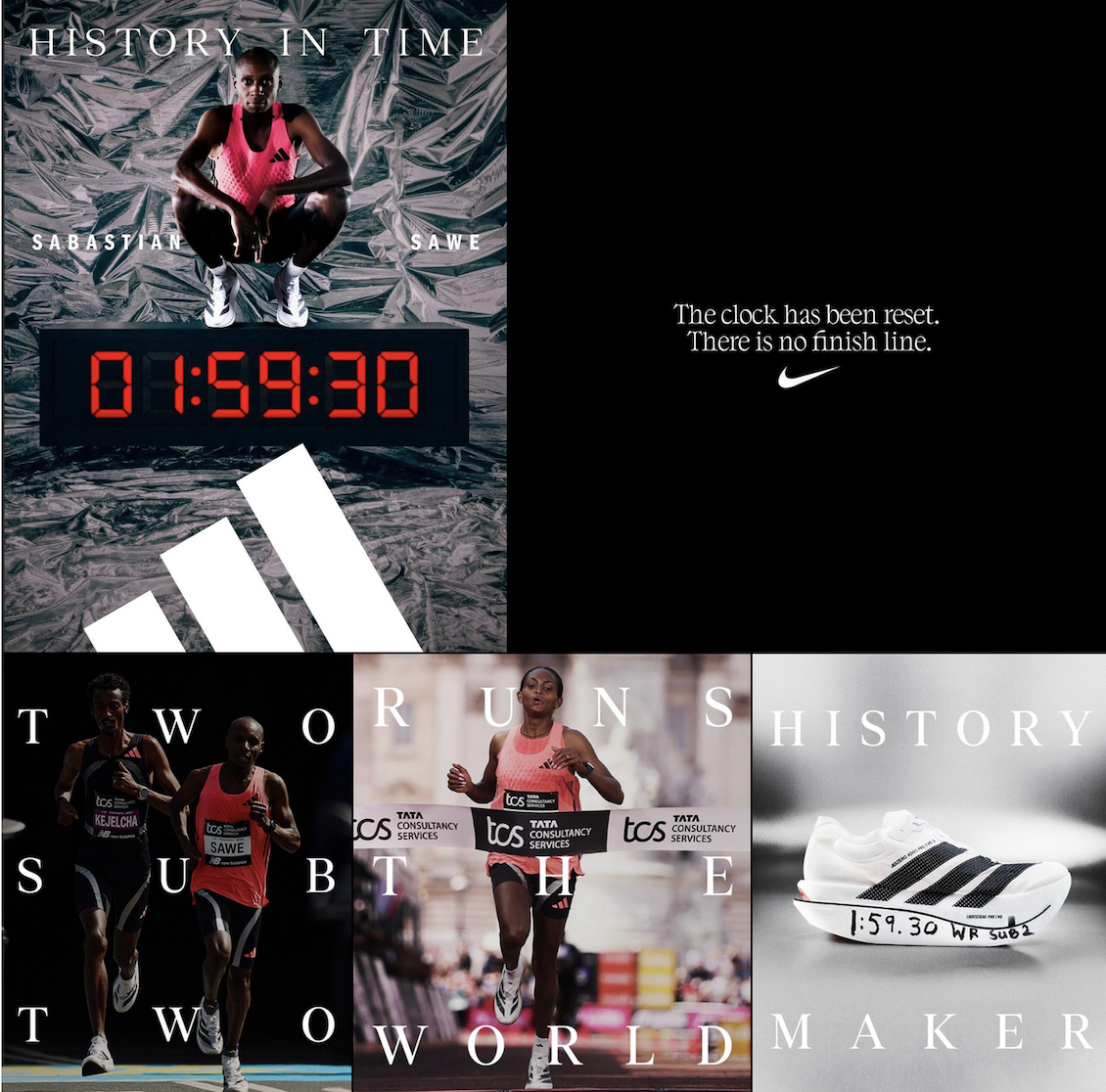
London Marathon Rewrites Human Possibility as Adidas Delivers the Sucker Punch Nike Spent a Decade Chasing 🏃♂️
📌 On Sunday 27th April, Sabastian Sawe became the first person to run 26.2 miles in under two hours in a sanctioned race, crossing the line in 1:59:30 at the London Marathon. Remarkably, second-place finisher Yomif Kejelcha also broke the barrier at 1:59:41 - meaning history was made twice in the same race. Both are adidas athletes. The achievement lands with particular commercial and cultural force given that Nike spent close to a decade pursuing this exact milestone through its "Breaking2" moonshot project, with Eliud Kipchoge coming agonisingly close in an unsanctioned 2019 attempt that fell outside record conditions. Adidas didn't just break the barrier - they broke it on Nike's idea.
Sabastian Sawe finished in 1:59:30 - the first sub-two-hour marathon in a sanctioned race
Yomif Kejelcha ran 1:59:41, making it the first time two runners have broken the barrier in the same race
Tigst Assefa, also an adidas athlete, continued her dominance in the women's field
Nike posted a public congratulation to Sawe on Instagram - a notable departure from standard competitor protocol
💡 This is one of the cleanest brand wins in recent sporting history. Nike conceived the dream, built the cultural mythology around it and handed it to a generation - then watched a rival claim the moment that mythology was always building toward. Adidas didn't need a campaign. The result was the campaign. For the London Marathon, hosting the first sanctioned sub-two on its course cements its status not just as a world-class event but as the stage where running history is made. Expect registration demand to surge accordingly. 🏅
Rough Trade at 50: How the Original Outsider Institution Turns an Anniversary Into a Cultural Argument 🎵
📌 Half a century after opening its doors in West London in 1976, Rough Trade remains one of the few music institutions that can claim to have shaped both the sound and the infrastructure of British independent culture. Born at the intersection of punk, reggae and DIY publishing, the label and record shop didn't simply sell music - it built an alternative distribution logic at a time when the mainstream had no interest in what it was carrying. To mark the anniversary, Rough Trade is taking over the Southbank Centre for a three-day festival spanning live performance, literature and film, a deliberate choice that reflects the breadth of what the brand has always stood for.
Rough Trade was founded in 1976 in Notting Hill, West London
Early catalogue helped launch acts including The Clash and The Smiths
50th anniversary festival takes place at the Southbank Centre, spanning music, literature and film
💡 In an era where independent music culture is increasingly absorbed, aggregated and algorithmically flattened, Rough Trade's longevity is a structural argument in itself. The decision to mark 50 years with a cross-disciplinary festival rather than a greatest-hits moment signals that the brand understands its own value - not as a catalogue, but as a curatorial philosophy. That's a harder thing to replicate than a streaming deal, and a more durable form of cultural authority. 🏴
Doechii and Lady Gaga Set the Cultural Table for The Devil Wears Prada 2 with 'Runway' 🎬
📌 Ahead of The Devil Wears Prada 2's release on 1st May, Lady Gaga and Doechii have unveiled 'Runway' - a music video directed by Parris Goebel that arrives as both promotional asset and cultural event in its own right. The pairing is deliberately loaded: Gaga's presence ties the sequel directly to the original film's fashion-and-power mythology, while Doechii's involvement signals an intentional reach into the current cultural moment. Goebel's direction - known for choreography-led visual storytelling with precision and attitude - ensures the video functions as standalone content, not just a trailer substitute.
'Runway' directed by Parris Goebel, released ahead of The Devil Wears Prada 2 on 1st May 2026
Lady Gaga styled by Chloe and Chenelle; Doechii styled by Sam Woolf
Video positions the sequel at the intersection of fashion, music and visual culture ahead of release
💡 This is franchise marketing operating at the level of cultural programming. Rather than leaning on nostalgia alone, the sequel is using music, choreography and two artists with distinct but complementary audiences to build anticipation across multiple taste communities simultaneously. For brands and studios watching, it's a reminder that the most effective entertainment marketing doesn't feel like marketing - it feels like content worth seeking out. 🎥
Paramount-Warner Bros. Discovery Reveals 38.5% Middle Eastern Ownership as Mega-Merger Takes Shape 🎬
📌 The scale of sovereign wealth involvement in the Paramount-Warner Bros. Discovery merger has come into sharper focus following an FCC filing that reveals Middle Eastern funds will hold 38.5% of equity in the combined entity. Saudi Arabia's Public Investment Fund takes a 15.1% stake, the UAE's sovereign wealth fund 12.8%, and the Qatar Investment Authority 10.6% - representing close to $24 billion in committed capital. Control, however, remains firmly with the Ellison family and RedBird Capital Partners, who retain 100% of voting shares with no board representation granted to any of the sovereign investors.
Saudi Arabia's PIF holds 15.1% equity; UAE sovereign wealth fund 12.8%; Qatar Investment Authority 10.6%
Combined Middle Eastern stake represents approximately $24 billion in investment
The Ellison family and RedBird retain sole ownership of Class A voting shares - no governance rights granted to external investors
Warner Bros. Discovery shareholders voted overwhelmingly in favour of the $111 billion deal
💡 The ownership structure reveals something important about how large-scale media consolidation is now being financed: sovereign capital provides the scale, while operational control remains tightly held by a small inner circle. For the industry, the deeper question isn't who owns the equity - it's what a combined Paramount-WBD, operating under intensified investor expectations and geopolitical scrutiny, will prioritise creatively and commercially once the dust settles. 🧠
Electronic Music Hits $15.1bn as IMS Business Report Confirms a Genre in Rude Health 🎧
📌 The annual IMS Electronic Music Business Report 2025/6, produced by MiDiA Research for IMS Ibiza, confirms the global electronic music industry has reached a record $15.1 billion in value - up 7% on 2024's already accelerated figure. Crucially, this growth is not being carried by a single revenue driver but distributed across streaming, publishing, merchandise and sponsorship, pointing to a more structurally resilient industry than at any previous point in its commercial history. At the same time, the report highlights how AI-powered music creation tools are rapidly reshaping the creator economy, while social platforms - particularly TikTok - continue to expand the genre's global fanbase at scale.
Global electronic music industry valued at $15.1bn in 2025, up 7% year-on-year (MiDiA Research / IMS)
Gen AI and stem separation tool revenues grew 651% between 2023 and 2025, reaching $333m with 63 million monthly active users
Ibiza club ticketing revenue reached €160m in 2025, continuing to grow despite a declining number of events per venue
Electronic music now accounts for 18% of all publicly announced music catalogue deals
💡 The $15.1bn figure matters less as a headline than as a structural signal - electronic music has moved from a culturally influential but commercially fragmented sector to one with diversified revenue, expanding global fanbases and growing investor appetite for its catalogues. The genre's scene-first identity, which for decades was seen as a commercial liability, is increasingly its most defensible asset: electronic music fans over-index significantly for time and money spent on music, and for the importance of real-world connection. In an industry increasingly shaped by algorithmic consumption and AI-generated content, that depth of community loyalty is genuinely scarce and genuinely valuable. 🎛️
Amazon Dismantles Wondery to Build Creator Ecosystems - and the Kelces Are Its Blueprint 🎙️
📌 When Amazon restructured its podcast arm Wondery in August 2025, the move looked like retreat. What it was actually doing was replacing an ad-supported network model with something structurally different: a Creator Services department built around the idea that the most valuable thing a podcast can generate isn't an ad impression, but a dedicated commercial world around it. The Kelce brothers - Jason and Travis, hosts of "New Heights" - are the model in practice, with a dedicated Amazon landing page selling merchandise, promoting Audible content, surfacing Prime documentaries and building live event programming around tentpole moments like the World Cup.
The Kelce brothers signed a podcasting deal with Wondery reported to be worth $100 million over three years
The "Kelce Clubhouse" on Amazon's website integrates merchandise, streaming content, branded promotions and live events
A "New Heights" live show is planned for June in Los Angeles around the World Cup, sponsored by Enterprise and Xfinity
Amazon's Creator Services department is focused exclusively on video podcasts
💡 The Wondery restructure is a significant structural bet: that the future of creator monetisation isn't advertising inventory but integrated commerce ecosystems, where audience loyalty is converted into purchasing behaviour across multiple touchpoints simultaneously. Amazon is uniquely placed to execute this - it owns the retail infrastructure, the streaming platform, the audio network and the events capability. What it's effectively doing is treating fandom as a supply chain problem, and the Kelces as proof of concept. For brands and media businesses watching, the question isn't whether this model works - it's who else has the infrastructure to replicate it. 🛒
The Sphere Rewrites the Live Music Economics Playbook as the World's Highest-Grossing Arena 🎡
📌 Opened in 2023 at a cost of $2.3 billion - nearly $1 billion over budget and years behind schedule - the Sphere in Las Vegas has defied its troubled origins to become the highest-grossing arena in the world. The formula that unlocked its commercial success is counterintuitive: the most technically advanced performance venue ever built has found its audience not through cutting-edge contemporary acts, but through legacy artists with deep catalogues and broadly familiar material. U2, the Eagles, Kenny Chesney, Backstreet Boys and Phish have all played to sold-out crowds, pairing nostalgic musical comfort with visual spectacle that the format has never been able to deliver before.
The Sphere was completed in 2023 at a cost of $2.3 billion, nearly $1 billion over its original budget
It is now the highest-grossing arena in the world
Residency acts have included U2, Eagles, Kenny Chesney, Backstreet Boys and Phish
The venue holds 17,600 fans per show
💡 The Sphere's success exposes something important about where premium live entertainment value actually sits: not in the novelty of the technology, but in the combination of emotional familiarity and sensory transformation. Audiences are paying to feel something they already know in a way they have never experienced before - and that's a remarkably powerful commercial proposition. No other venue can replicate this yet, and that exclusivity is the real product. 🏟️
Gamma's Larry Jackson Bets on Kanye West's Rehabilitation - and BULLY Suggests the Gamble Is Paying Off 🎤
📌 The commercial return of Kanye West has been orchestrated less by the artist himself than by Larry Jackson, founder and CEO of music and media company gamma., whose strategic involvement has quietly rebuilt the infrastructure around West's career following years of industry withdrawal. West's twelfth studio album BULLY debuted at number two on the Billboard chart and generated over $30 million in ticket sales from two sold-out Los Angeles shows - figures that would be remarkable for any artist, let alone one whose Adidas, Gap and Balenciaga contracts were all cancelled following antisemitic outbursts in 2022. Jackson's approach has centred on rebuilding credibility with platform gatekeepers first, securing playlist support from Spotify and Apple Music following private listening sessions before the album's wider release.
BULLY debuted at number two on the Billboard chart with 152,000 album equivalent units
Two sold-out Los Angeles shows grossed over $30 million in ticket sales
West's partnerships with Adidas, Gap and Balenciaga were all terminated following his 2022 antisemitic outbursts
Gamma. is not a traditional label but a music and media company, with Jackson operating as an active strategic adviser
💡 The BULLY campaign is a case study in how reputational rehabilitation is increasingly managed as a strategic communications problem rather than a purely creative one. Jackson has positioned himself as the credibility proxy - appearing in press, managing platform relationships and framing West's contrition to industry decision-makers - while West's own public statements have been limited to emailed releases. Whether the model holds depends less on the music than on how durable that institutional goodwill proves to be. 🧠
FIFA Moves to Regulate League Games Abroad as the Fight Over Football's Global Expansion Intensifies ⚽
📌 FIFA has proposed a new regulatory framework that would permit domestic leagues to stage one top-division fixture abroad per season, while limiting any single host country to a maximum of five such matches annually. The proposals arrive after both La Liga and Serie A had fixtures lined up for the United States and Australia respectively this season - only for both to be scrapped following objections from local football authorities, club supporters and, ultimately, UEFA. Under the new framework, any request to move a competitive fixture abroad would require sign-off from multiple stakeholders including national associations and confederations, with FIFA retaining a right of veto.
La Liga's Villarreal v Barcelona was lined up for Miami's Hard Rock Stadium; Serie A's Milan v Como was planned for Perth - both were cancelled
Under the proposed rules, host countries would be limited to staging a maximum of five international league matches per season
Domestic leagues would not be consulted if clubs pushed for games abroad against the league's wishes
The five-match cap per country reflects specific concerns about the US market being overwhelmed by European and South American clubs
💡 The real tension here isn't regulatory - it's commercial. Clubs, particularly those with American ownership, see overseas fixtures as direct access to high-yield ticket markets and global broadcast audiences without the structural commitment of relocation. FIFA's framework attempts to manage that appetite while protecting domestic league integrity and MLS's position in the US market. But any rule that sidelines leagues from the decision-making process while giving clubs and confederations the power to act is a governance structure with conflict built into its design. The fight over where football is played is ultimately a fight over who controls its most valuable commercial moments. ⚖️
Coachella's Pricing Squeeze Exposes the Structural Tension at the Heart of the Festival Model 🎡
📌 Coachella 2026 general admission tickets for the first weekend were priced at $649 - a 51% increase on the $429 fans paid in 2018 to see Beyoncé, The Weeknd and Eminem headline. The festival sold out quickly this year with Justin Bieber on the bill, but recent editions have struggled to move tickets at anywhere near the same pace, exposing a structural problem that goes beyond any single line-up decision. As Dan Runcie of Trapital has outlined, the artists capable of driving that kind of demand no longer need festivals - stadium tours generate far greater revenue, making festival guarantees increasingly unappealing. What made the Bieber Coachella moment particularly instructive was that it wasn't just an artist appearing at a festival - it was a household deploying Coachella as a platform, with Hailey Bieber's Rhode beauty brand simultaneously generating 68.4 million engagements through creator-led content that outperformed every on-ground brand activation at the event.
Coachella 2026 general admission tickets priced at $649 for Weekend 1, up 51% from $429 in 2018 (Trapital/Dan Runcie)
Justin Bieber's headline set was reportedly valued at $10 million, with $5.04 million in merchandise sales generated through his own brand Skylrk across Weekend 1
Rhode generated 68.4 million engagements across Coachella Weekend 1 - more than three times the next closest beauty brand
Live music revenue reached $30 billion in 2025, but much of that growth has been driven by ticket price increases rather than volume (MiDiA Research/IMS)
💡 Bieber's Coachella appearance crystallises the festival dilemma perfectly. He sold out the event, but arrived having already restructured his entire business model around ownership, distribution and direct monetisation - meaning Coachella needed him far more than he needed Coachella. And while he performed, Rhode was winning the brand conversation off-site entirely through creator distribution. Together, the Biebers treated Coachella not as a destination but as a launchpad - a single node in a self-contained commercial ecosystem spanning music, beauty, content and live events. Festivals are increasingly paying premium guarantees to artists who operate exactly this way, absorbing the cost of star power that has become structurally more valuable elsewhere. 🎟️
Why Kith Built a Padel Court and Dior Is Opening Spas 🏛️
📌 A structural shift is under way in how the world's most commercially astute fashion and lifestyle brands are choosing to compete. Dior is expanding into branded spas. Lululemon is opening yoga studios. Alo Yoga has launched a subscription wellness club. Kith opened a padel court in New York. Tecovas serves free drinks across all 50 of its stores with no purchase required. These are not wellness companies diversifying - they are fashion brands that have recognised a fundamental truth about where loyalty is actually built: not at the point of sale, but in the time spent inside the brand world between purchases. McKinsey research confirms that being part of a like-minded community is the number one driver of emotional connection with a brand - ahead of product quality and ahead of price.
89% of consumers identify community belonging as the primary driver of emotional brand connection, ahead of product and price (McKinsey)
84% of US consumers now cite wellness as a top personal priority, with 51% saying they would maintain or increase that spending even if their income fell
Nearly one third of consumers discover a brand for the first time through community interaction - not advertising, influencer content or runway exposure
💡 If community is the primary driver of brand loyalty, then the brands investing in physical and experiential infrastructure - spaces that give people a reason to return beyond a transaction - are not spending on amenities. They are building retention systems. For independent brands and emerging designers, the corollary is equally important: the direct, specific community connection that large brands are spending millions to manufacture is something smaller brands often already possess. The competitive advantage in fashion right now is not scale - it is belonging, and belonging cannot be bought at the speed money would suggest. 🧠
Regional News Page Views Collapse 28% as Platform Dependency Takes Its Toll 📉
📌 The latest Ipsos figures for the UK regional press make for stark reading: page views across regional online newsbrands fell 28% year-on-year in March 2026, dropping from 795 million to 566 million in a single twelve-month period. The headline figure masks a more complex picture - overall unique audiences fell by just 2% to 33.6 million, suggesting the crisis is less about losing readers entirely and more about losing the repeated visits that sustain advertising revenue. The divergence between audience stability and page view collapse points directly to the structural consequences of platform dependency: as X and Facebook have dramatically reduced outbound referral traffic, the passive discovery loop that once drove return visits has broken down.
Total regional newsbrand page views fell from 795 million in March 2025 to 566 million in March 2026, a 28% decline (Ipsos)
The Manchester Evening News saw page views fall 44%; Birmingham Live dropped 45%; Leeds Live fell 74%
Overall unique audiences declined just 2% year-on-year to 33.6 million
The Express & Star bucked the trend with page views up 81% and average user engagement of nine minutes per visit
💡 Publishers are not losing readers - they are losing the platform-driven behaviour that brought those readers back repeatedly without the publisher having to earn it each time. The titles posting growth tend to share a common characteristic: deep local specificity and engagement metrics that suggest readers are actively choosing to return rather than being delivered by an algorithm. In a post-referral media landscape, that distinction - between an audience that is owned and one that is borrowed - is becoming the difference between viability and decline. 📰
Meta Launches Two Products to Recover the Social Behaviours Its Own Platforms Eroded 📱
📌 Two product announcements from Meta this week reveal a company in active pursuit of social dynamics it has spent years inadvertently destroying. Instagram is testing Instants - a standalone app for disappearing, unedited photo sharing with no camera roll uploads and no filters, currently live in Spain and Italy - in a direct acknowledgement that the platform's shift toward curated content, advertising and influencer culture has hollowed out the casual peer-to-peer sharing behaviour it was originally built on. Simultaneously, Threads has launched Live Chats, a real-time public group chat feature designed around cultural moments such as live sport and album drops, debuting with the NBA Playoffs.
Instagram's Instants app is currently being tested in Spain and Italy, allowing single-tap photo capture with no editing, no uploads and disappearing content viewable once within 24 hours
Threads Live Chats launched with the NBAThreads Community for the NBA Playoffs, featuring real-time polls, live scores and typing indicators
Instagram's pivot toward ads and influencer content has been so extensive that Meta now requires a separate product to recover the casual sharing behaviour its main app originally built its user base on
💡 Meta has optimised Instagram so aggressively for monetisation that it has had to build an entirely separate app to get back the social behaviour that made the platform valuable in the first place. And on Threads, the Live Chats play is a straightforward attempt to inherit Twitter's most commercially useful function: the real-time public conversation around live events. Whether either product succeeds matters less than what both reveal - that the dominant platforms of the last decade are now spending significant resource trying to recover what they gave away in pursuit of scale. 🧠
Axel Springer Paid £575m for the Telegraph Without Due Diligence - and the Numbers Explain Why That Matters 📰
📌 Axel Springer's £575m acquisition of the Telegraph titles was completed without the standard due diligence process, with CEO Mathias Döpfner choosing speed over scrutiny to secure a media asset he had been pursuing for two decades. Industry analysts had consistently valued the Telegraph at around £350m based on the underlying economics, and a closer look at the subscriber base reveals a more complex picture than the headline figures suggest. While total subscribers reached 1.086 million in 2024, 41% of that base at the last published breakdown were on very low or free rates, and print revenues - still accounting for 61% of total publishing income - continue to decline across every category.
Axel Springer paid £575m for the Telegraph, against an analyst consensus valuation of approximately £350m
Print sales, subscriptions and advertising account for 61% of Telegraph publishing revenues, with all three in decline
Digital subscription revenue grew 18% to £81m in 2024, but the Telegraph has been offering discounts of up to 89% on annual subscriptions
41% of the 1.035 million subscriber base at the last published breakdown were on very low or free rates
💡 The Telegraph deal is less a straightforward acquisition and more a statement of long-term strategic intent. But skipping due diligence on a print-heavy business in structural decline, at a price that requires a successful transition to a profitable digital subscription model, is a significant bet. The subscriber inflation achieved through discounting and low-value add-on titles will need to be replaced by genuinely monetisable digital readers - and that transition, against a backdrop of AI-era advertising pressure and a collapsing print base, is far from guaranteed. 🧠
OpenAI Turns on Cost-Per-Click Ads Inside ChatGPT - and the Advertising Industry's Next Battleground Takes Shape 🤖
📌 OpenAI has activated cost-per-click advertising inside ChatGPT, allowing marketers to pay when someone clicks on an ad rather than per thousand impressions served - with bids currently set between $3 and $5 per click. The move represents a significant step in OpenAI's accelerating push toward advertising as a primary revenue stream, and follows the quiet launch of its own ads manager. Simultaneously, OpenAI is recruiting its first advertising marketing science leader, signalling that the infrastructure being built is intended to be permanent and scalable rather than experimental.
OpenAI has activated cost-per-click ads inside ChatGPT with bids set between $3 and $5 per click (Digiday)
OpenAI has quietly launched its own ads manager and is hiring its first advertising marketing science leader
OpenAI's internal projections forecast $2.4 billion in advertising revenue in 2026, rising to $102 billion by 2030
💡 The CPC model is the more strategically significant development here. Impression-based advertising in an AI interface is relatively easy to dismiss as experimental inventory - but cost-per-click creates a performance accountability loop that connects ChatGPT directly to the outcome-driven budgets that dominate modern media planning. If OpenAI can demonstrate that ads served inside a conversational AI context drive clicks and conversions at competitive rates, it doesn't just add a new ad format - it repositions the entire intent-based advertising market that Google has owned for two decades. That is the prize OpenAI is now openly pursuing. 🧠
Social Media Executives Deny Platforms Are Addictive to Children - as UK Age Restrictions Move Closer to Law 📱
📌 Representatives from Meta, Roblox and TikTok appeared before the UK's cross-party education select committee this week, denying their platforms are inherently addictive to children and describing a potential under-16 access ban as unenforceable - a position that sits in increasingly uncomfortable tension with the political direction of travel. The House of Lords has already voted 316-165 in favour of an outright ban, the government's consultation is weeks from closing, and Australia has already legislated. Greece has announced restrictions for under-15s. France and Spain are moving.
The House of Lords voted 316-165 in favour of an outright social media ban for under-16s
Meta, Roblox and TikTok representatives told the education select committee a ban would be "unenforceable"
Australia's legislation is already in force and is the primary reference model for UK policymakers
Functionality restrictions, curfews and full access bans are all under active consideration
💡 The platform executives' testimony before MPs is less a legal argument than a delay tactic, and an increasingly transparent one. Every youth marketing strategy built on Instagram, TikTok and YouTube reach to 13-15 year olds faces structural disruption - not gradually, but through legislation with a hard compliance date. The brands that treat this as a legal housekeeping exercise will cede ground to those already investing in owned channels, gaming environments, school and community partnerships, and CRM infrastructure that doesn't depend on a social feed. ⚖️
Yung Lean and Romain Gavras Demonstrate What Creative Direction as Media Strategy Actually Looks Like 🎬
📌 Swedish artist Yung Lean released new music this week inside a short film directed by Romain Gavras - the filmmaker behind some of the most culturally significant music visuals of the last decade. Set in 2034 and featuring Lean as an adult returning to primary school, the film exists as a standalone cultural object rather than a promotional asset - no press rollout, no paid media, no traditional campaign infrastructure. The release is characteristic of the broader Drain Gang creative ecosystem, which has spent years building a shared universe around its music rather than competing for algorithmic attention through conventional release mechanics.
The film was directed by Romain Gavras, whose previous work includes visuals for Jay-Z, M.I.A. and Kanye West
No traditional press rollout, paid media or promotional infrastructure accompanied the release
The Drain Gang ecosystem has built one of underground music's most devoted and self-sustaining fan communities through consistent world-building over conventional promotional strategy
💡 The Gavras collaboration is a precise illustration of something the broader marketing industry talks about but rarely executes: the idea that the conditions under which something is made are as commercially significant as the distribution budget behind it. Gavras wasn't hired to make a music video - he was brought in to establish a frame of reference before a single viewer watches a frame. The director is the media buy. The concept is the targeting. For brands spending significant resource on reach while under-investing in the creative authority that makes reach worthwhile, the Drain Gang model is an uncomfortable mirror. 🎥
The NFL Draft Draws 13.2 Million Viewers in Pittsburgh - Reaffirming Live Sport's Irreplaceable Media Value 🏈
📌 The 2026 NFL Draft, held in Pittsburgh across 23-25 April, averaged 13.2 million viewers across television and digital platforms for its first round — making it the third-most watched Draft on record, behind only the pandemic-era 2020 edition and last year's figure of 13.6 million. In a media landscape defined by fragmentation, declining linear audiences and platform referral collapse, the Draft's sustained viewership is a significant data point. It is one of a shrinking number of live cultural events capable of commanding mass simultaneous attention without a marquee sporting contest at its centre - the event itself, the anticipation, the narrative and the stakes are sufficient to drive appointment viewing at scale.
The 2026 NFL Draft Round 1 averaged 13.2 million viewers across TV and digital, the third-most watched first round on record (ESPN)
The Draft was held in Pittsburgh and broadcast across ESPN, ABC and the ESPN App
Fernando Mendoza, Heisman Trophy winner and national championship quarterback from Indiana, was selected first overall by the Las Vegas Raiders
💡 The NFL Draft's sustained viewership numbers matter beyond football. They are evidence that live, unscripted moments of genuine consequence retain a gravitational pull that no amount of on-demand content can replicate. For brands and broadcasters, the Draft represents something increasingly scarce: a predictable window of mass cultural attention that arrives on a known date, with a known audience, and built-in emotional stakes that no campaign can manufacture. As the broader media landscape fragments further, the premium on these moments will only increase. 📺
NWSL Expansion Fee Hits Record $205M as Columbus Award Signals Accelerating Commercial Momentum ⚽
📌 The National Women's Soccer League has awarded its 18th franchise to Columbus, Ohio, under the majority ownership group behind MLS side Columbus Crew, with the expansion fee set at a record $205 million. The figure represents an 86% increase on the $110 million paid by Denver Summit just over a year ago - a rate of valuation growth that reflects both the NWSL's rapidly expanding commercial footprint and the strategic logic of co-locating women's and men's franchises under unified ownership. Columbus will debut alongside Atlanta in 2028. In Seattle, the league's longest-serving player, Jess Fishlock, announced she will retire at the end of the current season.
Columbus NWSL expansion fee set at a record $205 million - up 86% from Denver Summit's $110 million fee paid just over a year ago
Columbus joins as the 18th NWSL franchise, debuting alongside Atlanta in 2028
Jess Fishlock will retire at the end of the 2026 season as the NWSL's longest-serving player, having played in Seattle since 2013
💡 The Columbus fee is the clearest financial signal yet that the NWSL has crossed from emerging property to premium asset. An 86% increase in expansion fees in just over twelve months is not gradual appreciation - it is a market rerating. For brands still treating women's football as a values-led adjacency rather than a core commercial platform, the Columbus valuation is a direct challenge to that positioning. The window for early-mover advantage is not closing - it has largely closed. 🏆
Swedish Publishers Move Toward Legal Action Against Meta Over Scam Ad Revenue 📰
📌 Swedish publishing organisation Utgivarna has instructed a law firm to explore civil litigation against Meta, following the tech giant's admission that it has generated billions in revenue from scam advertisements. The publishers' argument centres on the specific harm caused to media brands and individual journalists whose names, images and editorial credibility are being appropriated without consent by criminal actors purchasing scam ads through Meta's platforms.
Utgivarna, the Swedish publishing organisation, has hired a law firm to consider filing a civil lawsuit against Meta over scam ad revenues
Meta has admitted earning billions in revenue from scam advertisements
The publishers argue that Swedish media brands and journalists are being exploited without consent in criminal scam ad campaigns sold through Meta's platforms (Dagens Nyheter)
💡 The significance of this case extends well beyond Sweden. If Utgivarna proceeds and establishes legal standing, it creates a potential template for publishers across Europe and beyond to pursue civil claims against platforms that have profited from the unauthorised commercial exploitation of journalistic credibility. For the broader media and brand industry, it raises a sharper question: if scam actors are systematically purchasing platform ads using trusted media identities, what does that reveal about the due diligence infrastructure that sits between an advertiser and an impression? ⚖️
Spotify and the New York Liberty Signal Where Music and Sport's Commercial Convergence Is Heading 🎧🏀
📌 Spotify has announced a multi-year partnership with the WNBA's New York Liberty, making it the platform's first official team partnership in the United States. The deal positions Spotify as the Liberty's Official Music Partner across Barclays Center, covering in-venue branding, digital touchpoints, court-level signage and a season-long content programme built around the intersection of music and basketball. The partnership follows Spotify's high-profile FC Barcelona deal, which has become a template for how the platform integrates music culture into live sport.
Spotify becomes the Official Music Partner of the New York Liberty in its first official US team partnership
The deal includes in-venue branding at Barclays Center, digital touchpoints, sponsored events and a co-created official team playlist refreshed throughout the season
Spotify's FC Barcelona partnership, launched in 2022, established the model combining naming rights, artist integrations and cultural programming
💡 The Liberty partnership is strategically deliberate on multiple levels. The WNBA is one of the fastest-growing sports properties in the world right now, and New York is its highest-profile franchise - making this Spotify's most visible entry point into US live sport at precisely the moment the league's commercial credibility is peaking. For brands assessing where women's sport investment generates the strongest return, Spotify's move is another signal that the window for early-mover advantage is narrowing fast. 🏀

🎙️ The Rise and Fall of Madchester - BBC Radio 6 Music, presented by Steve Lamacq and Alison Bell
An eight-part series tracing the seismic cultural and commercial arc of the Madchester scene - from the industrial decline that made it possible, through the Factory Records era, The Haçienda and the collision of indie guitar and acid house, to the movement's dramatic unravelling.
✅ Worth Your Time Because: Madchester is one of the most instructive case studies in how cultural movements are built, commercialised and destroyed - and this series treats it as exactly that, examining the social and political context alongside the music. At a moment when the industry is grappling with sovereign wealth investment, catalogue acquisition and the tension between creative independence and commercial scale, the Factory Records story - creative freedom, financial chaos, extraordinary cultural output - is not just history. It is a live argument about what happens when a scene runs on belief rather than infrastructure. Hosted by Steve Lamacq and Alison Bell, it is documentary, cultural analysis and cautionary tale in equal measure.

👀 Things to Be Aware Of This Week
Monday 4 May – Sunday 10 May 2026
🎵 The Great Escape approaches (13-16 May) - the 20th anniversary edition of the UK's most important new music festival features 450+ artists across 30+ venues, with Peaches and Kingfishr headlining spotlight shows. The Kooks have withdrawn due to injury and will be replaced by Quebec duo Angine de Poitrine on opening night. If you work in music, talent or brand partnership, this is the week to be paying attention to what's building.
🏀 NBA Playoffs continue - the post-season is in full swing and with it, Threads Live Chats launching specifically around the NBA as Meta's first real-time community test case. Worth watching how the platform handles the cultural moment it's explicitly been designed for.
🎬 The Devil Wears Prada 2 released on 1st May - how the film performs commercially in its opening weekend will be a test of whether franchise marketing built around music and creator content actually converts at the box office.
⚽ Premier League title race reaches its conclusion - with the season entering its final weeks, commercial and media intensity around the run-in is at its peak.
🌐 Ibiza club season opening parties - the Balearic season moves into its first full week of programming through May, setting the commercial and cultural tone for European summer nightlife.
🏛️ Met Gala (5 May, New York) - the most commercially loaded night in fashion's calendar. Every brand partnership, red carpet placement and cultural moment generated tonight will be dissected by marketing teams for weeks. Watch which brands show up in the conversation versus those who paid to be in the room.

About the Author: Vicky Elmer (Beercock) is a brand communications and marketing leader with 20+ years' experience building culturally relevant, commercially effective brands across drinks, music, fashion, sport and entertainment. Her work and selected projects can be found at vickyelmer.work. She is currently open to both permanent and contract opportunities.