The ES-355 and the Innovator What Laufey's ascent tells us about where music is actually going
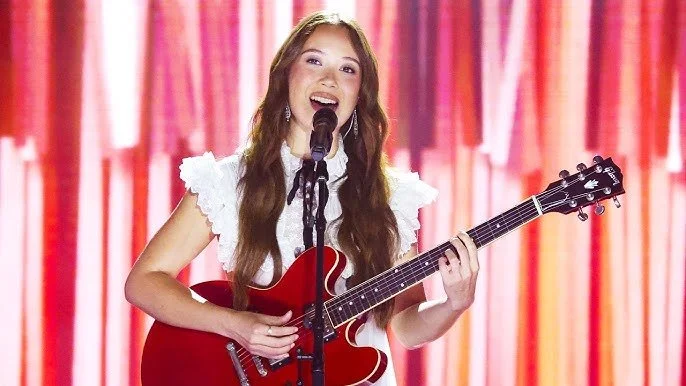
Laufey walked onto the Billboard Women in Music stage on April 29th with a cherry red Gibson ES-355 and nothing else. No band. No orchestra. No backing track. Just her, a semi-hollow electric with six decades of jazz and blues lineage behind it, and complete command of the room.
Then she accepted the Innovator Award, presented by Brandi Carlile. Every bit of it earned.
The word innovator gets thrown around carelessly in music. It's become industry shorthand for "doing well" or "doing something slightly different." But Laufey's case is worth interrogating properly, because what she has actually pulled off - sonically, commercially, culturally - is genuinely rare. She hasn't just found a lane. She's built an entirely new road and somehow convinced a mainstream audience to follow her down it.
The Sound First
Start with the music, because everything else flows from it.
Laufey's core innovation is harmonic. Jazz harmony - extended chords, flat sevenths, major sevenths, the kind of voicings that feel emotionally complex without being dissonant - has always existed in tension with pop's preference for clean triadic resolution. The reason jazz never fully crossed over isn't a mystery: the harmony asks more of the listener. It doesn't land the same way. It lingers, unresolved, in places pop doesn't usually go.
What Laufey figured out - and this is the thing - is that the emotional register of jazz harmony maps perfectly onto confessional songwriting. The unresolved chord and the unresolved feeling are the same thing. She didn't simplify the harmony to make it pop-accessible. She found the emotional context where complex harmony felt necessary, even inevitable. That's not a production trick. That's compositional intelligence.
Her classical training runs underneath all of it. She studied piano and cello seriously, trained at the Central Conservatory of Music in Beijing, then Berklee. That background shows up not in the obvious ways - not just in the orchestral arrangements - but in her understanding of voice leading, of how melodies move through harmony, of restraint. Classical musicians learn early that less is more information. Every note is a decision. That discipline is all over her records.
What A Matter of Time Actually Does
Her third album is where the synthesis becomes undeniable.
Bringing in Aaron Dessner as co-producer was the right call and an underreported one. Dessner's work with Taylor Swift - particularly folklore and evermore - showed he understood how to build emotional atmosphere without sonic maximalism. Sparse arrangements. Space in the mix. Production that serves the song's feeling rather than announcing itself. That sensibility is exactly what Laufey needed to push further without losing the intimacy that built her audience.
The result is an album that sits in genuinely unusual sonic territory. The jazz harmony is still there, but the production palette has expanded — there are textures and tones on A Matter of Time that have no obvious precedent in either jazz or mainstream pop. Bossa nova rhythm feel underneath arrangements that could exist in a concert hall. A vocal delivery that's conversational one moment and operatically controlled the next. An album that debuted at #4 on the Billboard 200 - the highest-charting jazz record in that position since 2018 - with 99,000 equivalent album units in its first week. Those numbers shouldn't be possible for this kind of music. She made them possible.
The vinyl strategy is worth noting too. The album launched across eight vinyl variants and three CD editions, each with a signed option. That's not just a collector play - it reflects a genuine understanding of how her audience relates to music as a physical, intentional experience. It's a release strategy built around depth of engagement rather than streaming volume. The fact that it also topped the Vinyl Albums chart is not a coincidence.
The Coachella Moment as Thesis Statement
Before the album came out, there was Coachella.
The LA Philharmonic, conducted by Gustavo Dudamel, opened with Wagner's Ride of the Valkyries - the first set billed solely to an orchestra in the festival's 26-year history. Then Laufey walked out and performed with them.
Think about what that image is. Coachella is the commercial apex of festival culture, built on pop, hip-hop, and electronic music. The LA Phil is one of the great orchestras in the world. These two things have never shared a stage in this context. And the artist bridging them is a 25-year-old Icelandic-Chinese woman who started posting jazz standards to TikTok during a pandemic.
That moment worked not because it was a clever juxtaposition, but because Laufey's music had already earned it. The orchestral arrangement didn't feel like a stunt because her records have always been orchestrally conceived. She wasn't borrowing the LA Phil's credibility. She was completing a thought she'd been developing across three albums.
"I've never felt more whole in my life," she said afterward. "I never had to give up any part of myself to achieve the goals that I wanted."
That's the innovation, stated plainly. The conventional wisdom in music has always been that crossover requires compromise - that you soften the jazz, dilute the classical, round off the edges to meet the mainstream where it is. Laufey didn't do that. She held every influence intact and moved the audience to her, rather than moving herself to the audience.
The ES-355 on an Empty Stage
Back to that image at the Women in Music Awards.
The Gibson ES-355 debuted in 1958 as the top of Gibson's semi-hollow range - gold hardware, block inlays, ebony fingerboard, cherry red finish. B.B. King played one. Chuck Berry played one. It has seventy years of jazz and blues history running through its construction.
Laufey played it solo. No accompaniment. One instrument, centre stage.
An artist who has performed with three different philharmonic orchestras chose to stand alone with a single guitar. An artist who sells out arenas - Madison Square Garden, the Royal Albert Hall, Crypto.com Arena - stripped everything back to its most essential form. Seven billion global streams, two Grammy awards, an Icelandic knighthood, and she walked out with one guitar and played it like that was always the point.
It was.
The solo performance is the artistic statement in its purest form. It says: the music is enough. I am enough. The innovation doesn't require production to justify it. And for an artist whose entire career has been about refusing to compromise her influences in pursuit of accessibility, playing alone on that stage is entirely consistent. It's the through-line made visible.
Why This Matters Beyond Laufey
She has demonstrated something the industry has been reluctant to accept: that audiences are more sophisticated than they're given credit for. That complex harmony, genuine musicianship, and emotional intelligence are not obstacles to commercial success. That the mainstream can move toward the music, rather than the other way around.
Nearly 7 billion global streams. The biggest jazz LP debut in Spotify history. An independent deal with AWAL that let her retain ownership of her work, struck after turning down a multimillion-dollar major label bidding war at 25.
The Innovator Award is accurate. But the innovation isn't a genre experiment or a marketing strategy. It's a proof of concept - that music built on genuine artistic conviction, held intact without compromise, can find an audience at the largest possible scale.
The cherry red ES-355, played alone, centre stage. That's the whole argument.