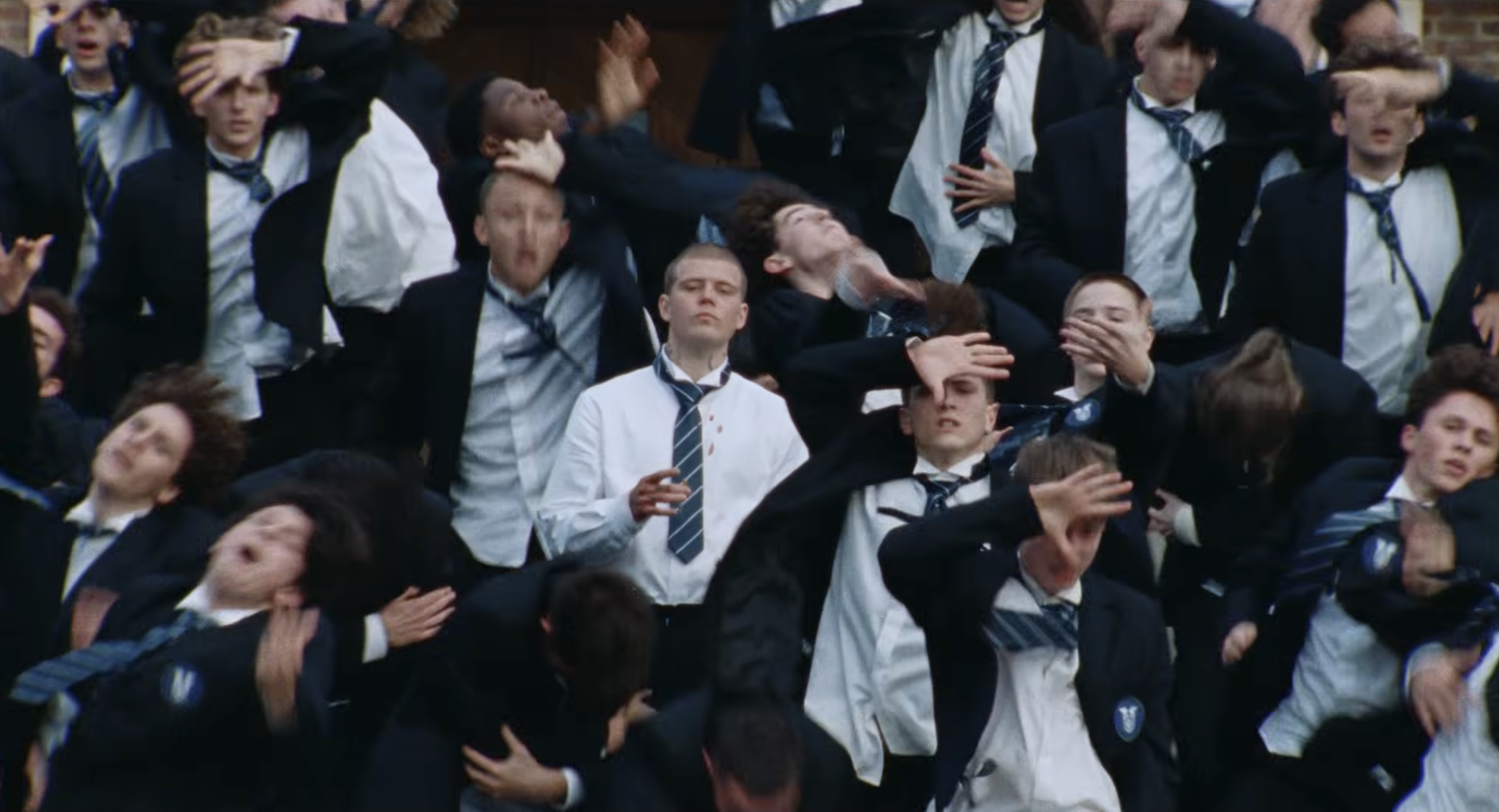
This week, Yung Lean released new music inside a short film set in 2034, directed by Romain Gavras. No press run. No rollout strategy. No paid amplification. Just a filmmaker with serious cultural authority, a concept sharp enough to travel on its own, and an audience conditioned to reward exactly that kind of respect.
Gavras is not an obvious choice for the uninitiated. But for anyone paying attention to where creative ambition and subcultural credibility intersect, the pairing is the entire message. His body of work - from M.I.A.'s "Born Free" to Jay-Z and Kanye's "No Church in the Wild" - carries a distinct visual intelligence. When he attaches his name to something, it arrives pre-loaded with meaning. That's not a media placement. That's a brand signal.
The film itself is a deliberate provocation: Lean, as an adult, returned to primary school in the year 2034. Tailored chaos. Enough conceptual strangeness to generate genuine conversation - the kind that doesn't require a boost budget because the image does the work. People screenshot it, share it, argue about what it means. That's earned distribution, built entirely at the creative stage.
"The director is the media buy. The concept is the targeting. The culture does the rest."
This is the shift that senior marketing teams are still underestimating. The conversation about attention has been dominated by platform strategy, influencer tiers, and optimisation. All of it downstream of a more fundamental decision: what are you actually making, and who are you making it with?
Lean's wider approach - the Drain Gang universe, the arena shows, the concert films - models what a coherent creative brand looks like in practice. Every release expands a shared world rather than competing for the same depleting pool of attention. The fanbase doesn't consume the output. It curates it, archives it, and evangelises it. That's not an algorithm outcome. It's the result of years of creative intentionality.
The marketing industry has spent a decade optimising for reach. The brands pulling ahead right now are the ones optimising for the conditions that make things worth reaching people with. Who you collaborate with creatively carries as much strategic weight as where you place the result.
If you pulled the paid support tomorrow, would anyone share this?
Who are we making things with - and what does that signal before anyone watches a frame?
Are we building assets, or are we building a world?
Creative direction has always mattered. What's changed is that it's now doing the job that media spend used to do. The brands and artists who understand that earliest will have the most durable advantage.
Lean and Gavras didn't make a music video. They made something people wanted to be seen talking about. There's a significant difference - and a significant lesson in it.