
Welcome to the next edition of On The Record, thoughtful analysis on culture, entertainment, tech, fashion, music, sport, and brands. Here’s a round-up of key conversations and campaigns that caught my attention this week.
Editor’s Summary
This week surfaces a consistent tension between authenticity and scale - and the growing cost of getting that balance wrong. Gap’s $1bn profit recovery demonstrates what sustained, culturally grounded collaboration can deliver when organisations commit to a strategy long enough for it to compound, while Allbirds’ pivot to AI infrastructure illustrates what happens when a brand mistakes capital market enthusiasm for commercial transformation. The SheerLuxe AI avatar backlash and the Coachella phone moment sit in the same register: audiences are increasingly fluent at detecting when an experience or a presence has been engineered rather than earned, and the reputational consequences are arriving faster than most organisations are equipped to manage. Across platform strategy, the EU’s move on Google search data and Spotify’s integration into the independent venue ecosystem both point toward a structural redistribution of discovery power, where the question of who controls the first moment of attention is becoming as commercially significant as the content itself. Meanwhile, women’s sport continues its acceleration - not as an emerging category but as a commercially mature one, with WNBA Draft data and parliamentary recommendations on broadcasting both signalling that the infrastructure around it is finally catching up to the audience that was always there.

Women’s Football Broadcasting Restrictions Face Parliamentary Challenge 📺
📌 A parliamentary committee has recommended removing the longstanding restriction on broadcasting women’s football during the 3pm Saturday slot, citing evidence that live coverage of women’s sport directly increases participation among girls. The “Game On” report frames the change not as a commercial question but as a structural one — broadcasting access as an instrument of social impact. The current blackout, which applies to both the men’s and women’s game, is rooted in legislation over 50 years old and was designed to protect in-person attendances at a time when the sporting landscape looked nothing like it does today.
– 3pm Saturday broadcasting blackout applies to both men’s and women’s football under current UK legislation
– Parliamentary committee recommends lifting restrictions as part of broader “Game On” report on sport participation
– Evidence cited shows girls are more likely to feel inspired and motivated to be active when women’s sport is broadcast
💡 The 3pm blackout was built around a men’s football economy that no longer exists in its original form, and applying it to the women’s game is increasingly difficult to justify on either commercial or cultural grounds. If visibility drives participation, then restricting broadcast access is not protecting the sport - it is limiting its reach at precisely the moment women’s football has the momentum to capitalise on it. The deeper question is whether legislation designed to serve a mid-20th century attendance model should be allowed to constrain a 21st-century growth category. 📺
Gap’s $1bn Profit Proves Collaboration Is a Brand Strategy, Not a Marketing Tactic 🤝
📌 Gap’s financial turnaround — from a $202m loss in 2023 to $844m profit in 2025 — is one of the more instructive brand recovery stories in recent memory, built not on product reinvention or store redesign but on a disciplined, sustained collaboration strategy executed at unusual pace and scale. Under CEO Richard Dickson, appointed in 2023, the brand executed 14+ partnerships across two years — spanning Sandy Liang, Cult Gaia, Madhappy, Palace, Béis, LoveShackFancy and Katseye, among others — each targeting a distinct cultural niche and each selling out. The approach was less about individual drops and more about accumulating credibility through association, using brands and talent that consumers already trusted to signal that Gap was worth caring about again.
– Gap reported a $202m loss in 2023; profits reached $502m in 2024 and $844m in 2025
– “Better in Denim” campaign with Katseye generated 400 million views and 8 billion impressions
– Seven consecutive quarters of same-store sales growth and highest gross margins in 25 years
💡 What Gap actually built was a permission structure — each collaboration functioning as a cultural endorsement from a brand or talent whose audience was being invited in, not sold to. The model only worked because it was committed to over time rather than tested and abandoned after one cycle, which is where most legacy brand revival attempts fail. For strategists, the lesson is less about which partners you choose and more about whether your organisation has the patience and executive conviction to let a compounding strategy compound. 🧠
76% of High-Performing Women Receive Negative Manager Feedback — Compared to Just 2% of Men 📊
📌 Analysis of performance reviews across more than 23,000 employees at over 250 organisations reveals that around 76% of high-performing women receive negative feedback from their managers, compared to just 2% of high-performing men. The data, collected by workplace language platform Textio, points to a consistent pattern of unconscious bias in how female performance is evaluated — with feedback disproportionately focused on personality traits such as likeability and collaborative disposition rather than output, impact or professional contribution. For organisations investing in talent retention, the commercial implication is direct: high-performing women receiving personality-led feedback rather than substantive development guidance are precisely the people most likely to leave.
– 76% of high-performing women receive negative manager feedback vs 2% of high-performing men (Textio)
– Data drawn from performance review analysis across 23,000+ employees and 250+ organisations
– Feedback patterns show women consistently evaluated on personality rather than professional contribution
💡 The retention risk here is straightforward - high performers leave when they stop seeing a pathway forward, and feedback anchored in likeability rather than development provides no such pathway. But the broader structural issue is that performance review language shapes promotion decisions, pay progression and succession planning, meaning bias at the feedback stage compounds quietly over time into representation gaps at senior levels. Organisations that treat this as a communication skills problem are missing the point: it is a commercial and structural one. 📉
SheerLuxe’s AI Avatar Strategy Sparks Backlash Over Body Image and Editorial Integrity 🤖
📌 SheerLuxe has introduced four AI avatars to generate behind-the-scenes and lifestyle content — sharing what is in their make-up bags, what they wore at the weekend, what products they recommend — in a move that has drawn sharp criticism from former fashion journalists and readers alike. The avatars have been described as uniformly slim and model-proportioned, prompting concern that the platform is reinforcing unattainable body ideals at a time when the wider media industry has invested significantly in representation and diversity. For a brand built on the trust of a loyal, predominantly female readership, the decision to replace human editorial voices with AI personas raises questions that go beyond aesthetics — touching on credibility, commercial transparency and what audiences are actually buying into when they consume lifestyle content.
– SheerLuxe launched four AI avatars to produce editorial and lifestyle content across its platforms
– Avatars have been criticised for presenting uniformly slim, model-proportioned body types
– Backlash centred on the replacement of real editorial voices with synthetic personas recommending real products
💡 The commercial logic of AI avatars - lower cost, always available, infinitely scalable - is straightforward enough, but the trust logic is far more fragile. Lifestyle media has always traded on the implicit promise that a real person tried the product, wore the dress or lived the experience. When that person is synthetic, the recommendation becomes advertising by another name, and audiences who feel misled rarely return quietly. SheerLuxe built its audience on intimacy and relatability - deploying AI avatars that look nothing like that audience is not an evolution of the brand, it is a contradiction of it. 📉
Nike Pulls Boston Marathon Advert After Inclusivity Backlash 💟
📌 Nike was forced to remove a poster displayed at its Newbury Street store ahead of the Boston Marathon 2026 after the copy — “Runners welcome, walkers tolerated” — drew widespread criticism for being exclusionary. The advert, intended to reference Boston’s notoriously strict qualification standards, landed poorly in a running community where walking during a race is often a necessity rather than a choice, driven by injury, weather or energy depletion. Nike acknowledged the misstep swiftly, pulling the sign before race day and issuing a statement committing to do better — while competitor Asics moved quickly to capitalise, posting its own counter-messaging in the city reading “Runners. Walkers. All Welcome.”
– Boston Marathon qualification requires sub-2:55 for men aged 18-34 and sub-3:25 for women in the same category
– Nike removed the poster before the race following online criticism and brand safety concerns
– Asics responded directly with rival in-market messaging positioned around inclusivity
💡 The speed of Nike’s retreat tells its own story - a brand already under pressure to reassert cultural relevance cannot afford to alienate the community it most needs to win back. But the more instructive moment belongs to Asics, which turned a competitor’s mistake into a values statement without spending a pound on media. In a category where trust and community belonging are the primary purchase drivers, showing up at the right moment with the right message is its own form of brand strategy. 💟
WNBA Draft Demand Spikes on eBay Signal a Fanbase That Is Ready to Spend 🏀
📌 Global eBay search data from the 2025 NCAA Women’s Basketball Championship and the 2026 WNBA Draft reveals the scale of consumer appetite now surrounding women’s basketball at its entry points. When UCLA Bruins won their first-ever women’s championship on 5 April, searches for key players surged dramatically within days — with Gabriela Jaquez seeing an increase of over 1,800%, Lauren Betts up more than 680% and Kiki Rice up more than 480%. WNBA Draft day on 13 April produced comparable spikes, with Raven Johnson up more than 740%, Flau’jae Johnson up more than 630% and number one overall pick Azzi Fudd up more than 200% — pointing to a fanbase that moves quickly from attention to acquisition intent.
– Gabriela Jaquez eBay search increase: 1,800%+ following NCAA Championship win (eBay)
– Raven Johnson eBay search increase: 740%+ on WNBA Draft day (eBay)
– Azzi Fudd, No. 1 overall pick, saw 200%+ global search spike on draft day (eBay)
💡 Resale search behaviour is one of the cleaner proxies for genuine fan engagement - it requires active intent, not passive scrolling. The fact that these spikes are happening at the draft stage, before these players have appeared in a single professional game, signals that women’s basketball is no longer building an audience slowly through performance - it is arriving with one already attached. For brands and rights holders still treating the WNBA as an emerging category, this data suggests the window for early-mover advantage is closing faster than the conversation has caught up. 🏀
EU Moves to Force Google’s Search Data Open to Rivals and AI Platforms 🔍
📌 The European Union has proposed measures that would require Google to share its search data with rival search engines and AI chatbots, as part of ongoing efforts to bring the tech giant into compliance with the Digital Markets Act. The proposals represent a significant escalation in regulatory pressure on Google’s core business, targeting the data advantage that has underpinned its search dominance for over two decades. For AI platforms and alternative search providers, access to Google’s search data would meaningfully reduce the structural disadvantage they currently face in training and surfacing relevant results at scale.
– EU proposals form part of enforcement action under the Digital Markets Act
– Measures would extend data access to both rival search engines and AI chatbot platforms
– Google has faced sustained regulatory scrutiny across the EU over its dominance in search (Bloomberg)
💡 Search data is not just a competitive asset - it is the foundational layer on which relevance, discovery and advertising are built, and Google’s accumulation of it over time represents one of the most durable moats in technology. If the EU’s proposals are implemented, the downstream implications extend well beyond search, touching how AI platforms train their models, how advertisers reach audiences and how the next generation of discovery tools are built. The question is not whether this reshapes the search landscape - it is how quickly, and who is positioned to move when it does. 🌐
DoorDash White House Stunt Becomes a Brand Risk Case Study 📱
📌 DoorDash is facing a wave of public backlash and reported account cancellations after participating in a staged McDonald’s delivery to the White House, intended to promote a domestic tax policy. The promotion drew criticism on multiple fronts — for its execution, its perceived political alignment and questions around the authenticity of talent featured in the campaign — with social media users publicly sharing screenshots of deleted apps and cancelled memberships. For a consumer platform whose entire value proposition rests on convenience and neutrality, the episode has become an unwanted demonstration of how quickly brand perception can shift when a marketing decision is read as ideological rather than commercial.
– Social media posts claiming DoorDash cancellations generated thousands of interactions across X and Threads
– DoorDash’s head of public affairs responded directly to negative comments on X
– The campaign drew additional scrutiny after viewers questioned whether talent featured in the video was authentic (Newsweek)
💡 The risk for consumer platforms entering politically charged territory is rarely the association itself - it is the speed and scale at which a misjudged moment travels. DoorDash did not set out to make a political statement, but in a polarised environment, proximity to a divisive figure functions as one regardless of intent. For brand strategists, the lesson is less about which partnerships to avoid and more about whether the perceived upside of a high-profile placement genuinely outweighs the reputational exposure - because in this media landscape, the downside moves faster than any correction can. 📉
Allbirds Abandons Footwear for AI in a $50m Pivot That Says More About Markets Than Strategy 🤖
📌 Allbirds, the San Francisco-based footwear brand once favoured by Silicon Valley’s professional class, has announced a $50m deal to reposition itself as an AI compute infrastructure business, rebranding as NewBird AI. The move involves acquiring graphics processing units and cloud services capacity to meet surging demand for AI computing power — an entirely unrelated business to the wool trainers that made the brand’s name. Shares surged more than 580% on the announcement, though the company’s stock market value remains more than 90% below its 2021 listing peak, and analysts have been quick to frame the move as a shell company manoeuvre rather than a genuine strategic transformation, with the Allbirds brand itself sold separately to fashion conglomerate American Exchange Group for $39m.
– Allbirds shares rose more than 580% following the AI pivot announcement (BBC)
– Stock market value remains more than 90% below its 2021 Nasdaq listing high
– Allbirds brand sold to American Exchange Group for $39m; NewBird AI retains the listed shell
💡 The Allbirds story is less a brand pivot and more a market psychology case study — proof that attaching “AI” to a struggling business is still capable of generating extraordinary short-term share price movement regardless of underlying commercial substance. For brand strategists, the more instructive signal is what the original decline reveals: a brand that built its identity around a single material innovation and a specific cultural moment, without developing the product depth or distribution resilience to outlast either. The AI rebrand does not solve that problem — it simply trades one set of unresolved questions for another. 📉
Audible’s Bookless Bookstore Reframes Physical Retail as a Discovery Engine 🎧
📌 Audible is opening a limited-time physical space in New York City in May — the Audible Story House — designed not to sell anything, but to let visitors sample audiobooks through story tiles, premium Sony headphones and Dolby Atmos surround sound in a free, publicly accessible listening lounge. The pop-up operates as a deliberate inversion of the traditional bookstore model, removing product and transaction entirely in favour of experience and discovery. For a platform competing for attention in an increasingly crowded audio landscape, the move reflects a broader strategic logic — that the most effective conversion tool for a digital product is sometimes a physical room.
– Audible Story House opens in New York City in May 2026, free and open to the public
– Space features “story tiles” for audiobook sampling alongside Sony headphones and Dolby Atmos sound
– Content spans bestselling genres including romantasy and true crime, alongside Audible’s podcast catalogue
💡 Streaming platforms have spent a decade optimising digital discovery through algorithms, but Audible is making a different bet here — that tactile, community-based environments can surface content in ways that recommendation engines cannot. The bookless bookstore is not a nostalgia play; it is a recognition that serendipitous discovery still happens most powerfully in physical space, and that the brands willing to invest in that experience will earn an audience relationship that no playlist or push notification can replicate. For marketers, it is a reminder that owned physical moments remain one of the most underleveraged tools in a digital-first world. 📚
Spotify’s Independent Venue Deal Is Infrastructure, Not Philanthropy 🎵
📌 Spotify has announced a year-long partnership with the National Independent Venue Association, committing to boost visibility for independently owned music venues through its platform — including venue pages, its Live Events Feed and a new Independent Booker Spotlight playlist series launching this summer. The initiative will display NIVA’s Certified Live Independent seal on participating venue pages, surfacing the grassroots ecosystem to Spotify’s global audience. Framed as community support, the move is better understood as a strategic repositioning — following Spotify’s retreat from direct ticket sales in 2024, the platform is now embedding itself into the live music pipeline through partnerships rather than ownership, placing itself at the point where streaming audiences convert into live attendees.
– Spotify contributed $500,000 to NIVA’s pandemic-era #SaveOurStages relief fund in 2021
– Nearly 200 million fans attend independent venues annually (NIVA)
– Spotify has helped artists generate more than $1 billion in ticket sales to date via its platform integrations
💡 Independent venues are where artist careers are built before the algorithm catches up — they are the earliest signal in the discovery chain, and Spotify has just formalised its presence there. Having stepped back from owning ticketing infrastructure, the platform is pursuing something more durable: integration at the cultural source. If Spotify becomes the connective layer between streaming behaviour and live discovery, it does not need to own the venues or the tickets — it owns the relationship between the audience and what they do next. That is a more defensible position than any ticketing experiment could have provided. 🎸
The Coachella Phone Problem Exposes a Deeper Tension in Live Experience Economics 📱
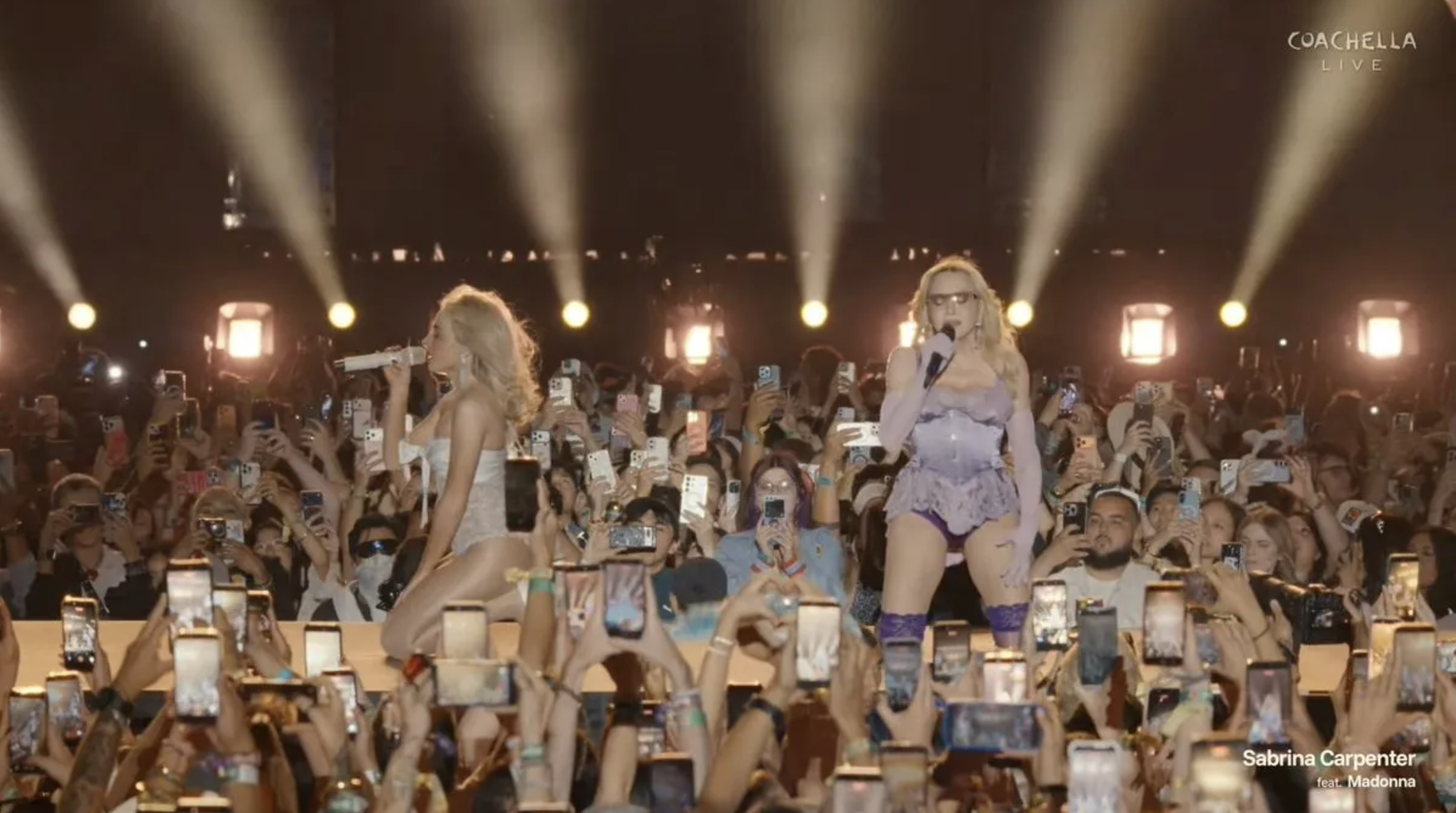
📌 When Sabrina Carpenter brought Madonna on stage at Coachella 2026 — her first appearance at the festival in two decades — livestream footage showed an audience of thousands holding phones perfectly still rather than responding to the performance. The moment, widely noted and debated online, sits within a broader conversation about how the primacy of content capture is reshaping the live experience from the inside. The tension is not new, but the scale at which it now defines premium festival moments raises a question that event organisers, brands and artists are increasingly having to answer: when the audience is producing content rather than experiencing the show, what is the live event actually for?
– Madonna’s last Coachella appearance was in 2006 — a 20-year gap preceding her 2026 return
– Livestream footage showed near-universal phone recording during the Carpenter-Madonna collaboration
– Sabrina Carpenter previously indicated openness to banning phones at shows but noted it risked alienating fans (Consequence)
💡 Festivals have spent years optimising for content virality — building stages, lighting rigs and surprise guest moments that are engineered to travel on social media. The Coachella phone moment suggests that strategy may now be working against the live experience it was designed to amplify. If audiences arrive primed to document rather than participate, the energy that makes a live moment worth capturing disappears — and with it, the cultural weight that justifies premium ticket prices. For event strategists, the challenge is no longer just selling the experience; it is protecting the conditions that make the experience worth having in the first place. 🎤

Can UpScrolled Keep Up With a Surge in Users? — Uncanny Valley, WIRED
Why It Matters: When TikTok’s US operations shifted to American investors, a new platform called UpScrolled surged — built on the promise of no censorship or shadow-banning. This episode talks to its founder about what that growth actually looks like, and the controversies already following it.
✅ Worth Your Time Because: The UpScrolled story is a live test case for what happens when platform trust collapses and audiences go looking for alternatives — a dynamic running through several of this week’s stories, from the SheerLuxe backlash to the EU’s move on Google search data. WIRED’s Uncanny Valley is consistently sharp on the collision of tech, politics and platform behaviour, and this episode asks uncomfortable questions about whether a new platform built on anti-censorship principles can survive its own growth without repeating the problems it set out to solve. Essential listening for anyone thinking about where audiences go next — and why.

👀 Things to Be Aware Of This Week
Monday 28 April – Sunday 4 May 2026
⚽ Premier League run-in intensifies (28 April onwards) — with the title race, European qualification and relegation all live simultaneously, this is peak commercial and broadcast value territory for the division, and one of the few remaining moments of genuine mass simultaneity in UK sport.
🎾 Madrid Open continues (ATP/WTA, through 4 May) — one of the most watched clay court events on the calendar ahead of Roland Garros, with strong broadcast presence and growing brand activation around women’s tennis in particular.
🏒 NHL Playoffs — Stanley Cup series develop through the week, with cross-cultural brand interest in hockey’s post-season continuing to grow beyond its traditional North American heartland.
🎌 Met Gala arrives on Monday 5 May — close enough to be on every brand, PR and cultural strategist’s radar this week, as activations, red carpet strategy and talent partnerships are confirmed and begin to surface publicly.
🏀 WNBA season tips off (mid-May, but rosters and brand partnerships confirming now) — with draft momentum fresh and sponsorship interest at record levels, the weeks ahead of opening night are where commercial positioning is established.