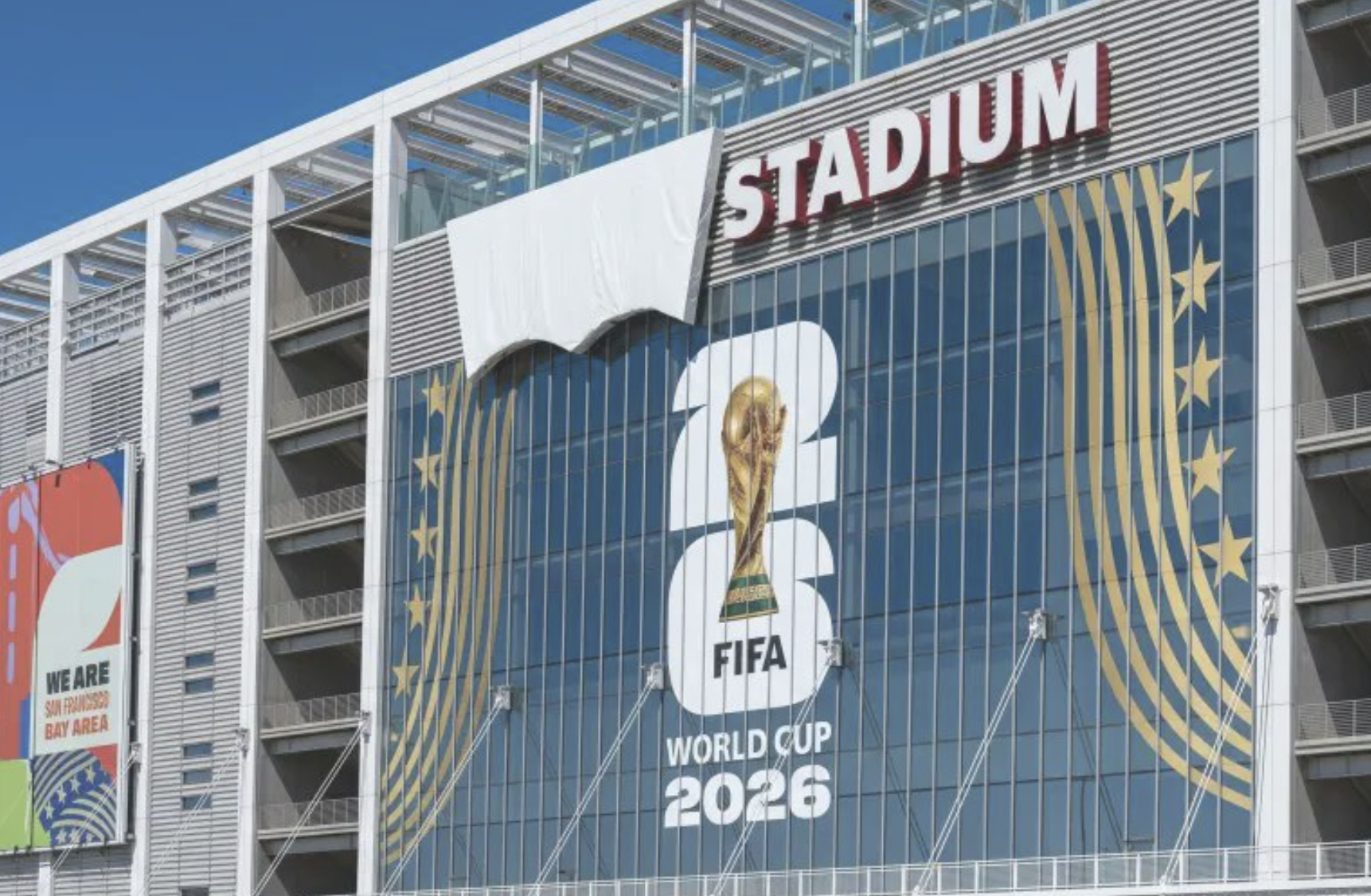
FIFA's clean-stadium rule is one of the most aggressive pieces of commercial control in sport. For the duration of the 2026 World Cup, any host venue carrying a non-FIFA sponsor's name has to strip or cover that branding and rename itself after its city. MetLife Stadium became New York New Jersey Stadium. Gillette became Boston Stadium. SoFi and Mercedes-Benz were covered. Levi's Stadium in Santa Clara, where Levi's holds a ten-year, $170m naming-rights deal, became San Francisco Bay Area Stadium.
Most of those brands complied quietly, because that is what the contract demands and there is nothing obvious to gain from arguing. Levi's did something different. It draped its signage in a white tarp cut into the exact shape of its batwing logo, then changed its own social profiles to match and posted a video of the shrouded sign captioned "Welcoming the world to the beautiful [redacted] stadium." The Instagram post passed 700,000 likes inside a day. A TikTok of the covered logo set to the "Nobody's Gonna Know" audio cleared nine million views. The brand spent effectively nothing and won the conversation around an event it was legally barred from appearing in.
It is being written up as a witty marketing stunt. Give the marketing team a raise. That reading is true and also the least interesting thing about it.
Who the rule was actually built to serve
The clean-stadium policy is not aesthetic. It exists to protect exclusivity for FIFA's official partners, whose sponsorship is forecast to generate around $2.8bn for this tournament. The rule supersedes the naming-rights contracts the venues already signed, which means the brands that paid most for year-round visibility are precisely the ones erased during the single biggest event their stadium will ever host. That is the trade FIFA enforces: it manufactures scarcity everywhere else in order to sell it back to its own sponsors.
So the people the rule is designed to serve are the official partners who paid for clean sightlines. The people it is designed to disadvantage are the incumbent naming-rights holders. Levi's took the disadvantage and converted it into the upside the official sponsors paid for, without paying for it.
FIFA didn't hide the logo, it advertised it
Here is the mechanism, because it matters more than the joke. Nobody shares a photo of a sponsor's logo sitting on a stadium. That is wallpaper. What people share is the fact that football's governing body went to the trouble of covering one of the most recognisable logos on earth and failed to actually hide it. The story is not the brand. The story is the attempt to suppress the brand, which is a far more shareable thing to be in the middle of, particularly when the body doing the suppressing is not widely loved.
So the act of covering it is what made it newsworthy. An uncovered Levi's sign is scenery. A covered one, still legible underneath, is a small act of comic defiance the internet was always going to pass around. FIFA didn't remove Levi's from the conversation. It wrote Levi's into it.
Why most brands could not have done this
This move was not available to everyone on that list. It worked because the batwing is one of the rare logos you can read from silhouette alone, with no wordmark attached. Cover a MetLife or a SoFi sign with a blank tarp and you get a blank tarp. Cover Levi's and you get a Levi's logo with the name taken out, which the entire internet can still read.
That is not luck and it is not wit. It is roughly 170 years of brand equity compounded into a single distinctive asset, to the point where the shape carries the meaning on its own. The censorship became a stress test, and the asset passed. Take the name away and the recognition sat exactly where it had always been. Witty is the surface. The real moat is having built a visual identity strong enough to survive being deleted, and most brands have not.
Rights and attention are not the same currency
This is the part worth taking into a boardroom. FIFA's official sponsors bought rights, access and association, and those remain genuinely valuable; the World Cup is one of the last places on earth a single audience still gathers at that scale. But Levi's demonstrated that attention now runs as a separate currency alongside rights, and you can capture a great deal of one while holding none of the other.
In Capital Test terms, the official sponsors are renting the World Cup's cultural standing for a fixed window. When the tournament ends on 19 July, that borrowed altitude expires and they are back where they started, having paid a fortune for the lease. Levi's drew on standing it owns outright, an asset that was already there and is not going anywhere, and let a restriction designed to erase it do the distribution instead. It did not buy its way into the stadium. It earned its way into the story.
The wider read
Clean stadiums belong to the same story as $100 train fares, four-tier ticket pricing and tailgating bans at this World Cup. It is all FIFA treating the tournament as a tightly controlled commercial environment where it decides who is seen and on what terms. The Levi's moment is what happens when a brand with real equity finds the gap between the letter of that control and its spirit, and walks straight through it.
FIFA could cover the name. It could not cover the brand. That distinction is the entire point, and it is worth more than the $170m on the contract.