
Welcome to the next edition of On The Record, thoughtful analysis on culture, entertainment, tech, fashion, music, sport, and brands. Here’s a round-up of key conversations and campaigns that caught my attention this week.
The gap between stated positioning and structural behaviour is wider than usual this week, and the market is starting to notice. Brands, platforms and festivals are making choices that contradict the identity they are selling - access restricted in the name of revenue, community culture borrowed while the community itself is displaced, advertising expanded to children on a platform facing child safety litigation, and opt-out offered where consent should be the default. Against that, the most commercially intelligent moves of the week came from organisations that closed the gap rather than widened it - an artist whose structural choices generated more fan equity and cultural currency than any conventional tour strategy would have delivered, a sports body that solved a real operational problem rather than badging a moment, and a band that made their politics inseparable from their live product. The week's most useful question for brand and strategy professionals is not what your organisation says it stands for. It is whether your structural choices would survive the gap test.

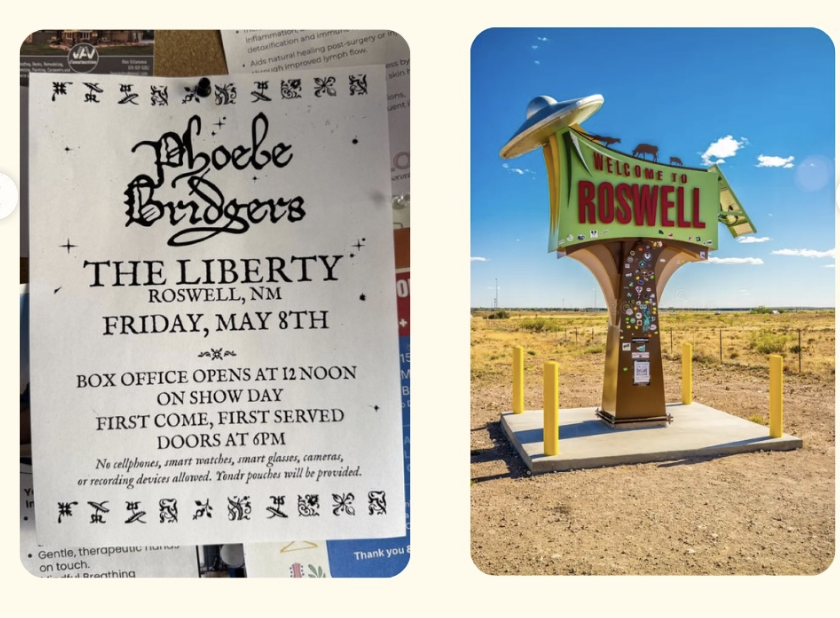
No Algorithm, No Ticketmaster, No Phones: Phoebe Bridgers Takes Her Tour Off-Grid 🎤
While the live music industry continues to debate ticket pricing, scalping and fan access, Phoebe Bridgers quietly ran a 14-date secret tour through small US towns, playing venues under 500 capacity with same-day paper flyer announcements, Yondr-pouched phones and first-come, first-served box offices. Venues held the secret for up to nine months under threat of cancellation. The run culminated in a surprise Madison Square Garden show with $1 tickets distributed via Tidal, with all revenue directed to the Immigration Bond Freedom Fund.
14 pop-up shows across small US towns, venues capped at under 500 capacity
MSG show announced via street poster with $1 tickets, all proceeds to the Immigration Bond Freedom Fund
Venues required to maintain secrecy for approximately 9 months; shows cancelled if word got out
Stripping out the conventional commercial infrastructure - no dynamic pricing, no merch margin, no phone content to farm - was not an anti-commercial decision. It was a precise one. Bridgers built scarcity, intimacy and fan devotion at a scale that no arena tour produces, while simultaneously road-testing new music, generating earned media across every market she played, and arriving at MSG with an audience primed and emotionally invested. The industry talks constantly about fan trust; she built it through structural choices, not messaging. For anyone watching how artists navigate an ecosystem still dominated by Live Nation and Ticketmaster, this is a reference point worth studying. 🎟️
Banned Speakers and Brick Lane Protests: SXSW London Faces a Double Controversy of Its Own Making 🎪
SXSW London's second edition arrived carrying two separate but overlapping controversies. The UK Home Office banned invited speakers Cenk Uygur and Hasan Piker from entering the country on the grounds that their presence "may not be conducive to the public good." While the Oxford Union publicly defended their right to speak, SXSW London stayed silent - a distinction Piers Morgan drew sharply from the festival's own stage, to audience applause. Separately, community group Nijjor Manush and the Save Brick Lane Coalition protested outside the Truman Brewery venue, challenging the festival for hosting events "celebrating Bengali culture" at a site they hold responsible for accelerating gentrification and displacement of the area's long-standing Bangladeshi community. The coalition's demands go further, calling on SXSW to scrutinise its sponsorship and partnership choices against the communities it claims to serve.
UK Home Office cancelled ETAs for Cenk Uygur and Hasan Piker citing presence "may not be conducive to the public good"
Protests held outside the Truman Brewery during the festival, organised by Nijjor Manush and the Save Brick Lane Coalition
SXSW London responded to Morgan's on-stage criticism by calling it evidence of the festival's commitment to diverse voices
When a festival gets publicly challenged for its choices from its own stage, and the community whose culture it claims to celebrate is simultaneously protesting outside the venue, the gap between cultural programming and cultural responsibility becomes difficult to paper over with a statement about open dialogue. The Brick Lane tension is particularly sharp - hosting events that celebrate Bengali culture while operating from a venue whose landlord has spent years accelerating the displacement of the very Bangladeshi community that built and sustained that culture is not an oversight, it is a contradiction. Culture borrowed as aesthetic while the people behind it are being pushed out is not celebration. And on the speaker ban, the contrast with the Oxford Union - an institution that moved quickly to defend free expression while SXSW London stayed quiet - raised its own questions about what the festival actually stands for when it matters. Both issues landed in the same week, on the same site. 🎤
Nike Goes Hollywood for the World Cup - But Is Star Power Enough to Solve a Cultural Problem? 🎬
With the World Cup days away, Nike has launched "Rip the Script", a cinematic campaign built around a deliberately broad cast designed to bring non-football audiences into the sport. Kim Kardashian, LeBron James, Travis Scott, Channing Tatum and Lisa from Blackpink appear alongside Mbappe, Ronaldo and Haaland, with Nike framing the strategy around "authentic connections" to football rather than celebrity for its own sake. The campaign is designed to extend across the full tournament, with character storylines developing throughout - an unusually long content commitment for a brand that has struggled in recent years to land a defining cultural moment.
Campaign features Kim Kardashian, LeBron James, Travis Scott, Channing Tatum, Lisa (Blackpink), Mbappe, Ronaldo and Haaland
Storylines planned to extend across the full tournament duration - the longest in World Cup history
Saint West's appearance marks the launch of the Paris Saint-Germain x Awake kit within the film itself
The official narrative is that this is Nike being bold, playful and culturally expansive. The more uncomfortable read is that a brand with genuine cultural authority doesn't need twelve celebrities to get people to care about its World Cup campaign. Scale of cast reads less like confidence and more like hedging. The contrast with Adidas' "Backyard Legends" is instructive - Timothee Chalamet, Messi, Bellingham and a nostalgic premise built around the joy of the game is a singular idea with a clear emotional centre. Nike's approach feels engineered to not miss anyone, which is a very different instinct, and one worth watching over the tournament to see whether breadth compounds into something or simply generates noise. 🎯
Massive Attack Turn Primavera Sound Into a Warning About Palantir and the Surveillance State 🎭
Massive Attack's live show at Primavera Sound has become one of the most politically charged performances of the festival season, deploying visuals built with filmmaker Adam Curtis and art collective United Visual Artists to condemn data company Palantir's expanding access to UK citizens' personal data. The show uses facial recognition technology to identify individuals in the crowd, overlaying subversive slogans to simulate how a Palantir monitoring interface might operate in practice - making the audience the subject of the very system being critiqued. Palantir, whose tools have links to the US Immigration and Customs Enforcement programme and the military's Maven platform, has gained significant access to NHS and wider public sector data in the UK, a development that journalists including Carole Cadwalladr have argued poses a serious risk to personal freedoms and democratic infrastructure.
Visuals built with Adam Curtis and United Visual Artists, simulating a Palantir Gotham monitoring interface
Palantir has links to US ICE enforcement and the military's Maven AI platform
Founder Robert Del Naja described Palantir's access to societal infrastructure as "a huge, potentially irreversible and dangerous overreach"
Most brands and artists treat data privacy as an abstract concern. Massive Attack made it visceral by turning a festival crowd into a live demonstration of the surveillance logic they are critiquing. For an industry increasingly dependent on data partnerships and audience tracking to drive commercial decisions, that is an uncomfortable mirror to hold up. The question the show implicitly asks - at what point does access to personal data stop being a product feature and start being a structural threat - is one the wider culture and entertainment sector has largely avoided confronting directly. Massive Attack confronted it on a festival stage. 👁️
Airbnb and WSL Launch £1m Fund to Solve One of Women's Football's Most Overlooked Problems 🏠
Airbnb and the Women's Super League have announced a £1 million Player Accommodation Fund, available across every transfer window for the next three years, providing short-term housing for players joining WSL and WSL2 clubs. The initiative targets one of the least visible structural barriers in women's football - the logistical and financial pressure of relocating to a new city during a transfer, a challenge that has historically received little institutional support despite its direct impact on player welfare and performance.
£1 million fund available across all transfer windows over three years
Covers players joining both WSL and WSL2 clubs
Addresses relocation and short-term housing needs during transfers
Sponsorship in women's sport has largely followed visibility - shirt deals, broadcast partnerships, stadium naming rights. This moves into less glamorous but arguably more impactful territory: the behind-the-scenes conditions that determine whether elite players can actually perform at their best after a transfer. Airbnb's commercial interest is clear, but the structural gap being addressed is real, and closing it has a direct bearing on the professional credibility and retention of talent in the league. As the WSL continues to scale, the brands willing to solve operational problems rather than just badge moments will build more durable equity. ⚽
Google Gives Publishers an AI Opt-Out in a World First - But the Structural Problem Remains 📰
The Competition and Markets Authority has secured a commitment from Google allowing publishers to opt out of their content being used to power AI features in Google Search, including AI Overviews - described by the CMA as a world first in platform accountability. The move comes against a backdrop of sustained pressure from publishers who have watched AI-generated search summaries reduce click-through traffic to their sites while simultaneously being trained on their content without direct compensation. The opt-out mechanism represents a meaningful regulatory intervention, but it shifts the burden onto publishers to act rather than requiring Google to seek consent by default.
CMA describes the opt-out mechanism as a "world first" in AI content governance
Applies to Google's AI Overviews and other AI-powered search features
Publishers must actively opt out rather than being protected by default
An opt-out is not the same as consent, and the distinction matters enormously. By making inaction the default, the framework still favours Google's data interests - publishers who lack the resources or awareness to navigate the process remain exposed, and the systemic extraction of content value continues unless actively interrupted. For an industry already under severe pressure from declining referral traffic and advertising revenue, placing the administrative burden of protection on publishers rather than the platform doing the extracting is a regulatory compromise that deserves scrutiny. The CMA has opened a door; whether publishers can actually walk through it at scale is a different question. 📡
Spotify Tells Brands Their Audience Is Already a Fan - And That Changes Everything 🎧
Spotify Advertising has launched "You're Among Fans", a global B2B campaign starring Lizzo and Jay Shetty, built around a single proposition: that Spotify's 761 million monthly active users are not passive consumers but active fans, making them a more valuable and engaged advertising audience than traditional reach metrics suggest. Created with BBDO New York, the campaign targets brands looking to move beyond impression-based thinking toward fandom-led audience strategy - positioning Spotify not just as a distribution platform but as a context that deepens brand relationships.
Spotify has 761 million monthly global active users
Campaign stars Grammy-winning artist Lizzo and podcast host Jay Shetty, whose show On Purpose recently expanded to Netflix
Built around the argument that fan engagement on Spotify creates deeper brand connection than standard audience reach
The strategic argument underneath the campaign is worth taking seriously. Fandom changes the quality of attention - someone listening to an artist they love, or a podcast they trust, is in a fundamentally different receptive state than someone scrolling a feed. Spotify is making the case that context is a commercial asset, and that brands paying for reach without considering the emotional register of that reach are leaving value on the table. For media buyers and brand strategists, that is a challenge to how audience planning is still largely done. 📻
Nostalgia Is Topping the Spotify Charts - And It Says Something About Where Attention Is Going 🎵
Michael Jackson's "Billie Jean" reached number one on Spotify's global chart in May 2026, almost 43 years after its original release, driven by the premiere of the Jackson biopic. Justin Bieber's 2012 single "Beauty and a Beat" and Dominic Fike's 2018 track "Babydoll" have also featured prominently in the top ten, pointing to a broader pattern where catalogue music and nostalgia-driven consumption are competing directly with new releases at the top of the streaming charts.
"Billie Jean" reached number one on Spotify's global chart on 14 May 2026, 43 years after its original release
Justin Bieber's 2012 single "Beauty and a Beat" among its closest competition
Catalogue and nostalgia tracks increasingly featuring in Spotify's top ten alongside new releases
When a 43-year-old track can top a global streaming chart, the release cycle logic that has driven label strategy for decades starts to look less stable. Catalogue is no longer just a back-catalogue revenue stream - it is actively competing for the same algorithmic real estate as new music, reshaping what labels invest in, how biopics are commissioned and marketed, and how platforms think about discovery versus familiarity. The audience is not always looking for what's new. Sometimes they are looking for what feels safe, and in the current cultural climate, that is a signal worth paying attention to. 🎶
Apple's Smart Glasses Bet Is Less About Tech and More About Owning the Next Computing Layer 👓
Apple is targeting a late 2027 launch for its first smart glasses product, codenamed N50, with incoming CEO John Ternus identified as a driving force behind the initiative. Unlike the Apple Vision Pro - which struggled with price, weight and a limited app ecosystem - the glasses are designed to be lightweight, display-free and deeply integrated with iPhone, Siri and AirPods rather than functioning as a standalone device. The strategic framing is significant: Apple is not primarily positioning this against Meta's Ray-Ban glasses, but against the $200 billion global eyewear market.
Expected price range of $499-$999, targeting mainstream wearable adoption rather than enthusiast early adopters
No built-in display - functionality centres on camera, notifications, call handling and Siri voice integration
Meta currently leads in smart glasses market share, retail partnerships and AI integration, creating pressure on Apple's timeline
Apple's playbook here mirrors the Apple Watch precisely - enter a traditional industry rather than a tech category, embed the ecosystem, and let design and habit formation do the work that specs cannot. The Vision Pro was a bet on immersive computing that the market wasn't ready for. Smart glasses are a bet on ambient computing that people already opt into every day when they put on their eyewear. The real competition is not Meta. It is inertia - and whether Apple can make the value exchange feel invisible enough that wearing a camera on your face stops feeling like a statement and starts feeling like nothing at all. 🍎
Arsenal Turns Its Pitch Into Diamonds - and Points to Where Sports Memorabilia Is Heading 💎
Spanish lab-grown diamond company Brilianto has partnered with Arsenal to create a limited collection of 1,886 pieces - a number referencing the club's founding year - each made from carbon extracted directly from the grass of the Emirates Stadium pitch. Using renewable-energy-powered high pressure technology, the carbon is purified and crystallised into certified diamonds, then crafted into jewellery incorporating club symbols including the iconic cannon. The partnership lands at a moment of particular resonance: Arsenal's first Premier League title in 22 years has given the collection a cultural weight that extends well beyond a licensing deal.
1,886 pieces produced, referencing Arsenal's founding year of 1886
Diamonds lab-grown from carbon extracted directly from the Emirates Stadium pitch using renewable energy
Lab-grown diamonds now account for 61% of engagement rings in the US; the global market is projected to reach $34bn by 2030
The memorabilia market has long operated on scarcity and sentiment - signed shirts, match programmes, limited-edition prints. Brilianto's model takes that logic somewhere structurally different, turning the physical fabric of a club's history into a certified, wearable and inheritable object with genuine material value. For sports organisations increasingly operating as lifestyle and entertainment brands, this points toward a new category of cultural IP - one where provenance, sustainability credentials and emotional resonance combine into a product that sits comfortably in fine jewellery retail rather than the club shop. Arsenal winning the title made the timing perfect. 💎
Apple's F1 Deal Is Not About Broadcasting - It's About Owning the Whole Stack 🎬
Writing in her motorsport and tech newsletter Idee Fixe, former tech executive and F1 commentator Toni Cowan-Brown makes the case that Apple's $140 million per year F1 broadcast deal is being widely misread. The visible layer is streaming rights. The architecture underneath is a full vertical integration where F1 becomes the flywheel cycling audiences between Apple TV, Apple Sports, Apple Music, Apple Maps and Apple Fitness+. Cowan-Brown points to the F1 movie as the clearest evidence of intent - Apple engineers replaced broadcast camera modules in actual race cars with iPhone-based hardware running custom iOS firmware, work that subsequently fed directly into iPhone 15 Pro features.
Apple secured exclusive US F1 broadcast rights in October 2025 in a five-year deal worth over $140 million per year
Custom iPhone-based cameras developed for the F1 film fed directly into iPhone 15 Pro feature releases
An entire MLS match between LA Galaxy and Houston Dynamo was broadcast shot solely on iPhone 17 Pro
Cowan-Brown's framing is the right one: Apple doesn't want to do sports broadcasting the way it's always been done - Eddy Cue said as much publicly. The broadcast rights are the entry point. What Apple is actually building is control over what F1 looks, sounds and feels like in the US - the platform, the camera technology, the content and the distribution. For anyone watching how media rights, technology and sport are converging, this is the most structurally interesting deal in the market right now. 📡
The Ballon d'Or Is Coming to London - and It Signals More Than a Change of Venue 🏆
The 2026 Ballon d'Or ceremony will be held in London this October, marking the first time the award has left its traditional Paris setting in its 70-year history. Scheduled for 26 October and coinciding with the award's 70th anniversary, the move brings football's most prestigious individual prize to a city that has become one of the sport's most commercially and culturally significant stages.
First time in 70 years the Ballon d'Or ceremony will leave Paris
Ceremony scheduled for 26 October 2026, coinciding with the award's 70th anniversary
Venue yet to be confirmed
Moving the Ballon d'Or to London is not a logistical decision - it is a positioning one. London is already home to the Premier League's global headquarters, the world's most watched football product, and a concentration of elite clubs, media infrastructure and brand investment that no other city matches. Bringing the ceremony here formalises something that has been true commercially for years: that English football, and London specifically, has become the gravitational centre of the global game. For brands, sponsors and rights holders already operating in that ecosystem, October just became significantly more interesting. ⚽
16 Million Illegal Streams of the Champions League Final Expose the Real Cost of Locking Sport Behind Paywalls 📺
Arsenal's Champions League final defeat by PSG attracted 16.2 million illegal stream views in the UK, traced to 3.7 million unique IP addresses, after TNT Sports chose not to make the match available free to air - the first time a Champions League final has been behind a paywall since the competition's rebrand in 1992. The match was watched legally by more than 7 million people on TNT Sports and HBO Max. The scale of illegal viewing is significant in its own right, but the accompanying data point sharpens the picture considerably: 89% of adverts on those illegal streams were for gambling brands not licensed in the UK.
16.2 million illegal stream views traced to 3.7 million unique UK IP addresses
Legal audience of 7 million via TNT Sports and HBO Max
89% of adverts on illegal streams were for unlicensed gambling brands
The piracy numbers are a symptom, not the story. When the 2022 final was streamed free on YouTube it peaked at 12.6 million viewers - legal ones. TNT's decision to put the most-watched club match of the year behind a subscription wall did not reduce demand, it redirected it into an ecosystem that funds unregulated gambling and undermines the regulated broadcasters paying billions for these rights. For rights owners, broadcasters and regulators, the question is no longer whether paywalling major sporting moments drives piracy - the data answers that - but whether the short-term subscription revenue justifies the long-term erosion of audience trust, legal viewing habits and broadcast value. 📡
Roblox Opens Advertising to Under-13s - and the Timing Could Not Be More Loaded 🎮
Roblox has made its under-13 user base available to advertisers for the first time, naming youth-focused ad marketplace SuperAwesome as its exclusive partner for this audience. Ads will be limited to direct deals only - no programmatic - and restricted to banner and in-game billboard formats, with no behavioural data collection and no rewarded video. The move is framed around recent safety improvements including new age verification and tiered user categories. It arrives, however, while Roblox faces at least 130 child safety lawsuits consolidated into a federal class action, plus additional state-level suits, and having settled two further cases last month.
Roblox had 144 million daily active users as of Q4 2025; 35% of age-verified users are under 13
No programmatic, no behavioural targeting and no rewarded video for under-13 audiences
Roblox currently faces at least 130 consolidated child safety lawsuits alongside multiple state-level cases
Roblox's spokesperson said the platform is "not doing anything different than real life" - but that framing sidesteps the question that matters. The under-13 audience is being monetised precisely because it represents a significant share of a 144 million daily active user base that Roblox needs to commercialise to grow its ads business. The contextual safeguards are real, but the structural incentive is also real: a platform facing serious child safety litigation is simultaneously expanding its advertising access to children. For brands considering this inventory, the brand safety controls matter less than the reputational context surrounding the platform they would be appearing on. 🧒
Gen Z Are Shopping in Stores Again - and Turning the Experience Into a Social Act 🛍️
New research from Snapchat and Portas finds that 51% of Gen Z prefer to shop in-store, with the physical retail experience increasingly functioning as a social occasion rather than a purely transactional one. The same research found that 83% of Gen Z send photos or videos of products they are considering to friends or family before purchasing - collapsing the boundary between physical browsing and digital validation, and positioning the in-store visit as the beginning of a social loop rather than the end of a purchase journey.
51% of Gen Z prefer in-store shopping, according to research by Snapchat and Portas
83% send photos or videos of potential purchases to friends or family before buying
Physical retail is increasingly functioning as a social and content-generating experience for this cohort
The retail industry spent the better part of a decade assuming Gen Z would complete the shift to purely digital commerce. What this data suggests instead is that physical stores remain relevant, but for different reasons than they were for previous generations. The in-store visit is now a content moment, a social experience and a decision-making trigger - with the actual conversion potentially happening online after peer validation. For brands and retailers, that changes what a store needs to do: less transaction point, more shareable environment that earns its place in the social loop before the purchase is made. 🏪
Ofcom Sets Out Its AI Regulatory Framework - and the Stakes Are Higher Than the Language Suggests ⚖️
Ofcom has published its updated strategic approach to AI, outlining how it intends to enable safe adoption across the communications sectors it regulates while monitoring emerging consumer harms. The document takes a deliberately technology-neutral, outcomes-based stance, covering everything from deepfake mitigation and AI chatbot trust to broadcasting content creation and telecoms network management. The framing is measured, but the underlying picture is one of a regulator actively building capability and expanding its remit in response to a technology landscape moving faster than existing legislative frameworks were designed to handle.
Ofcom has launched a formal investigation into X's Grok chatbot
Coordinated with AISI and the National Cyber Security Centre following concerns raised by Anthropic's Claude Mythos preview around frontier AI cybersecurity implications
Eight case studies published covering AI deployment across spectrum licensing, online safety, broadcasting, telecoms and cybersecurity
Regulatory documents of this kind are easy to dismiss as procedural. The more useful read is to look at where Ofcom is investing attention - deepfakes, AI chatbot trust, agentic AI, network resilience - because these are the areas where it expects harm to materialise at scale. The formal investigation into Grok and the coordination around frontier AI cybersecurity concerns signal that the era of regulators observing from a distance is ending. For brands, platforms and media organisations operating in these sectors, the outcomes-based approach means the question is no longer what the rules say, but what the regulator decides a good outcome looks like. Those are not always the same thing. ⚖️
Ferrari Signs Its First Skincare Deal - and It Makes More Sense Than It Sounds 🏎️
Scuderia Ferrari HP has named SkinCeuticals as its official skincare partner, marking the first time the team has entered a partnership in this category. The clinical skincare brand, known for its science-led positioning and professional credibility, becomes part of Ferrari's expanding commercial ecosystem as F1's audience demographics and brand partnership appetite continue to broaden well beyond traditional motorsport categories.
First skincare partnership in Scuderia Ferrari HP's history
SkinCeuticals is a clinical skincare brand positioned around dermatologist-backed, science-led formulations
Deal follows F1's continued commercial expansion into lifestyle, fashion and beauty categories
Ferrari and SkinCeuticals share a positioning logic that makes the partnership coherent: both operate at the premium end of their respective categories, both lead with performance credentials over lifestyle aspiration, and both carry a professional endorsement story - engineers and dermatologists respectively. F1's audience has shifted significantly in the past five years, with a growing proportion of female fans and younger demographics who engage with the sport as a cultural platform rather than purely a racing product. Beauty and skincare brands have taken note, and Ferrari's willingness to enter this category for the first time signals how seriously the team is taking that audience expansion. 🏁
YouTube's Paywall Integration Claim Was Walked Back Within 24 Hours - But the Conversation It Started Matters 📺
YouTube's vice president for Europe Pedro Pina told the WAN-IFRA World News Media Congress in Marseille that the platform had product and engineers working on integrating with publisher paywalls, suggesting it would be "happening very soon." Within 24 hours, YouTube issued a statement clarifying there are currently no plans to launch such a feature, without suggesting Pina had been misquoted. The retraction is notable, but so is the underlying pressure it reveals: publishers including Le Monde, which generates 4 million video views per day on YouTube, are actively pushing the platform to find ways to convert that reach into subscription revenue.
YouTube walked back Pina's paywall integration comments within 24 hours of them being made
Le Monde generates 4 million daily video views on YouTube, with 25% growth in total views in 2025
Research released the same week found YouTube has overtaken Netflix for daily average viewership across 20 international markets
The retraction does not erase the signal. A senior YouTube executive made these comments on stage at a major industry congress in response to direct publisher pressure - that does not happen without some internal conversation having taken place. The gap between "we have engineers working on it" and "there are no current plans" is the kind of corporate distance that gets closed quietly over time. For publishers already using YouTube as a discovery engine, the more important point is structural: if YouTube eventually enables paywall integration, it shifts the platform's role from top-of-funnel reach driver to a direct participant in subscription revenue - which changes the commercial relationship with publishers fundamentally. 📡

🎙️ Chris vs. The People - Kelly Cutrone: The Fashion Industry's Ruthless Truth-Teller
Why It Matters: Kelly Cutrone built People's Revolution into one of fashion's most formidable PR operations by operating on the kind of unfiltered industry logic that rarely makes it onto the record. This conversation surfaces what she actually thinks about the new generation of fashion commentary, what genuine career survival looks like, and why her defence of Tyra Banks is worth hearing out.
Worth Your Time Because: For anyone who came of age in The Hills era, this is a nostalgia hit with real substance underneath. Cutrone holds nothing back - on the ruthless business logic behind her reality TV appearances, what's broken in contemporary fashion media, and a rock-bottom story that reframes the career arc entirely. In an industry increasingly shaped by curated personal brands and managed narratives, her willingness to be genuinely unfiltered is a counterpoint worth sitting with. This is the guilty pleasure listen that also happens to be one of the most commercially honest conversations about fashion PR you'll find.

Monday 8 June - Sunday 14 June 2026
⚽ FIFA World Cup 2026 kicks off - 11 June, Mexico City - the most commercially loaded sporting event on the planet gets underway, with implications across media, brand, ticketing and fan experience that will run for weeks.
🏎️ F1 Spanish Grand Prix, Barcelona - 12-14 June - the European leg of the season continues at Circuit de Barcelona-Catalunya, the first of two Spanish races on the 2026 calendar.