
Welcome to the next edition of On The Record, thoughtful analysis on culture, entertainment, tech, fashion, music, sport, and brands. Here’s a round-up of key conversations and campaigns that caught my attention this week.
This week examines how credibility is being actively managed across brands, politics and media. From heritage sponsors re-entering women’s football and fashion codes shaping political authority, to newsrooms navigating legal risk, protest coverage and selective silence, visibility is no longer neutral. The common thread is control: who earns trust, who sets the terms, and what happens when attention becomes conditional rather than guaranteed.

🏟️ Bad Bunny’s Super Bowl was joyful... and a positioning statement.
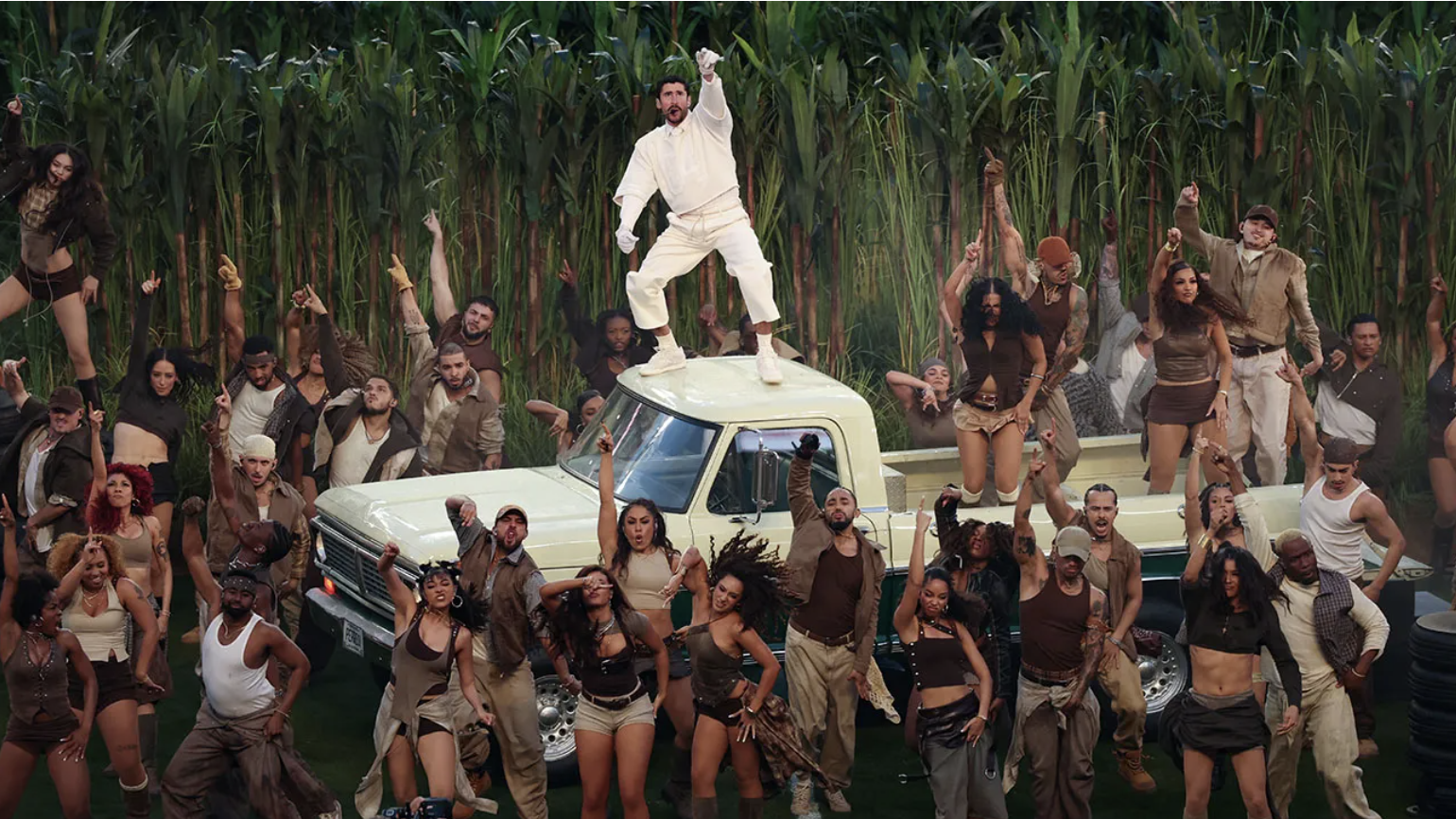
When Bad Bunny took over the Super Bowl LX halftime show, the spectacle landed squarely at the fault line of US culture, politics and identity.
On the surface, it was joyful, cinematic and celebratory. Beneath that, it was quietly radical.
Performed largely in Spanish, the show arrived amid an aggressive immigration crackdown under Donald Trump’s second administration, with ICE operations dominating headlines and Latino communities living under heightened fear. Against that backdrop, Bad Bunny didn’t protest loudly. He danced.
Joy as resistance
The performance unfolded as a living portrait of Puerto Rican life: sugar-cane fields, jíbaros in pava hats, La Casita, bodegas, domino tables, barber shops, weddings, children asleep mid-party, and workers climbing utility poles during “El Apagón”.
Crucially, the neighbourhood wasn’t a prop. The food stalls, shops and stands on stage represented real vendors and real small businesses, the kind that anchor Puerto Rican communities on the island and across the diaspora. This wasn’t aesthetic borrowing. It was economic visibility.
Live brass, plena percussion and salsa bled into reggaeton and dembow, foregrounding heritage rather than flattening it for mass consumption. Puerto Rican music wasn’t inspiration. It was infrastructure.
This wasn’t accidental. As scholars have noted, Puerto Rican music has long operated as resistance through joy, where protest songs double as party songs. In that tradition, celebration itself becomes political.
Every detail carried meaning
Nothing in the show was decorative.
The opening fields referenced sugarcane labour and rural Puerto Rico.
Traditional instruments (panderos, cuatro, güiro, maracas) asserted Taíno, African and Spanish musical lineage.
La Casita recreated a marquesina party, centring community over celebrity.
The real wedding wasn’t symbolism. A couple legally married on stage, with Bad Bunny as witness.
The Grammy moment, where a child held Bad Bunny’s Album of the Year trophy, reframed aspiration and belonging at a time when Latino children are being detained rather than celebrated.
White plastic chairs, lifted from the cover of Debí Tirar Más Fotos, elevated everyday objects into cultural artefacts.
Power lines exploding during “El Apagón” referenced Puerto Rico’s ongoing infrastructure crisis, post-Hurricane Maria neglect, corruption and displacement.
The light blue Puerto Rican flag, associated with the independence movement, recalled a time when displaying it was illegal under the 1948 Gag Law.
This was choreography as history lesson.
The guest list told a story
The cameos weren’t random flexes.
Ricky Martin represented lineage, the early crossover that made this moment possible.
Cardi B and Karol G anchored the present and future of Latin pop.
Lady Gaga was the most strategic signal of all, a mainstream cultural endorsement that didn’t recentre the narrative.
Cameos from figures like Pedro Pascal widened familiarity without shifting authorship.
This was coalition-building, not crowd-pleasing.
Why language mattered
To sing in Spanish on the Super Bowl stage is not technically controversial. Culturally, in Trump’s America, it is loaded.
Guardian reporting made clear that speaking Spanish in public has increasingly become a provocation, sometimes even a risk, for Latino communities. In that context, an all-Spanish or mostly Spanish halftime show becomes an act of visibility. Not defiance, but insistence.
Bad Bunny has been explicit elsewhere, declaring “ICE out” at the Grammys just a week earlier. At halftime, he chose something more powerful than slogans: normalisation. Spanish wasn’t framed as foreign. It simply was.
The ending said everything
The show closed with Bad Bunny holding a football stamped:
“Together, We Are America.”
He spoke his only English words, “God bless America,” then named countries across Latin America before ending with the USA, Canada, and finally Puerto Rico. His final words in Spanish: “We’re still here.”
Not America as exclusion. America as hemisphere. America as shared.
Why this matters for brands and culture
This wasn’t culture-war baiting. It was culture setting.
Joy can be a political language.
Representation works best when it’s structural, not symbolic.
You don’t need to dilute culture to reach mass audiences.
Global relevance now comes from specificity, not neutrality.
Bad Bunny didn’t ask for permission to belong on the Super Bowl stage. He redefined what that stage could hold.
In a moment where MAGA outrage tried to frame the show as un-American, the performance quietly made the opposite case.
Not by arguing. By dancing.
🇺🇸 Turning Point USA’s “All-American Halftime Show” Failed to Land
Positioned as culture-war counterprogramming to Bad Bunny’s Super Bowl LX halftime show, Turning Point USA’s “All-American Halftime Show” ultimately landed as a flop, failing to generate meaningful cultural impact or momentum beyond its own ideological bubble.
Headlined by Kid Rock, the livestream featured MAGA-aligned country artists and framed itself around “faith, family and freedom”. Despite heavy promotion from conservative figures, coverage described the event as flat, inward-facing and notably low-energy, especially when contrasted with the scale, production value and global reach of the official halftime show.
Further undercutting the narrative of organic support, screenshots circulated widely on social media during and after the broadcast showing alleged paid-attendance listings on Craigslist, offering cash for people to appear at a live political media event on Super Bowl night. Turning Point USA has not publicly confirmed or denied the listings, but the claims added to criticism around manufactured turnout versus genuine audience demand.
TPUSA claimed roughly 5m live YouTube viewers, with higher total views post-event, though figures are self-reported
The stream reportedly did not air on X due to licensing restrictions
Alleged paid-attendance ads circulated widely, though remain unverified by TPUSA
💡 Counterprogramming can create noise, but without cultural pull, it rarely creates moments.
🏠 Soho House Goes Private Again
📌 Soho House has officially returned to private ownership, ending its four-year run as a publicly listed company. In a letter to members, CEO Andrew Carnie described the move as a way to refocus on members, Houses, and creative community, after years of tension between investor expectations and Soho House’s culture-led identity. The $2.7bn USD exit follows a volatile period, including a near-collapse of the deal when lead backer MCR Hotels faced funding shortfalls, before a last-minute $200m USD raise secured the transaction. With its public market chapter closed, Soho House is signalling a return to its original member-first model alongside renewed global expansion plans.
Shares dropped 21% earlier this month amid uncertainty over deal financing
The take-private deal valued the business at $2.7bn USD
The investor group included figures such as Ashton Kutcher
💡 Going private may give Soho House the breathing space to prove that community-driven brands struggle to thrive under public market pressure.
⚽ Nike Reveals 2026 NWSL Match Ball
📌 Nike has unveiled the official match ball for the 2026 National Women’s Soccer League season. The design features a clean white base with layered blue wave accents that intensify at the centre, paired with a black-and-grey star-like core displaying both the Nike Swoosh and NWSL logo. Continuing the league’s tradition of combining visual identity with on-pitch performance, the ball is engineered for precision, durability, and visibility, while also positioning itself as a fan collectible ahead of the new season.
The 2026 NWSL season kicks off on 13 March
The ball is available to purchase now ahead of opening weekend
Designed for professional match play, balancing performance and visibility
💡⚽ Match balls are increasingly brand assets, reinforcing league identity while turning performance equipment into merch-led cultural symbols.
👟 Why Women’s Sportswear Is Set to Become a $165bn Industry
📌 A new study from Research and Markets predicts a major acceleration in the global women’s sportswear market, driven by the rapid growth of women’s professional sport and participation. The report forecasts the category expanding from $113.7bn in 2025 to $164.7bn by 2031, underpinned by rising viewership, increased licensed team merchandise, and a broader cultural shift towards health, wellness, and athleisure. Even amid inflation, supply chain pressure, and sustainability costs, women’s athletic apparel continues to outperform the wider sporting goods sector.
Market value forecast to grow from $113.7bn (2025) to $164.7bn (2031)
Compound annual growth rate of 6.46%
Women’s athletic apparel grew 3.2% in 2024, outpacing the wider sporting goods market (2.9%)
💡👟 Women’s sport is no longer a brand adjacency, it’s a growth engine reshaping performance wear, merch, and lifestyle apparel strategies.
🧦 Vivianne Miedema Launches Charity Collab Supporting War Child
📌 Vivianne Miedema has partnered with Guts & Gusto to support War Child, using football culture as a vehicle for social impact. The collaboration centres on a limited-edition pair of socks inspired by classic football kits, designed to be simple, wearable, and intentional. Featuring Miedema’s number 9 and a personal message about standing up for what you believe in, the project reflects her long-standing commitment to the cause. A War Child ambassador since 2019, Miedema was closely involved in shaping the collaboration, with all proceeds going directly to support children affected by war.
Miedema has been a War Child ambassador since 2019
The product is a limited-edition sock, inspired by heritage football design
100% of proceeds go directly to War Child
💡🧠 Athlete-led charity collaborations are increasingly favouring understated, culture-first products that signal values without sacrificing wearability.
📈⚽ Investing in Women’s Sports Is Delivering Real Returns
📌 New performance data shows that women’s sports are no longer an experimental media buy but a proven commercial channel. Over the past year, advertising spend in women’s sports more than doubled, while campaigns placed within women’s sports media delivered results 40% more effective than the average primetime ad. As audiences across women’s football, basketball, volleyball, and athletics continue to grow, brands are increasingly reallocating spend based on measurable engagement, performance, and ROI rather than perceived risk.
Advertising spend in women’s sports more than doubled year-on-year
Campaigns delivered 40% higher effectiveness than average primetime ads
Women’s sports now rank among the fastest-growing media investments in sport
💡📊 What’s happening isn’t a trend cycle, it’s a market correction, with women’s sport proving its ability to drive attention, loyalty, and revenue at scale.
🧠⚽ U.S. Soccer Commits $30m to Female Athlete Health Research
📌 U.S. Soccer Federation has announced a $30m USD investment to launch the Kang Institute, a new platform designed to address long-standing gaps in female athlete research. Backed by a transformative donation from business leader and women’s sports advocate Michele Kang, the initiative will focus on female-specific injury prevention, menstrual health, and mental health. The programme aims to replace outdated, male-centric training models with research-backed best practices that better support women and girls across every level of the game.
$30m USD committed to female athlete health research
Focus areas include injury prevention, menstrual health, and mental wellbeing
Designed to inform training, performance, and long-term athlete care
💡🧠 This marks a structural shift in sports science investment, recognising that performance, wellbeing, and longevity in women’s sport require research built for female bodies, not retrofitted from men’s models.
🍺⚽ Guinness Returns to the Shirt With Bristol City Women
📌 Bristol City Women have unveiled Guinness as their new front-of-shirt sponsor as part of a multi-year partnership, marking the brand’s return to UK kit sponsorship after more than 30 years. Guinness 0.0 will feature across all three Robins shirts, which had remained blank this season, signalling a renewed commercial confidence in the women’s game. The deal follows Mercury13 acquiring a majority stake in the club in September, and adds momentum to the group’s ambition to attract global brands into women’s football ecosystems. Beyond the shirt, Guinness will also invest in the matchday experience at Ashton Gate, working with fan groups and Bristol’s creative community to deepen cultural and local engagement.
Guinness returns to UK shirt sponsorship for the first time in 30 years
The partnership follows Mercury13’s majority acquisition of the club
Guinness 0.0 will feature across all three Bristol City Women kits
💡🍺 Heritage brands are increasingly using women’s football as a credible, culture-forward re-entry point into sponsorship, pairing visibility with community-led activation.
🧥❄️ Zohran Mamdani’s Carhartt Moment Shows How Political Cool Is Built
📌 New York City mayor Zohran Mamdani turned his first major snowstorm into a case study in modern political credibility, using clothing not as costume but as narrative control. Across multiple briefings, Mamdani appeared in purpose-built outerwear, culminating in a custom-embroidered Carhartt jacket during the height of the storm. The choice landed because it aligned function, labour symbolism, and cultural fluency, positioning him as competent and current rather than performative.
The jacket was custom-embroidered by Arena Embroidery, a Bushwick-based studio with fashion and cultural credibility
Carhartt, founded in 1889, carries deep associations with labour, durability and subcultural authenticity
Mamdani paired the visual moment with hands-on visibility, including shovelling snow and live public briefings
💡🧠 Political “cool” isn’t about style alone, it’s about coherence. When presentation, action and context align, cultural signalling stops looking strategic and starts reading as earned, turning crisis moments into credibility-building ones.
⚽🤝 Leah Williamson Backs Grenfell Athletic FC Through Nike Grant
📌 Leah Williamson has partnered with Nike to support Grenfell Athletic FC via an Athlete Think Tank grant. The funding will strengthen the club’s community programmes, which use football to create positive opportunities for young people in the local area. As part of the initiative, Grenfell Athletic FC also received new kit, helping to support training, participation, and grassroots development.
Funding delivered through Nike’s Athlete Think Tank grant
Investment supports community-led football programmes
New kit provided to aid training and grassroots participation
💡⚽ Athlete-brand partnerships are increasingly channelling resources directly into community infrastructure, turning visibility into tangible, local impact.
🎶🗣️ Grammys 2026: Artists Speak Out Against ICE and Immigration Enforcement
📌 At the 68th Grammy Awards, political statements around U.S. Immigration and Customs Enforcement (ICE) emerged as a defining theme of the night, with multiple artists using the platform to criticise the agency and stand in solidarity with immigrant communities amid recent nationwide protests. Several winners brought the issue into their acceptance speeches, while others made symbolic statements on the red carpet.
Artists who spoke out against ICE during the ceremony
Bad Bunny — Opened his acceptance speech for Best Música Urbana Album by saying “ICE out,” condemning ICE and emphasising immigrant humanity, earning a standing ovation.
Billie Eilish — During her Song of the Year speech, stated “No one is illegal on stolen land,” calling for continued protest and activism against ICE.
Olivia Dean — As Best New Artist winner, spoke about her immigrant heritage and celebrated immigrant courage.
Kehlani — Used her platform on the red carpet and in interviews to criticise ICE and advocate ICE Out messaging.
Shaboozey — Voiced support for immigrants and criticised enforcement policies in acceptance remarks.
Artists who made symbolic statements or gestures
Justin Bieber & Hailey Bieber — Wore “ICE Out” pins on the red carpet.
Joni Mitchell — Also sported an “ICE Out” pin at the ceremony.
Justin Vernon (Bon Iver) — Wore an orange whistle in solidarity with Minneapolis community alerts about ICE.
💡🗣️ The intensity and breadth of anti-ICE statements at the Grammys went beyond music accolades, with artists leveraging arguably music’s biggest night to amplify a political protest that has resonated widely across culture and society.
📰⚖️ Arrests of Don Lemon and Georgia Fort Raise Press Freedom Concerns
📌 The recent arrests of journalists Don Lemon and Georgia Fort while covering protests against U.S. Immigration and Customs Enforcement have intensified scrutiny around the criminalisation of on-the-ground reporting in the US. Neither journalist was accused of inciting unrest or organising protest activity, yet both were detained while documenting events, prompting warnings from press freedom organisations about the growing risk faced by reporters covering state power, enforcement, and dissent. The incidents have been widely interpreted as part of a broader pattern in which journalistic scrutiny, even when measured and procedural, is increasingly treated as interference.
Don Lemon and Georgia Fort were arrested while reporting, not protesting
Both cases prompted public concern from press freedom advocates
The arrests sparked widespread media, cultural, and late-night backlash, reframing the incidents as press freedom issues rather than isolated events
💡🧠 When journalists documenting power are treated as participants rather than observers, the boundary between public order and press suppression becomes dangerously thin.
📰⚠️ Questions Grow Over Media Silence on Trump Mentions in the Epstein Files
📌 As renewed attention falls on court documents linked to Jeffrey Epstein, media critics and transparency advocates are questioning why mainstream coverage of references to Donald Trump has remained limited. Reports indicate that files containing Trump’s name were briefly accessible before being removed, while images in which he appeared were released with his face redacted. At the same time, victims’ identities and, in some cases, explicit images reportedly remained unredacted, raising serious concerns about whose privacy is being protected and whose is not. Compounding this unease, an estimated three million Epstein-related files remain unreleased, leaving significant gaps in public understanding.
Mentions of Trump in released files were reportedly removed shortly after publication
Images allegedly showing Trump were redacted, while victims’ identities and nude images were not
An estimated three million Epstein-related documents remain sealed or unreleased
Media observers have questioned whether legal threats, ownership pressure, or risk aversion are influencing editorial decisions
💡🧠 The issue is not the presence of a name in unproven documents, but whether fear of litigation, concentrated media ownership, or proximity to power is shaping what gets scrutinised, and what quietly disappears.
🧠📉 Signs of Fracture as MAGA Influencers Begin Creating Distance From Trump
📌 A growing number of high-profile media figures who once helped amplify Donald Trump’s cultural and political dominance are now showing visible signs of distance. While not a coordinated break, recent commentary across podcasts and creator-led platforms suggests increasing discomfort with Trump’s volatility, legal exposure, and fixation on grievance. The shift points less to ideological realignment and more to a recalibration of influence, credibility, and audience trust as risks around Trump intensify.
Notable figures showing distance or criticism:
Joe Rogan has repeatedly questioned Trump’s temperament, behaviour, and fitness for office, stating publicly that he does not want Trump as president again.
Tucker Carlson has criticised Trump’s lack of discipline and strategic focus, warning that chaos and personal vendettas weaken the broader movement.
Elon Musk has openly challenged Trump’s age, divisiveness, and relevance, despite previously aligning with Trump-adjacent rhetoric.
Ben Shapiro continues to frame Trump as electorally risky and strategically damaging, despite alignment on policy issues.
Piers Morgan has shifted from defender to frequent critic, questioning Trump’s credibility, legal exposure, and loyalty demands.
Theo Von has increasingly questioned Trump’s coherence and fixation on the past, framing him as culturally stagnant rather than forward-looking.
Andrew Schulz has criticised Trump’s ego, legal chaos, and inability to stay on message, arguing that Trump now limits cultural reach with younger audiences.
Lex Fridman has pushed back against personality-driven politics, favouring systems and institutional accountability over individual loyalty.
Dave Smith has intensified criticism of Trump’s executive overreach, framing MAGA loyalty as incompatible with libertarian values.
Tim Dillon has increasingly mocked Trump’s legal exposure, narcissism, and obsession with retribution, contributing to cultural fatigue rather than reverence.
None of these figures have aligned behind an alternative candidate
Criticism centres on credibility, electability, and control, not ideology
Each maintains audiences that significantly overlap with Trump’s base
💡🧠 This isn’t a collapse of MAGA ideology, but a fragmentation of influence. As Trump’s personal and political risk profile grows, creator-led media figures are hedging, loosening allegiance to protect their platforms, audiences, and long-term relevance.
🎙️🇬🇧 Keir Starmer Tests a Softer Media Strategy After Comms Misfires
📌 After a prolonged struggle to land a confident, consistent communications style, UK Prime Minister Keir Starmer appears to be trialling a more relaxed, personality-led approach across both media and public appearances. His government’s communications strategy has so far been widely criticised for feeling rigid, overly defensive, and slow to cut through, leaving Starmer looking uncomfortable outside tightly controlled settings. Recent moves suggest an attempt to correct course by borrowing from long-form, informal formats popularised by figures such as Gavin Newsom, alongside a more conversational tone in live environments.
Starmer appeared on Untapped, hosted by Spencer Matthews, signalling a shift toward long-form, personality-led media
He adopted a lighter, more conversational tone, including self-aware humour and personal asides
At a recent conference, joking about Emmanuel Macron’s aviator sunglasses suggested a deliberate effort to appear more relaxed and culturally fluent in front of live audiences
💡🧠 The experiment reflects a broader recalibration: after early communications misfires, Starmer’s team appears to be testing whether informality, humour, and podcast-style openness can help him find a more comfortable public register, without tipping into awkward or overly engineered relatability.
🤖🏙️ Barnsley Named UK’s First ‘Tech Town’ in AI Push
📌 Barnsley has been designated the UK’s first official “Tech Town”, positioned by the government as a national testbed for how artificial intelligence can be applied to everyday life. Backed by Microsoft, Cisco and Adobe, the initiative will roll out AI across public services including schools, colleges, the NHS and local businesses. Technology Secretary Liz Kendall described the programme as a “national blueprint”, with learnings from Barnsley intended to inform how AI is deployed across the rest of the UK.
Barnsley will receive free AI and digital skills training via Barnsley College and the South Yorkshire Institute of Technology
AI tools will be trialled in healthcare, including faster check-ins, triage and outpatient services at Barnsley Hospital
Schools and colleges will test edtech and AI systems aimed at improving pupil outcomes, inclusion and teacher workload
An estimated 250,000 residents will be eligible for training and support
💡🤖 The move highlights Labour’s ambition to embed AI directly into public infrastructure, but also raises questions about pace, public trust and the growing influence of US tech firms in shaping how UK services modernise.
🔴✨ The Grammys Red Carpet Embraces Risk, Drama and Fashion Maximalism
📌 The 2026 Grammy Awards red carpet once again cemented its role as fashion’s most experimental mainstream stage. While the night celebrated major musical wins from artists including Bad Bunny, Lady Gaga, Kendrick Lamar and Olivia Dean, the arrivals leaned fully into theatricality, risk, and runway-level ambition. In contrast to the restraint associated with awards like the Oscars, the Grammys continued to reward bold silhouettes, gender-fluid styling and avant-garde statements.
Harry Styles wore Dior by Jonathan Anderson, completing the look with mint green bow-detail ballet mules shown on the Spring 2026 runway, reinforcing the Grammys as a platform for runway-to-red-carpet experimentation
Addison Rae chose a plunging white Alaïa dress, one of Pieter Mulier’s final designs for the house
Sabrina Carpenter channelled Old Hollywood glamour in glittering Valentino
Lady Gaga leaned into avian avant-garde in a black feathered Matières Fécales gown
Bad Bunny delivered a menswear moment in Schiaparelli, marking one of the label’s first major men’s red-carpet looks
Malice, Pusha T and Pharrell Williams coordinated in blush-pink velvet Louis Vuitton suits
💡👗 The Grammys continue to operate as fashion’s cultural testing ground, where artists and luxury houses can debut ideas around silhouette, gender and spectacle that would feel too directional anywhere else.
🏆🎶 Grammys 2026: The Night’s Big Winners
📌 The 2026 Grammy Awards saw a dominant showing from a mix of global superstars and next-generation talent, with the ceremony also shaped by visible anti-ICE statements across the night. Bad Bunny and Kendrick Lamar emerged as the biggest winners, while Olivia Dean and Lola Young marked breakout moments on the global stage. The ceremony also saw a historic milestone as Steven Spielberg became an EGOT winner.
Top categories
Album of the Year: Bad Bunny – Debí Tirar Más Fotos
Record of the Year: Kendrick Lamar feat. SZA – Luther
Song of the Year: Billie Eilish – Wildflower
Best New Artist: Olivia Dean
Major genre wins
Best Rap Album: Kendrick Lamar – GNX
Best Pop Vocal Album: Lady Gaga – Mayhem
Best Pop Solo Performance: Lola Young – Messy
Best Música Urbana Album: Bad Bunny – Debí Tirar Más Fotos
Best Dance/Electronic Album: FKA twigs – Eusexua
Best Alternative Music Album: The Cure – Songs of a Lost World
Notable moments
Steven Spielberg completed EGOT status after winning a Grammy for a John Williams documentary
The ceremony featured multiple anti-ICE statements, continuing music’s role as a platform for political expression
UK artists Olivia Dean and Lola Young reinforced Britain’s growing influence on the global pop and soul landscape
💡🎵 Grammys 2026 underscored a shift toward global dominance, genre fluidity and political visibility, with commercial success, cultural relevance and activism increasingly sharing the same stage.
🎸 Kate Nash tells MPs post-Brexit touring has become financially unviable
📌 Kate Nash told MPs that post-Brexit regulations have made touring economically unsustainable, despite her established career and global fanbase. Appearing before the Culture, Media and Sport Select Committee, she revealed she lost £26,000 on her most recent European tour and £13,000 touring the UK due to increased costs tied to visas, transport and logistics. Nash said the financial pressure forced her to lay off a crew member and warned that touring is becoming a privilege only accessible to artists with independent wealth. She argued the knock-on effect risks shrinking the UK’s cultural export power, narrowing access to music along class, race and gender lines, and weakening the future pipeline of British talent.
£26,000 lost on her most recent European tour
£13,000 lost touring the UK
20 years into her career, touring is now only viable via external income streams
💡 🎟️ If an established artist can’t make touring stack up, the economics of live music are structurally broken.
🚗 Kendrick Lamar’s “TV Off” soundtracks new Buick ad
📌 Kendrick Lamar soundtracks Buick’s latest campaign for the 2026 Envista with “TV Off”, a track from his recent album GNX. The partnership builds on a long-running personal connection between Lamar and the brand, which he has referenced publicly, from being brought home from hospital in a Buick Regal to later purchasing and showcasing a vintage GNX on social media. The spot lands during a landmark moment in his career, following his record-breaking wins at the 2026 Grammys, where he became the most awarded rapper in history. Rather than a conventional endorsement, the campaign leans into legacy, authenticity and cultural continuity between artist and brand.
“TV Off” features in Buick’s 2026 Envista commercial
Kendrick Lamar became the most awarded rapper in Grammy history in 2026
GNX marks his sixth studio album
💡🎶 This is brand alignment through lived narrative, not sponsorship, turning heritage into cultural credibility.
🥃 Johnnie Walker and Sabrina Carpenter light up LA at the Grammys
📌 Johnnie Walker staged a high-impact series of activations in Los Angeles around the 68th Grammy Awards as part of its multi-year partnership with Sabrina Carpenter. Backed by parent company Diageo, the brand delivered skyline projections, industry pre- and post-parties with Universal Music Group, and an immersive, Carpenter-inspired takeover of Max and Helen’s on Larchmont Boulevard. Central to the activation was the Go Go Highball, Carpenter’s signature serve made with Johnnie Walker Black Label, positioned as the ‘drink of the moment’ and poured across key Grammys weekend events. The partnership aims to modernise whisky culture by embedding it into live music, nightlife and pop moments, while introducing the category to a younger, culturally fluent audience.
Multi-year Johnnie Walker x Sabrina Carpenter partnership launched August 2025
Activations centred on the 68th Grammy Awards in Los Angeles
Go Go Highball rolled out as a limited-time serve across select LA venues
💡✨ This is whisky marketing re-engineered for pop culture, where serves, spaces and stars do the heavy lifting instead of heritage alone.
⚽ Coke taps fan emotions ahead of the World Cup
📌 Coca-Cola unveiled a global FIFA World Cup campaign built around the unifying power of fan emotion, reworking Jump as a shared anthem of anticipation. Rolling out across three TV spots ahead of the tournament’s June kickoff, the creative focuses on everyday moments where suppressed excitement spills over as fans sense the World Cup approaching. The campaign spans 180 markets and extends beyond advertising into digital, in-person and on-pack activations, including collectible stickers with Panini and QR-led prize mechanics. While the work leans heavily into unity and joy, it lands amid heightened geopolitical tension as the tournament approaches its North American host cities.
Three TV spots rolling out between January and June 2026
Campaign active across 180 global markets
“Jump” reimagined with contributions from multiple contemporary artists
💡 🎶 Coke is doubling down on emotional universality, using fandom as one of the last truly global cultural languages.

🎙️ How Social Media Was Designed To Manipulate You
I've Got Questions (host: Sinead Bovell) featuring Renée DiResta, author of Invisible Rulers
📌 What this episode is really about
This is a sharp, unsettling breakdown of how social platforms are structurally designed to fragment reality. Renée DiResta explains why it feels like we’re living in parallel worlds online - and how algorithms, influencer incentives, and virality mechanics quietly reward outrage, identity signaling, and emotional escalation over truth.
Rather than framing misinformation as a content problem, DiResta reframes it as a systems design problem - where rumours, memes, and moralised language can convert fringe ideas into mainstream political narratives at scale.
✅ Worth Your Time Because:
Offers a rare, systems-level explanation of how attention is engineered - and why “rage travels faster than facts”
Breaks down the “majority illusion”, helping brand leaders understand why extreme views can appear dominant online
Essential context for marketers navigating influencer culture, algorithmic amplification, and reputational risk
Directly relevant to anyone thinking about trust, cultural fragmentation, and brand meaning in a post-reality media environment

🎬 Berlin International Film Festival (12–22 Feb) – Berlinale opens mid-week, kicking off ten days of premieres and political-leaning cinema that shape Europe’s film conversation.
🏀 NBA All-Star Weekend (13–15 Feb) – The league’s most culture-facing weekend blends basketball with music performances, fashion moments and celebrity gravity.
👗 New York Fashion Week (11–16 Feb) – AW26 begins in New York, where casting, street style and emerging designers set the early fashion narrative.
🎶 BRIT Awards campaign week (9–15 Feb) – Nominee performances, playlists and press moments dominate UK music platforms ahead of the ceremony.
🎥 BFI Southbank Berlinale-linked screenings (from 13 Feb) – Berlin competition titles spill into London cinemas as the festival conversation goes international.
🏆 Super Bowl LX post-game cultural fallout (week of 9 Feb) – Brand winners, halftime discourse and ad rankings dominate Monday media cycles.