
Welcome to the next edition of On The Record, thoughtful analysis on culture, entertainment, tech, fashion, music, sport, and brands. Here’s a round-up of key conversations and campaigns that caught my attention this week.
This edition arrives at a moment when three structural forces are converging with unusual clarity. The first is the completion of the creator economy's transition from marketing channel to commercial infrastructure - confirmed most visibly at Cannes Lions, where the physical and programmatic reorganisation of advertising's most powerful annual gathering around creators was not a trend observation but a floor plan. The second is the acceleration of AI-powered advertising as the dominant growth engine of the global entertainment and media economy, with PwC confirming that ad spend crossed $1 trillion for the first time in 2025 and is headed for $1.4 trillion by 2030, driven by hyper-personalisation at scale - a structural shift now visible in deal architecture across Netflix, ESPN, Omnicom and Snapchat simultaneously. The third is live sport's consolidating position as the last reliable source of simultaneous, high-attention, AI-proof mass engagement - a fact every major platform, rights holder and advertiser is now building strategy around, from Wimbledon to the World Cup knockout stage to the British Grand Prix. What connects all three is a single underlying dynamic: audiences are migrating toward the private, the live and the personal, and the brands, platforms and creators that understand where attention is actually going - rather than where it used to be - are building the infrastructure that will define the next decade of commercial culture.

Creator Economy Takes Centre Stage at Cannes Lions 👀
The creator economy's transition from marketing channel to commercial infrastructure was made structural at Cannes Lions 2026, as the festival reorganised physically and programmatically around creators. With 500 creators attending - up from 400 in 2025 - and UTA representing over 70 on the ground, the question the industry spent the week debating had shifted decisively: not whether to work with creators, but how to scale those relationships without losing what makes them commercially potent. Agentic AI dominated the technology conversation, with Amazon's Alexa+ Agentic Ads and OpenAI's framing of an "intelligence economy" setting the commercial direction for how creator content and AI-driven distribution converge.
• UTA represented 70+ creators at Cannes Lions 2026, the largest agency creator contingent at the festival to date
• Independent attendance costs estimated at $20,000-$25,000 per person, reinforcing creator access as a structural advantage for represented talent
• Adobe's LIONS Creators partnership formalised the creator economy as a distinct discipline within the festival's award and programme architecture
Cannes Lions reorganising around creators is not a cultural moment - it is a commercial signal. When advertising's most powerful annual gathering restructures itself to accommodate a new class of participant, it is acknowledging that the old protagonist has changed. The industry that built its identity around holding companies and broadcast campaigns is now competing for relevance with individuals who own their distribution, their audience relationship and increasingly their product revenue. The question for brands is not whether to engage with that shift, but what they are actually buying when they do. 📡
Spotify's "Verified by Spotify" Badge Draws Artist Backlash 🎧
Spotify's introduction of a green "Verified by Spotify" badge - replacing the existing blue verified mark - has drawn significant backlash from artists and music industry figures, who argue it turns authenticity into a metric rather than a status. To qualify, artists must sustain 10,000 monthly active listeners over three consecutive months and demonstrate an off-platform presence. AI-generated profiles are explicitly ineligible. Critics argue the threshold creates a two-tier system in which emerging and independent artists are structurally disadvantaged, while the badge itself conflates commercial scale with credibility.
• Verification requires 10,000 monthly active listeners sustained across three consecutive months
• Spotify removed more than 75 million spammy or low-quality tracks from its platform in the period to September 2025
• AI-generated artist profiles explicitly excluded from eligibility regardless of listener numbers
Spotify's badge system does something that sounds neutral but isn't: it makes scale the proxy for legitimacy. That matters because Spotify is not just a streaming platform - it is increasingly the primary discovery infrastructure for recorded music. When the platform that controls discovery also defines what counts as a "verified" artist, it has moved from distribution into gatekeeping. The artists pushing back understand this. The badge doesn't reward quality; it rewards persistence at volume. Those are very different things. 🔒
Fashion's Emissions Targets Are Failing 🌍
A Business of Fashion analysis of the industry's largest brands reveals that the majority are falling critically behind the emissions reduction targets they set for themselves. The gap between commitment and delivery is not marginal - it is structural, reflecting a broader pattern in which sustainability has lost boardroom priority as commercial pressures and post-pandemic recovery have dominated strategic attention. The data exposes a system in which brands have made public commitments they cannot currently fulfil, raising questions about accountability, regulatory pressure and what genuine progress in a high-impact industry actually requires.
• H&M: 34.6% reduction achieved against a 56% target; Kering: 34% against 54.6%; Burberry: 22.1% against 46% (source: BoF/company filings)
• LVMH: 20% against a 50% target; adidas: 5% against 42%; Inditex: 7% against 51%; Tapestry: 1.1% against 42%
• Sustainability has deprioritised at board level across multiple major groups as growth and margin recovery have taken precedence
The gap between commitment and delivery is the story here, not the targets themselves. Every brand on this list made public sustainability pledges during a period when ESG was a board-level priority. The data now shows what happens when that priority competes with margin recovery and growth pressure: the commitments hold on paper but not in practice. For brand strategists, this is a reputational risk that compounds over time. Consumers and regulators are both getting better at reading the gap between what brands say and what they do - and fashion is making that gap very visible. 📊
How Indie-Era Artists Like Gracie Abrams and Suki Waterhouse Build Careers Beyond the Algorithm 🎵
A growing cohort of artists is demonstrating that sustainable careers can be built outside algorithmic dependency, using owned storefronts, email capture, pre-save campaigns and direct-to-fan merchandise drops to create audience relationships that platforms cannot control or monetise away. Gracie Abrams and Suki Waterhouse are among those using this model most visibly - combining major label distribution with direct audience infrastructure that preserves commercial leverage regardless of platform changes. UMG's acquisition of EVEN in February 2026, a direct-to-fan platform, signals that the major label system is now treating owned audience infrastructure as a strategic asset rather than a niche workaround.
• Email open rates for direct-to-fan communications average 28-35%, compared to approximately 5% organic reach on Instagram (source: Chartlex)
• UMG acquired EVEN, a direct-to-fan infrastructure platform, in February 2026
• Pre-save campaigns and owned storefronts are increasingly integrated into standard release strategy at both independent and major label level
What these artists are building is not a workaround - it is the core asset. An email list that an artist owns is worth categorically more than a follower count that a platform controls. The artists who understand this are not rejecting streaming or social; they are using them as top-of-funnel and building the owned infrastructure underneath. UMG acquiring EVEN is the industry acknowledging that this infrastructure has strategic value. The question is who ultimately owns it - and whether "direct-to-fan" stays direct once a major label is in the chain. 📬
Nando's Makes Its US Debut in New York with Culture-First Playbook 🍗
Nando's has opened its first US location at 341 Broome Street in SoHo, New York, running from 27 June to 19 July, with a deliberately culture-led launch strategy designed to build brand credibility before commercial scale. Rather than a traditional marketing-led opening, the activation leads with programming: an Aitch and Max Khadar England vs Panama World Cup watch party, a Nia Archives evening, an NTS Radio night with A$AP Nast, and a collaboration with Utopia Bagels across two weekends. Free food and ticketed events are being released weekly via the Nando's UK Instagram.
• US debut runs 27 June to 19 July 2026, 341 Broome Street, SoHo, New York City
• Programming includes Nia Archives, NTS Radio with A$AP Nast, and a Utopia Bagels collaboration on 4 and 11 July
• Tickets released weekly via @NandosUK Instagram; Monkey Shoulder named as presenting partner
Nando's is doing something that very few brands attempting a US market entry get right: leading with culture rather than product. The SoHo location is not a restaurant opening; it is a brand credibility exercise in one of the most discerning cultural markets in the world. The programming - Nia Archives, NTS, A$AP Nast, a beloved local bagel brand - signals that Nando's understands how British cultural capital translates into US relevance. The risk is whether a month-long pop-up creates enough lasting brand equity to support permanent expansion. The playbook is right; the staying power is the test. 🌶️
Uber Eats Bags Up Competitors' Billboards 🛍️
Uber Eats has wrapped competitors' outdoor advertising in Sydney and Brisbane with branded tarpaulins as part of its "Get Almost, Almost Anything" platform, turning rivals' media spend into its own content. The campaign - running 1-29 June 2026 across McDonald's, Burger King, KFC, Petbarn and Guzman y Gomez sites - was created by Special, produced with JCDecaux and planned by EssenceMediacom. The execution is built around the insight that the act of covering and the enforcement response it generates is the campaign; the tarpaulin is the trigger, not the ad.
• Campaign runs across Sydney and Brisbane, 1-29 June 2026, targeting McDonald's, Burger King, KFC, Petbarn and Guzman y Gomez outdoor placements
• Created by Special, with JCDecaux managing OOH production and EssenceMediacom handling media planning
• Part of Uber Eats's "Get Almost, Almost Anything" brand platform
The smartest thing about this campaign is that it understands where the value actually sits. The tarpaulin is not the media - the reaction is. By covering a competitor's billboard, Uber Eats manufactures a moment that generates coverage, social content and brand conversation at a fraction of what a conventional OOH buy would cost. It is ambush marketing operating at the level of earned media mechanics rather than paid placement. The brands that do this well know that the best advertising is the one that gets talked about, not the one that gets seen. 🎯
Pharrell Turns Louis Vuitton SS27 Runway Into a Beach - and a Record Label 🌊
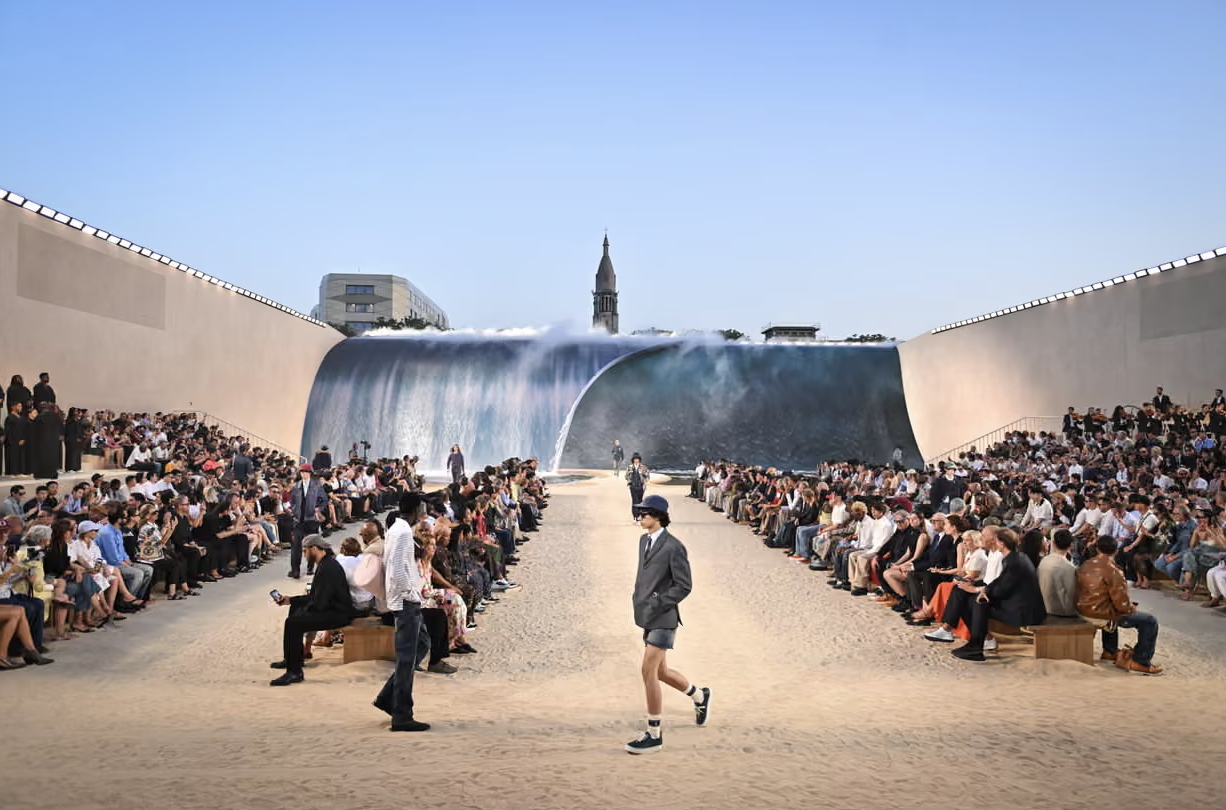
Louis Vuitton's SS27 men's show under Pharrell Williams transformed the Cite Internationale Universitaire in Paris into a man-made beach on 23 June, presenting a collection built around what Pharrell called "A Dandy Experience" - wetsuit-inspired fabrication, Loro Piana cashmere, trompe l'oeil techniques, surf embellishments and monogram surfboards. Four new unreleased tracks were premiered during the show, from Quavo, Lil Baby and YoungBoy NBA, continuing a pattern across Pharrell's consecutive Louis Vuitton men's shows of using the runway as a music premiere platform. A coral gardening partnership with Coral Gardeners - committing to 1,000 corals across 250sqm of reef - accompanied the collection.
• SS27 show staged at Cite Internationale Universitaire, Paris, 23 June 2026; four consecutive LV men's shows under Pharrell have premiered unreleased music
• New tracks from Quavo, Lil Baby and YoungBoy NBA debuted during the show; collection features Loro Piana cashmere and bespoke surf hardware
• Coral Gardeners partnership commits to 1,000 corals across 250sqm of reef restoration; attendees included Jeremy Allen White, Missy Elliott, Lola Young and J-Hope
Pharrell has turned the Louis Vuitton men's show into something the fashion industry has rarely seen: a cultural platform that simultaneously operates as a music label, an entertainment moment and a luxury product launch. Four consecutive shows premiering unreleased music is not a coincidence - it is a model. The runway is the best-attended, most documented, most culturally amplified launch event fashion produces. Using it to break new music means Pharrell is extracting cultural capital for the artists and for the brand simultaneously. Louis Vuitton gets the cultural heat; the artists get a platform that no streaming service can replicate. 🎵
Instagram Is Coming for Your Television 📺
Instagram has begun rolling out horizontal video on Samsung televisions from 22 June 2026, with episodic storytelling and live TV experiences confirmed as the next phase of development. The move marks a significant shift in Instagram's content strategy - from a mobile-first social platform toward a living room entertainment destination - and reflects the broader direction of social video: creators building longer, serialised content designed for passive viewing rather than active scrolling. Tessa Lyons, Instagram's VP of Product, framed the shift at Cannes Lions as part of a deliberate push toward "microdramas" and episodic formats for short-form creators.
• Horizontal video on Samsung TVs launched 22 June 2026; episodic and live TV formats confirmed as next phase
• YouTube was the most-watched television provider in the US in 2025, ahead of all traditional broadcast and cable networks
• TikTok's PineDrama initiative and HOORAE's content deal have established creator-led serialised drama as a commercially viable format
Instagram moving onto the television screen is not a product feature - it is a distribution strategy. The living room is the last mass-audience screen that social platforms have not fully colonised, and YouTube's dominance of US TV viewership in 2025 has demonstrated what is possible. For creators, this changes the economics of content: longer formats, episodic structures and passive viewing behaviour mean that the skills required to succeed on Instagram television are closer to those of a TV producer than a social media creator. The platforms are building toward entertainment; the creators who adapt earliest capture the most value. 📡
Fred Again Announces India Tour 🎶
📌 Fred Again has announced his first ever India shows, confirming three dates in December 2026. The tour - Delhi on 5 December at Leisure Valley Ground, Mumbai on 9 December at Mahalaxmi Race Course, and Bengaluru on 13 December at NICE Grounds - has been made possible in part through a Monkey Shoulder sponsorship, with tickets priced at 1,750 and 3,500 rupees (approximately £17 and £34), significantly below what comparable international acts charge in Western markets. Tickets go on sale via BookMyShow from 29 June 2026.
Three shows: Delhi (5 Dec, Leisure Valley Ground), Mumbai (9 Dec, Mahalaxmi Race Course), Bengaluru (13 Dec, NICE Grounds)
Ticket prices: 1,750 and 3,500 rupees (approximately £17 and £34); on sale via BookMyShow from 29 June 2026
Fred Again's 2026 live activity to date closed with a historic b2b with Thomas Bangalter at Alexandra Palace on 27 February; the India dates are his only currently confirmed shows for the rest of the year
💡 The significance of Fred Again choosing India for his next confirmed run is not just cultural - it is commercial. Brand sponsorship enabling sub-£35 ticket pricing at stadium-scale venues demonstrates the model through which international acts can access emerging markets without the economics of Western touring. India's live music infrastructure is developing rapidly, and the combination of genuine demand, a growing middle-class fanbase and sponsorship-subsidised access creates conditions that are increasingly attractive to artists who want to grow audiences rather than extract from them. 🌏
Bose Launches Bose Studios and Bose Records 🎵
Bose has launched two creative entities simultaneously: Bose Studios, a content production company backed by Michael Sugar's Sugar23 and confirmed to have a project with Steven Soderbergh in development, and Bose Records, a label that takes no ownership of masters and no cut of streaming revenue, allowing artists to sign elsewhere simultaneously. The first signing to Bose Records is Grammy-nominated artist Alissia. The dual launch positions Bose not as a traditional brand sponsor of music but as an active participant in the creative and commercial infrastructure of the industry.
• Bose Studios backed by Sugar23 (Michael Sugar); Steven Soderbergh project confirmed in development
• Bose Records takes no ownership of masters and no streaming revenue share; artists can sign to other labels simultaneously
• Grammy-nominated artist Alissia is the first signing to Bose Records
Bose is making a very deliberate architectural choice here: a record label that doesn't behave like a record label. No masters, no streaming cut, no exclusivity - it is brand participation in the music industry structured to look like patronage rather than extraction. That distinction matters for the artists who sign, and it matters for how Bose is perceived culturally. Red Bull Records is the only comparable precedent at this scale, and it took years to establish genuine credibility. The question is whether Bose can build the same - and whether the Soderbergh film project signals that Bose Studios is the more commercially significant bet of the two. 🎧
Boy George and Artist Included Re-record "Karma Chameleon" Using AI 🤖
Boy George has re-recorded "Karma Chameleon" in collaboration with Artist Included, a new AI venture co-founded by Paul Kemsley and Jeremy Rosen with Robert Earl (Planet Hollywood) as chairman, using Syntiant neural processing technology developed with original producer Steve Levine. The process involved Boy George re-singing the track while AI reshaped his current vocal to match the sonic character of his 1983 performance - a process that took 18 months to refine. The release is on BMG in partnership with the venture. The context: a Virgin sync deal has generated approximately $4 million for the original "Karma Chameleon" recording, none of which reached George under his original contract terms.
• AI vocal reshaping developed with Syntiant technology and original producer Steve Levine over 18 months
• A Virgin sync deal generated approximately $4 million for the original "Karma Chameleon" recording under existing contract terms
• Artist Included co-founded by Paul Kemsley and Jeremy Rosen; Robert Earl (Planet Hollywood) serves as chairman; released on BMG
The framing here is important. This is not an AI replacing an artist - it is an artist using AI to reclaim commercial value from a recording that has generated millions he never received. The original "Karma Chameleon" sync revenue flowing to Virgin rather than George is the structural injustice the project is responding to. Whether the re-recording achieves that commercially is a separate question, but the motivation is a specific grievance about how the legacy recording industry treats catalogue ownership and sync revenue - and AI is the tool being used to create an alternative asset. ⚠️
Olivia Rodrigo's Daisy Chain Fields Festival Is All-Women, All-Free, All-Charity 🌼
Olivia Rodrigo has announced Daisy Chain Fields, a one-day festival on 29 August at Great Park in Irvine, California, built on three structural commitments: an all-women lineup, every artist performing for free, and 100% of net proceeds going to charity. The lineup includes Bikini Kill, Chappell Roan, Doechii, Garbage, Mitski, The Breeders, Santigold, Rachel Chinouriri, KATSEYE and special guests Karen O, Sarah McLachlan and Stevie Nicks. Ten charity partners include the Center for Reproductive Rights, Planned Parenthood and the National Women's Law Center. McLachlan - whose Lilith Fair directly inspired the event - was the first person Rodrigo called. The festival is produced by C3 Presents and Live Nation.
• All-women lineup performing for free; 100% of net proceeds to ten charity partners including Center for Reproductive Rights and Planned Parenthood
• Lineup includes Bikini Kill, Chappell Roan, Doechii, Garbage, Mitski, The Breeders, Santigold and special guests Karen O, Sarah McLachlan and Stevie Nicks
• 29 August 2026, Great Park, Irvine, California; produced by C3 Presents and Live Nation
What Rodrigo has built here is a values statement that operates as a cultural product. The decision to have every artist perform for free is not a logistical detail - it is the editorial position of the entire event, and it changes the meaning of every act on the bill. Lilith Fair, which Rodrigo cites as the direct inspiration, was commercially successful precisely because it demonstrated that a women-led festival could generate genuine cultural momentum and audience. Daisy Chain Fields is making the same argument in 2026, with an additional layer: directing all commercial output to causes that are directly under political pressure. That is a specific and deliberate structural choice. 🌸
Art Reclaiming the Language of Violence - Barcelona and Edinburgh 🎨
Two distinct activist art interventions have deployed the visual language of historical and contemporary violence as political communication in European cities this month. In Barcelona on 20 June, the Chilean collective Casagrande conducted a Poem Bombing of the Gothic Quarter, dropping thousands of poems from helicopters referencing the Spanish Civil War bombings of the same streets - reclaiming the act of aerial attack as an act of literature. In Edinburgh, Doug Crabtree's "The Killing of Hind Rajab National Scotland Tour" displayed a replica of the black Kia vehicle that carried Hind Rajab and her family in Gaza, marked with 335 bullet holes corresponding to the rounds fired into it, alongside a replica Palestine Red Crescent ambulance.
• Casagrande's Poem Bombing dropped thousands of poems over Barcelona's Gothic Quarter on 20 June, referencing Spanish Civil War aerial bombardments of the same streets
• Crabtree's Edinburgh installation features a replica vehicle with 335 bullet holes - one for each round fired into the car carrying Hind Rajab - and a replica PRCS ambulance
• The Edinburgh tour ran across four Scottish cities in April 2026; supported by Scottish Palestine Solidarity Campaign and Edinburgh Gaza Genocide Emergency Committee
Both works are doing something specific: using physical replication to make abstract numbers tangible. 335 bullet holes is a count that becomes incomprehensible when stated as a figure; as holes in a car body, it becomes a material reality. Thousands of poems falling from the sky is not a re-enactment that transforms the meaning of what happened in the same streets. For brands operating in cultural and creative spaces, the relevance is this: political art is becoming increasingly precise in its methods, and the question of whether and how to engage with that precision is one that cultural marketing cannot indefinitely defer. ✊
TIDAL Launches Direct-to-Fan Sales at 90% Revenue Share 💰
TIDAL has launched a direct-to-fan sales tool offering artists a 90% revenue share, using Square payments infrastructure that switched from Stripe from 4 June 2026. The tool is currently available to US-based artists selling to US-based fans, covers digital products and physical merchandise, and does not generate streaming royalties - positioning it as a Bandcamp competitor rather than an extension of TIDAL's streaming model. Fans can preview and purchase without a TIDAL subscription, lowering the barrier to entry for artists whose audience may not be on the platform.
• 90% revenue share on direct-to-fan sales; Square payment processing (switched from Stripe, 4 June 2026)
• Currently US-only for both artists and fans; no streaming royalties generated on Upload tracks
• Fans can preview and purchase without a TIDAL subscription; positions directly against Bandcamp's fan-owned commerce model
A 90% revenue share is a significant number, and TIDAL knows it. In a market where Bandcamp's 85% is the existing benchmark for artist-friendly commerce, TIDAL is positioning slightly above that while adding the credibility of Block's payments infrastructure. The US-only limitation is a constraint that will eventually expand, but the more interesting structural question is whether TIDAL's streaming audience converts into a meaningful direct-to-fan buyer base - or whether artists use the tool and keep their audiences elsewhere. Direct-to-fan commerce is only valuable if the platform that hosts it also generates discovery. 🎵
Warner Music Group Acquires Sureel AI to Track AI Training Use of Music 🤖
Warner Music Group has acquired Sureel AI, a company that has built what it describes as an "AI DNA" system for songs - breaking recordings into constituent components to trace whether and how they have been used in AI training datasets. The system also includes a name, image and likeness attribution suite tracking voice clones, avatars and style replication across millions of music assets, extending to video and image. Sureel will operate as a standalone entity. The team includes Pledgemusic co-founder Benji Rogers and former UMG executive Aileen Crowley. WMG previously sued and then separately licensed Suno, the AI music generation platform.
• Sureel's registry covers millions of music assets; NIL suite tracks voice clones, style replication and avatar use across audio and visual media
• Team includes Pledgemusic co-founder Benji Rogers and former UMG executive Aileen Crowley; Sureel operates as standalone entity post-acquisition
• WMG CEO Robert Kyncl; WMG previously sued and later licensed AI music platform Suno
The acquisition of Sureel is WMG positioning itself to own the evidentiary infrastructure for AI music disputes. If you can prove what was used to train which model, you control the legal and licensing conversation that follows. The move from suing Suno to licensing it, and now acquiring attribution technology, traces a clear strategic arc: WMG is not trying to stop AI music, it is trying to be the entity that defines the terms on which AI music operates. Owning the detection layer is the most powerful position in that negotiation. 🔍
UMG and Sony Expand Suno Lawsuit to 61,000 Recordings 🎵
Universal Music Group and Sony Music have expanded their copyright infringement lawsuit against Suno, the AI music generation platform, to 61,026 recordings after using Audible Magic fingerprinting technology to identify the presence of their material in Suno's training data during a court-approved inspection in November 2025. The labels describe 61,026 as "only a small fraction" of affected recordings. Suno has attempted to seal the training data figures and is opposing the expansion. A summary judgment hearing is scheduled for July 2026. Warner Music Group settled separately in November 2025 and exited as a plaintiff. An independent artist class action, Nguyen v. Suno, proceeds separately in the Northern District of California.
• 61,026 recordings identified via Audible Magic fingerprinting after physical access to Suno's training data in November 2025; labels describe this as "only a small fraction"
• Suno opposing the case expansion and attempting to seal training data figures; summary judgment hearing scheduled July 2026
• WMG settled November 2025 and exited as plaintiff; independent artist class action (Nguyen v. Suno) proceeds separately in N.D. California
The expansion to 61,026 recordings with the caveat that this is "only a small fraction" is the most significant line in this story. It tells you that the labels believe the total figure is vastly larger, and that the fingerprinting process - once complete - will produce numbers that change the scale of the legal and financial exposure Suno faces. For the wider AI music industry, this is the litigation that will set the precedent. The settlement WMG reached is the template; whether that template becomes the standard or whether UMG and Sony push for structural remedies rather than licensing fees is the question that will define the next phase. ⚖️
New York's Synthetic Performer Disclosure Law Takes Effect 📜
New York's first-in-nation Synthetic Performer Disclosure Law came into effect on 9 June 2026, having been signed in December 2025 with SAG-AFTRA backing. The law requires conspicuous disclosure for any AI-generated human likeness used in advertising that reaches New York consumers, regardless of where the advertiser is based. First violations carry a $1,000 fine; subsequent violations cost $5,000. The law excludes audio-only content, language translation, and expressive works, but captures the broad category of AI-generated visual human likenesses in commercial advertising contexts.
• Effective 9 June 2026; $1,000 first violation, $5,000 for subsequent violations; applies to any ad reaching NY consumers regardless of advertiser location
• Backed by SAG-AFTRA; excludes audio-only, language translation and expressive works from disclosure requirements
• First state-level law in the US to mandate disclosure of AI-generated human likenesses in advertising
The significance of this law extends beyond New York. A disclosure requirement that applies to any ad reaching New York consumers regardless of where the advertiser is based is, in practice, a near-national standard - because virtually every major advertising campaign reaches New York. Brands cannot run separate creative executions for New York and everywhere else at meaningful scale. This means the compliance cost and the creative constraint are effectively national, even though the law is state-level. Watch for other states to follow, and watch for the federal conversation to accelerate. 🗽
Wimbledon's Fashion Stakes Rise with Miu Miu x New Balance and Nike 👟
Two of the WTA's most commercially significant players have arrived at Wimbledon 2026 with capsule collections that reframe what tennis kit means. Coco Gauff is wearing a Miu Miu x New Balance Wimbledon capsule - 13 pieces including a pleated skirt, scalloped tops, silk-tech jacket and the NB 530 SL in white and brown leather at $1,270 - launched on 23 June and available through Miu Miu boutiques and miumiu.com. Naomi Osaka's Nike Wimbledon dress ($185), featuring a kirigami-inspired design with 3D appliqued flowers and a micro-pleated hem, sold out nearly every size within hours of launch. Osaka noted on Threads that fans had sold out the dress before she had worn it on court.
• Miu Miu x New Balance Wimbledon capsule launched 23 June; NB 530 SL retails at $1,270; 13-piece collection available through Miu Miu boutiques globally
• Naomi Osaka's Nike Wimbledon dress ($185) sold out near-completely within hours of launch; Osaka posted on Threads: "You guys selling out my Wimby dress before I even had the opportunity to wear it on court is really gagging me"
• Gauff and Osaka are the only WTA players with full global signature collections; both collections are Wimbledon dress code compliant
Two different models of cultural value are operating here simultaneously. The Miu Miu x New Balance collaboration is fashion renting tennis credibility - Miu Miu builds cultural authority by positioning itself on the most prestigious court in the world, while New Balance gains luxury association it could not achieve independently. The Nike/Osaka relationship is different: it is fashion generating demand from an athlete's existing cultural capital, to the point where fans are buying the product before the athlete has worn it competitively. One is borrowed standing; the other is owned. The sell-out is the proof of which has more durable value. 🎾
Sony Pictures Invests $100 Million in Cosm's Immersive Venue Network 🎬
Sony Pictures has led a $100 million Series C investment in Cosm, taking a minority stake and placing CEO Ravi Ahuja on Cosm's board. Cosm operates 87-foot, 12K LED dome venues in Los Angeles, Dallas and Atlanta, with Detroit and Cleveland in development, using its proprietary Shared Reality technology to create live and entertainment experiences at a scale that cannot be replicated at home. Recent activations have included the FIFA World Cup, NBA Finals, UFC, and entertainment IPs including Harry Potter, The Matrix and Willy Wonka. Other investors include Fox, Kroenke Sports and Marc Lasry.
• Sony Pictures leads $100M Series C; CEO Ravi Ahuja joins Cosm board; existing investors include Fox and Kroenke Sports
• Cosm operates 87-foot 12K LED dome venues in LA, Dallas and Atlanta; Detroit and Cleveland in development
• Shared Reality technology has hosted FIFA World Cup, NBA Finals, UFC, Harry Potter and Matrix experiences
Sony Pictures investing in Cosm is a bet on physical presence as a competitive advantage in an era of abundant home streaming. The proposition is simple: a 12K LED dome showing a live sporting event creates an experience that a television - however large or sophisticated - cannot replicate. The question is whether the economics work at the venue count required to build a meaningful network, and whether the content rights relationships necessary to fill those domes with live sport can be secured at terms that make sense. Fox and Kroenke's presence as investors suggests the sports rights access question is being taken seriously. 🏟️
IOC Launches $140 Million "Fit for the Future" Athlete Grant Fund 🏅
The International Olympic Committee has announced a $140 million grant fund paying $10,000 to every eligible Olympian per Olympic cycle, regardless of performance or medal result. The fund - named "Fit for the Future Olympian Grant" - will first be distributed to approximately 2,900 eligible athletes from the Milano Cortina 2026 Winter Olympics, followed by approximately 11,000 LA28 athletes. Grants are delivered via National Olympic Committees and athletes with doping or ethics violations are excluded. The announcement was made by Pau Gasol at the 146th IOC Session in Lausanne. The IOC generated $7.7 billion in commercial revenue in the 2021-2024 cycle.
• $10,000 per eligible Olympian per cycle regardless of performance; $140M total per cycle; first distribution to Milano Cortina 2026 athletes (~2,900 eligible)
• Delivered via National Olympic Committees; doping and ethics violations result in ineligibility
• IOC generated $7.7 billion in commercial revenue 2021-2024; announced by Pau Gasol at 146th IOC Session in Lausanne
$10,000 per athlete per cycle is a meaningful gesture and a very modest redistribution from a $7.7 billion commercial revenue base. The IOC is not sharing profits - it is making a career support payment that acknowledges the gap between athlete sacrifice and athlete income, particularly for those who never reach the medal podium. The more significant signal is the framing: "Fit for the Future" positions this as investment in athletes' long-term viability, not prize money. That framing is important for the IOC's narrative around athlete welfare, but the gap between $140 million distributed and $7.7 billion generated is a number that will not go unnoticed. 🎖️
CIVICUS Raises Female Athlete Executions and World Cup Human Rights at UN 🏳️
CIVICUS presented a statement at the UN Human Rights Council's 62nd Session on 23 June, at a panel on women and girls in sport, naming at least six female athletes executed by Iran in 2026 including Pakhshan Aziz, Sharifeh Mohammadi and Verisheh Moradi. The statement also named Hoda Abdel Moneim and Kenia Hernandez, and called on the UN Office of the High Commissioner for Human Rights and the Special Rapporteur on extrajudicial executions to issue a public statement. Separately, CIVICUS's Global Solidarity Cup campaign is mapping human rights conditions in all 48 World Cup host states, with a human rights coalition including Human Rights Watch, Amnesty International and the ACLU maintaining pressure on FIFA throughout the tournament.
• At least six female athletes executed by Iran in 2026 named in CIVICUS statement at UN Human Rights Council 62nd Session, 23 June
• CIVICUS calls on OHCHR and Special Rapporteur on extrajudicial executions to issue public statement; Global Solidarity Cup maps conditions in all 48 World Cup host states
• Human rights coalition (HRW, Amnesty, ACLU, Dignity 2026, Sport and Rights Alliance) has maintained sustained pressure on FIFA; FIFA awarded Trump a FIFA Peace Prize in December 2025
The juxtaposition that no institution wants to articulate directly: the FIFA World Cup is generating record commercial revenue in host cities while a coalition of human rights organisations is documenting executions, journalist arrests and inadequate child safeguarding plans across the same tournament. For brands sponsoring or activating around the World Cup, the question is not abstract. What does association with an event look like when the UN is being asked to comment on executions connected to sport in the same week the knockout stage begins? Brand safety frameworks exist precisely for this kind of calculation. ⚖️
World Cup Ambush Marketing Outperforms Official Sponsorship on Cultural Currency ⚽
Three non-official FIFA World Cup sponsors have generated significant earned media and cultural traction through precision ambush marketing during the tournament's group stage. Levi's tarpaulin cover of a competitor's signage generated 9 million TikTok views and has been rolled out to seven global markets as a full campaign. Beats by Dre's teaser built around a masking-tape photograph of Jamal Musiala has generated significant pre-launch attention for an unreleased headphone product ("Spoiler alert: it's a b."). Heinz turned a taped ketchup bottle into a limited-edition release. Meanwhile Unilever, as official Personal Care Sponsor, has deployed a 35-brand activation model including "The Locker Room", a 24/7 real-time content operation with creator hubs in New York, Mexico City and Miami.
• Levi's ambush tarpaulin generated 9 million TikTok views; rolled out to 7 global markets as a campaign
• Beats by Dre Musiala masking-tape teaser builds toward unreleased headphone launch; Heinz taped bottle became a limited-edition product release
• Unilever (official sponsor): 35+ brands activated, including House of Fresh creator hubs in NYC, Mexico City and Miami, and 24/7 "The Locker Room" content operation
The three ambush plays share a structural logic: the restriction or constraint is the creative device. The tarpaulin is interesting because it covers something. The masking tape is interesting because it hides something. The Heinz bottle is interesting because it looks like it shouldn't be sold. Official sponsorship at this scale is about category ownership and association rights; ambush marketing at its best is about attention engineering. The Levi's case is the most instructive: 9 million TikTok views and a global campaign rollout from a piece of canvas. The enforcement created the content. ⚽
Michele Kang Acquires Olympique Lyonnais in Landmark Women's Football Deal 🏆
Michele Kang has acquired an 87.78% stake in Olympique Lyonnais from Eagle Bidco - Textor's Eagle Football Group - for $30 million, committing a further €71 million in capital injection over two seasons. The deal required creditors Goldman Sachs, MetLife and MUFG to grant 18-month concessions on approximately €232.6 million of subordinated debt and remains conditional on DNCG approval of Ligue 1 status. Kang already owns OL Lyonnes (the women's team), Washington Spirit in the NWSL and London City Lionesses in the WSL, all operating under her Kynisca umbrella. The acquisition makes Kang one of the most significant owners in world football - not just women's football.
• $30M acquisition price for 87.78% stake; €71M capital injection committed over two seasons; ~€232.6M subordinated debt written off by creditors Goldman Sachs, MetLife and MUFG
• Kang owns OL Lyonnes (women's), Washington Spirit (NWSL), London City Lionesses (WSL) under the Kynisca umbrella; deal conditional on DNCG Ligue 1 approval
• Textor's response to the sale process described as "Smear, divide, and conquer"; deal represents one of the most significant ownership transitions in European club football in 2026
Kang's acquisition of Olympique Lyonnais is the moment where women's sports investment moves from a portfolio play into something more structurally ambitious. Owning the men's and women's sides of one of Europe's most decorated clubs - plus a WSL and NWSL team - creates a talent development, commercial and data infrastructure that no other women's sports owner has. The $30 million entry price for a club of this history and brand equity is also a signal about where European club football valuations are heading when debt levels reach this scale. Kang has acquired cultural capital that would cost multiples in any other context. 🌍
PwC: Global Ad Spend Crossed $1 Trillion in 2025, Heading for $1.4 Trillion by 2030 📈
PwC's Global Entertainment and Media Outlook 2026-2030, published 22 June, confirms that global advertising spend crossed $1 trillion for the first time in 2025 and is forecast to reach $1.4 trillion by 2030 at a 5.6% CAGR, driven by AI-powered hyper-personalisation. Total global E&M revenue reached $3.5 trillion in 2025 and is projected to grow to $4.2 trillion by 2030. Internet advertising reached $755.6 billion in 2025, up 12.2% year on year and projected to grow at 7.2% CAGR. Traditional TV continues its structural decline, falling 2.7% in 2025 to $360.5 billion and projected to reach $341.2 billion by 2030. Online gambling has doubled since 2021 to $79.5 billion - larger than the global cinema market. Live music is projected to reach $41.5 billion by 2030.
• Global ad spend crossed $1 trillion in 2025; projected $1.4 trillion by 2030 (5.6% CAGR); internet advertising: $755.6B in 2025, +12.2% YoY (source: PwC Global E&M Outlook)
• Traditional TV: -2.7% in 2025 to $360.5B, declining to $341.2B by 2030; live music projected at $41.5B by 2030
• Online gambling doubled 2021-2025 to $79.5B - now larger than the global cinema market; total E&M: $3.5T in 2025 projected to $4.2T by 2030
The trillion-dollar ad spend figure is the number the industry will be quoting for the next decade, and it matters for OTR's audience because it contextualises everything else in this edition. The Omnicom/Netflix data deal, the ESPN Fan House participation model, the Snapchat private channels research, the OpenAI advertising projections - all of these are individual data points within a market that has just confirmed its scale at a level that changes strategic conversations. The shift of that spend toward AI-powered personalisation and away from linear television is not a gradual evolution. The TV decline numbers confirm it is structural. 💡
Serena Williams Returns to Wimbledon Singles at 44 🎾
Serena Williams has accepted a singles wild card for Wimbledon 2026, making her first Grand Slam singles appearance since her defeat to Ajla Tomljanovic at the 2022 US Open. Williams is 44 years old and carries no current singles ranking, meaning she could be drawn against any seed in the first round. She is also confirmed for doubles with Venus, their first pairing at a Grand Slam in approximately a decade. Williams' Wimbledon record stands at 98-14 in singles - two wins from a century. Her seven Wimbledon singles titles, the last in 2016, remain the most of any player in the Open Era alongside Martina Navratilova and Steffi Graf.
• First Grand Slam singles appearance since 2022 US Open defeat to Tomljanovic; Wimbledon singles record 98-14 - two wins from 100
• Confirmed for doubles with Venus Williams - first Grand Slam pairing in approximately a decade; no current singles ranking, first round draw unrestricted
• Seven Wimbledon singles titles (last 2016); wild card accepted 21 June 2026
The commercial and cultural logic of Serena's return is inseparable from the sporting one. Wimbledon is the most globally televised Grand Slam; a Serena Williams first-round match generates media value that no other wild card entry in tennis history can match. For the tournament, this is a content event as much as a sporting one. For Serena, a run at a hundred singles wins at Wimbledon - she needs two - is a narrative that writes itself. The question of whether her body can execute what her reputation commands is the only variable. Everything else is already in place. 👑
ESPN Launches Fan House Participation Platform for College Football Season 📱
ESPN has announced Fan House, launching in August 2026 at the start of the college football season, a participation-based platform powered by Flowcode QR technology that allows fans to engage with live polls, trivia, sweepstakes, merchandise and brand integrations while watching games. Publicis Sports is named as the first agency partner. The platform integrates digital wallet functionality and exclusive rewards into the ESPN app. ESPN averaged 2.2 million viewers per game last college football season - its highest since 2011 - and College GameDay drew a record 2.7 million viewers. The announcement was made at Cannes Lions on 22 June.
• Fan House launches August 2026; powered by Flowcode QR; participation model includes polls, trivia, sweepstakes and brand integrations
• Publicis Sports is first agency partner; digital wallet and exclusive rewards integrated into ESPN app
• ESPN averaged 2.2M viewers per college football game in 2025 (highest since 2011); College GameDay: 2.7M viewers (record)
ESPN is building the participation layer that makes linear television sticky again. The problem with broadcast sport in a streaming era is not the sport - it is everything around it. Fan House is an attempt to give the audience something to do during the game, a reason to stay in the app rather than migrate to a second screen. The Flowcode QR integration is the mechanics; the commercial logic is brand integrations that benefit from a captive, high-intent audience already in an activation mindset. If it works, it is a model that every major sports broadcaster will adopt. 📺
Omnicom Media and Netflix Launch First-Ever Data Collaboration 🎬
Omnicom Media Group has announced a first-of-its-kind data collaboration with Netflix, combining Acxiom audience segments with the Netflix Ads Suite and large language model technology to enable brands to integrate their assets into Netflix's visual environment. The partnership includes "digital twin" technology that allows brand assets - products, packaging, visual identity - to be rendered in Netflix's visual style, including potential placement within Netflix content. Closed-loop measurement is included. The collaboration launched in the US and will expand globally by year-end. Bimbo Bakeries is confirmed as the first client. A separate partnership with NBCUniversal enables dynamic contextual advertising at the episode and scene level, currently in beta testing. Both were announced at Cannes Lions on 22 June.
• Omnicom x Netflix: Acxiom audiences + Netflix Ads Suite + LLM; "digital twin" technology integrates brand assets into Netflix visual environment; closed-loop measurement
• Bimbo Bakeries confirmed as first client; live in US, global expansion by year-end 2026
• Separate NBCU partnership: dynamic contextual ads to episode/scene level; currently in beta testing; both announced at Cannes Lions 22 June
The phrase "digital twin technology" is doing a lot of work in this announcement and deserves unpacking. What Omnicom and Netflix are describing is the ability to render a brand's products inside Netflix content - not as traditional product placement negotiated at the production stage, but as a post-production AI layer that can be applied at scale across existing content. If that is what is actually being built, the implications for the production deal model, for talent contracts and for content rights frameworks are significant. The closed-loop measurement is the commercial proof of concept; the digital twin is the long-term asset. 📊
Piers Morgan Uncensored Raises $27 Million at $145 Million Valuation 📺
Piers Morgan Uncensored has raised $27 million in a funding round led by Raine Ventures and Antenna Group, with strategic investors including Elisabeth Murdoch, Simon and David Reuben. The valuation is $145 million. CEO Rashida Jones, the former MSNBC president, is leading the commercial expansion. The company's channel portfolio - Piers Morgan Uncensored (4.43 million YouTube subscribers, 1.4 billion views), History Uncensored, The Royals Uncensored and World Cup Uncensored - has an Antenna content licensing deal reaching 500 million users globally. Channel 5 (Paramount UK) handles UK distribution; Time Studios holds a long-form interview deal. Morgan left Rupert Murdoch's TalkTV in 2025, retaining brand ownership.
• $27M raised at $145M valuation; Raine Ventures and Antenna Group lead; strategic investors include Elisabeth Murdoch and the Reuben brothers
• CEO Rashida Jones (former MSNBC president); Piers Morgan Uncensored: 4.43M YouTube subscribers, 1.4B views; Antenna content licensing deal reaches 500M globally
• Channel 5 (Paramount UK) distribution; Time Studios long-form interview deal; Morgan left TalkTV in 2025 retaining brand ownership
The $145 million valuation on a YouTube-native interview channel is the data point that matters here, and it tells you something important about where media asset value is consolidating. Morgan's decision to leave TalkTV while retaining brand ownership - and then raise at this valuation - is the most commercially intelligent thing he has done in his career. The audience he built on a linear channel became an asset he owned rather than one the network owned. The Rashida Jones appointment and the Raine Ventures-led round signal that this is being built as a serious media company, not a vanity project. The subscriber count is the collateral. 📡
Snapchat Research: 63% of People Now Connect Primarily Through Private Channels 💬
Research conducted by Snapchat and Mindscope, presented at Cannes Lions as part of their Reset Velocity model for EMEA audiences, finds that 63% of people now connect primarily through direct messages and private Stories rather than public feeds, with 85% sharing privately between one and ten times per day. Among Snapchat's own user base, 59% use the app primarily for DMs compared to 18% on the average social platform. Separately, 56% of respondents prefer to interact with brands privately rather than through public or feed-based formats, compared to 20% who prefer public interaction. 950 billion Snapchat chats were sent in Q1 2026. Note: the research was commissioned by Snapchat.
• 63% connect primarily via DMs or private Stories; 85% share privately 1-10 times per day (source: Snapchat/Mindscope Reset Velocity, Cannes Lions)
• 59% of Snapchat users use primarily for DMs (vs 18% platform average); 56% prefer private brand interaction vs 20% public/feed
• 950 billion Snapchat chats sent in Q1 2026; research commissioned by Snapchat - treat directionally rather than as independent data
The caveat on this data matters - commissioned research by a platform with a direct commercial interest in the conclusion should be read directionally rather than as independent evidence. That said, the migration toward private communication is independently documented across multiple platforms and is visible in publisher referral data, group chat growth and the structural shift in how content travels. If brands and their agencies are still optimising for public feed reach as the primary metric, they are measuring the channel that audiences are most actively leaving. The Snapchat data overstates the case; the underlying direction is real. 🔒

🎙️ Can Traditional Media Actually Scale the Creator Economy? - Strictly Business, Variety
Why It Matters: Recorded live at Cannes Lions, this episode puts Fox Entertainment CEO Rob Wade and Fox Creator Studios head Billy Parks in the chair to explain why one of America's largest broadcast networks is going all-in on the creator economy - not to replace its TV business, but to use it as infrastructure for something new. Wade's decade with Gordon Ramsay - the YouTube clipping operation, the HexClad investment, the IRL events - is the working model. The question the episode forces is whether traditional media can genuinely enable creator independence, or whether "scale" is just a more polite word for acquisition.
Worth Your Time Because: This edition has tracked the creator economy's move from marketing channel to commercial infrastructure across Cannes, Bose Records, TIDAL, Olivia Rodrigo and the direct-to-fan stories. Wade and Parks are the counterargument - the case for institutional muscle as a creator accelerant rather than a ceiling. Whether you buy it or not, this is the conversation the industry is having right now, and it's more commercially honest than most.

(Monday 29 June - Sunday 5 July 2026)
🎾 Wimbledon begins (29 June - 12 July, All England Club, London) - the Championships open with Serena Williams in the singles draw for the first time since 2022, Venus and Serena in doubles together for the first time in a decade, and the fashion stakes unusually high with Miu Miu x New Balance and Nike both activated.
⚽ FIFA World Cup Round of 32 continues across the US, Canada and Mexico (29 June - 3 July) - with England, Brazil, Germany, France and Mexico all in action this week in the knockout stage. The last 16 begins 4 July.
🏎️ Formula 1 British Grand Prix (3-5 July, Silverstone) - one of the biggest single-venue sporting events in the UK, attracting over 400,000 fans across the weekend. A calendar highlight that doubles as a major brand activation moment.
🏏 ICC Women's T20 World Cup continues across England and Wales (until 5 July) - semi-finals stage approaching, with the tournament running until 5 July at venues including Lord's and The Oval.