Welcome to the next edition of On The Record, thoughtful analysis on culture, entertainment, tech, fashion, music, sport, and brands. Here's a round-up of key conversations and campaigns that caught my attention this week.
This edition lands in the quiet week between the World Cup's afterglow and the new season, and the stories in it keep coming back to what counts as proof. Nobody at Oasis has confirmed a single date, but a council licence filing did the marketing anyway. LIV Golf announced a rescue investor without confirming a number, and the gap between announcement and evidence tells you most of what you need to know. The PWHL doesn't need a broadcaster to validate its audience because it publishes its own viewership figures, Calvin Klein's CMO read out actual sales numbers on a podcast instead of gesturing at engagement, and a Munich court has ordered Suno to disclose exactly what its infringement earned. Even the BBC's own director-general handed the coalition opposing podcast advertising its best evidence, in committee, on the record. Meanwhile women's sport keeps setting price records almost as a by-product: a £1.25m WSL export fee, a $200m single-market rights deal within touching distance of what FIFA earned globally last cycle, a first solo shirt sponsor at Brighton, and, in the week's biggest story, the two women on UEFA's executive committee driving the revolt that killed a $20bn sell-off in three days. The receipts are talking louder than the press releases this week, and the sharpest operators were the ones who understood which documents actually move markets.

🏛️ SPORT, POWER & GOVERNANCE
YouTube Becomes the Broadcast Deal Emerging Women's Leagues Never Had 📺
Free global livestreaming is doing for emerging women's sport what television rights never got round to. Leagues without legacy network deals are building audiences directly on the platform, sidestepping the geographic gatekeeping that kept smaller properties off cable schedules for decades. The clearest evidence sits with the PWHL, now in its third season, where live viewership climbed sharply as the league's global footprint expanded. Women's Sport Trust research confirms the pattern extends well beyond hockey.
PWHL live YouTube viewership up 77% season over season in 2025-26, with fans tuning in from 154 countries, up from 106 the season before (PWHL)
WTA led YouTube views among all women's sport properties in 2025 with 185 million video views (Women's Sport Trust)
Women's properties outgrew men's across YouTube, Instagram and TikTok when comparing the top 10 global properties on each platform in 2025 (Women's Sport Trust)
💡 The leagues growing fastest right now are the ones with no legacy broadcast deal to protect, and that's the real signal here. PWHL's case for investment used to mean asking a network to take a bet on an audience nobody had measured, now it's a self-published viewership number the league controls and can put straight in front of broadcasters and sponsors. That changes who holds the cards in the next round of rights talks, leagues now arrive with their own proof of demand instead of waiting to be discovered 📺
London Submits Final Bid for 2029 World Athletics Championships After West Ham Standoff Resolved 🏟️
A bid nine years in the making has cleared its biggest obstacle just before the deadline. Athletic Ventures, the consortium behind London's push to host the 2029 World Athletics Championships, has submitted its final documents to World Athletics after reaching agreement with West Ham United over use of the London Stadium, a deal complicated further by the club's relegation to the Championship this season. The host city will be confirmed in September, with London last staging the event in 2017 to sold-out crowds.
Athletic Ventures, a joint venture of UK Athletics, London Marathon Events and the Great Run Company, projects more than £400m in economic and social benefit from the bid (London Stadium News)
World Athletics is scheduled to confirm the host city in September 2026 (London Stadium News)
The event's preferred September 2029 dates overlap with the start of the 2029-30 Premier League season, a clash the bid has tried to resolve with alternate July/August dates (Goal)
💡 West Ham's relegation this season should, in theory, have given the club less to lose in a stand-off over its own stadium, and instead it ended up conceding the ground to a UK Government-backed bid carrying more than £400m in projected economic benefit. The lease has always given major sporting events priority over league fixtures, so the "agreement" reported this week formalises a position the stadium's landlord has held from day one rather than settling anything new. For a venue built on Olympic legacy promises, that's the real story, a stadium whose primary tenant has less say over its own calendar than the events built to justify its existence 🏟️
UK Sport Strips GB Snowsport of Direct Funding Despite Britain's Best-Ever Winter Games 🎿
Delivering a country's best-ever medal haul is apparently no guarantee of keeping control of how that success gets funded. UK Sport has confirmed it will no longer route its record £33m Alpes 2030 investment through GB Snowsport, the sport's national governing body, once funding from the Milan-Cortina cycle ends. The decision comes months after GB Snowsport delivered Britain's most successful Winter Olympics on snow, including the country's first-ever snowsport gold medal, and arrives alongside a fresh independent governance review.
UK Sport is investing more than £33m across winter sports for the Alpes 2030 cycle, including £12.5m ringfenced for snowsport athletes and coaches, but will not route it through GB Snowsport (SnowBrains)
Milan-Cortina 2026 delivered Team GB's best-ever Winter Games on snow: five medals including three golds, among them Britain's first-ever snowsport gold in the mixed team snowboard cross (Newswav)
GB Snowsport says an independent governance review it commissioned, funded by UK Sport, has already confirmed its governance standards are "strong and appropriate" (GB Snowsport statement)
💡 Three golds and a best-ever medal haul turned out to be the wrong currency here. UK Sport is deciding who controls the money behind those medals, and routing funding through a new multi-sport delivery body would move power away from individual governing bodies entirely, treating snowsport as the test case for a structure that could spread across UK Sport's wider Olympic portfolio. GB Snowsport's governance review, confirming standards are "strong and appropriate," answers a question UK Sport doesn't appear to be asking. The real dispute sits over who controls the pipeline between public money and Olympic medals 🎿
Barcelona Break Their Own Transfer Record to Sign Kerolin From Man City ⚽
Eighteen months is all it took for Kerolin Nicoli to go from a January arrival in the WSL to its most expensive departure. Barcelona have signed the Brazilian forward from Manchester City on a four-year deal, smashing both the WSL's export record and their own long-standing reluctance to spend big on transfer fees. The deal underlines how quickly the ceiling on women's football valuations is moving, and how little patience Europe's top clubs now have for waiting out a rival's asking price.
Barcelona paid a fee believed to be around £1.25m, the largest ever received by a WSL club, breaking the previous record of £1m paid for Olivia Smith's move from Liverpool to Arsenal last summer (Sky Sports)
The fee also breaks Barcelona's own women's team transfer record, more than doubling their previous high paid for Keira Walsh in 2022 (Sky Sports)
Kerolin joined Manchester City from North Carolina Courage in January 2025 and helped the club win the WSL and Women's FA Cup last season before her move (Goal)
💡 Barcelona had never paid over £500,000 for a women's player before this deal, and breaking that ceiling for a player City signed just eighteen months ago says more about the direction of the market than about Kerolin specifically. Clubs used to wait out contracts and pick up players for nothing once patience ran out; paying a record fee for someone with two years still on her deal signals that the free-transfer era for peak-age talent is closing fast. For the WSL, the more uncomfortable number isn't the fee Barcelona paid, it's what City are now able to recoup on a player they signed for a fraction of that price ⚽
Netflix's $200m Women's World Cup Deal Reveals Streaming's New Math for Live Sport 📺
The reported price tag on one market's rights deal is nearly as large as everything FIFA earned globally from broadcasting the last Women's World Cup. Netflix is paying an estimated $200m for exclusive US and Canada rights to the 2027 and 2031 tournaments, according to people familiar with the terms, a sum FIFA has never previously secured from a single market for the women's competition. The deal lands as FIFA pushes to double total tournament revenue to around $1bn and as streaming platforms increasingly treat live sport as a subscriber and advertising engine rather than a prestige add-on.
Netflix is paying an estimated $200m for US and Canada rights to the 2027 and 2031 FIFA Women's World Cups, among the largest annual media deals in women's sport (Bloomberg)
FIFA's total global broadcast rights revenue for the entire 2023 Women's World Cup was around $270m, across every market combined (Bloomberg)
The fee is roughly 40% of the $485m Fox paid for US rights alone to the far larger, more established Men's World Cup in 2026 (Investing.com)
💡 A single market's rights fee for the women's tournament now sits within striking distance of what FIFA earned worldwide from the last one, and that's the number worth sitting with, more than the $200m headline itself. Streaming platforms are treating live women's sport the way they once treated prestige scripted drama, as a subscriber-acquisition tool worth overpaying for early, before the price catches up to the audience. FIFA gets a price benchmark for its next rights cycle, Netflix gets an exclusive tentpole to sell against Amazon and Disney in the same fight for live sport, and the actual football becomes the mechanism both sides are using to solve a completely different problem 📺
FIFA's $20bn World Cup Sell-Off Collapses After UEFA Boycott Threat, Two Women Led the Internal Revolt ⚽
A plan to sell stakes in football's biggest tournaments to private investors, including the Kushner family, lasted barely three days once European nations threatened to walk away entirely. FIFA president Gianni Infantino scrapped the proposed $20bn commercial venture late on the Friday after all 55 UEFA member nations agreed to boycott the World Cup and other FIFA competitions unless it was dropped. Behind the scenes, reporting from The Athletic found that the two women on UEFA's 21-member executive committee, Wales' Laura McAllister and Norway's Lise Klaveness, were among the most vocal figures pushing for the boycott and a governance overhaul.
Infantino's proposal to create a commercial venture and sell stakes in the World Cup and Club World Cup drew opposition from three confederations, with UEFA's 55 nations agreeing Thursday to boycott all FIFA competitions unless it was abandoned (NPR, ESPN)
Two senior FIFA officials broke ranks publicly the day before the plan collapsed, one resigning as a presidential adviser, another saying staff had been misled about the project (ESPN)
Of UEFA's 21-member executive committee, only two seats are designated for women, currently held by McAllister and Klaveness, and no non-designated seat has ever been held by a woman (The Athletic)
💡 The detail likely to get buried under the FIFA-Infantino headlines is who was actually driving the internal resistance once the crisis meeting started. According to The Athletic's reporting, it was McAllister and Klaveness, the only two women on UEFA's executive committee, who pushed hardest for the boycott and laid out what a leadership change would require, not the men occupying the body's other 19 seats. Both built their standing outside football's traditional power structures, as international players first, which raises the uncomfortable question the reporting itself points to, whether football is actually ready to put either of them forward for the top job, or only ready to lean on them when the institution is in crisis ⚽
LIV Golf Secures Lead Investor, Set to Make Players Majority Owners After Saudi PIF Pulls Funding ⛳
A league that spent four years running almost entirely on Saudi state money says it has found a way to keep going without it. LIV Golf CEO Scott O'Neil announced a signed, board-approved agreement with an unnamed lead investor, with reports putting the deal in the $250m-$300m range, though the league has not confirmed a figure. The restructuring would make LIV players majority equity holders, a first among major global sports leagues, four months after Saudi Arabia's Public Investment Fund said it would stop funding the league beyond 2026.
The board-approved deal with an unnamed lead investor is expected to close in September, with terms still being finalised and more than a dozen parties expressing interest as minority investors (Yardbarker, Golf.com)
Saudi PIF confirmed on 30 April 2026 it would end its backing after investing more than $5bn in LIV Golf since its 2022 launch (ESPN)
LIV 2.0 is expected to run 10 events, five international "Team Majors" and five US-based events tied to major championship weeks, with purses reportedly shrinking from $30m toward $15m-$20m (Golf.com)
💡 No dollar figure has actually been confirmed by LIV Golf itself, everything reported so far, the $250-300m range, the investor's identity, comes from unnamed sources rather than the league's own statement. That gap matters because the number determines whether "majority equity holders" is a meaningful ownership stake or a symbolic gesture attached to a fraction of what PIF was spending, over $5bn against a reported $250-300m replacement. Player equity sounds like power shifting toward the athletes who built LIV's roster, but with purses already set to shrink and financial terms still undisclosed, the real test is whether that equity is worth anything once the new investor's actual commitment becomes public ⛳
🎵 MUSIC, RIGHTS & OWNERSHIP
Blue Note Lands in London, Betting Its Opening Season on the Scene It's Entering 🎷
After 45 years anchored in Greenwich Village and expansions through Tokyo, Los Angeles, Milan, São Paulo and Shanghai, the world's most recognised jazz brand is opening its first UK venue this September. Rather than leaning on legacy American names to sell the opening season, the initial lineup is built substantially around the artists driving Britain's current jazz resurgence. The symbolism runs deep too, opening night falls on what would have been John Coltrane's 100th birthday.
Blue Note London opens 23 September 2026 in the basement of St Martins Lane hotel, Covent Garden, its first UK venue (Pollstar)
Opening lineup includes Robert Glasper as creative ambassador (opening night, plus a seven-show November residency), Erykah Badu, Jamie Cullum, Nubya Garcia, Yussef Dayes, Kokoroko, Hak Baker and Shabaka (Resident Advisor)
Two performance spaces: a 250-capacity main room with two nightly shows, and a 100-capacity B-Side room opening later in 2026 dedicated to emerging British talent (UK Jazz News)
💡 The opening lineup reveals what Blue Note actually needs from London. Yussef Dayes, Nubya Garcia, Kokoroko and Hak Baker built their audiences over years through the UK jazz scene's own festivals, labels and word of mouth, not through any Blue Note stage. Attaching that momentum to a 45-year-old American brand gets Blue Note instant local credibility in a scene it hasn't previously had a claim on. The harder question is whether that credibility compounds into something the London scene still owns once the opening season ends, or whether it simply becomes another line on Blue Note's global expansion map 🎷
Oasis Promoter's Knebworth Licence Application Becomes a Marketing Event of Its Own 🎸
A routine council filing has done more to fuel Oasis reunion speculation than any official announcement could. North Hertfordshire Council has granted SJM Concerts, promoter of the band's record-breaking Live '25 tour, a licence to stage events for up to 125,000 people at Knebworth Park, site of the band's legendary 1996 shows. Nothing has been confirmed by Oasis, Noel or Liam Gallagher, yet reports of a 2027 return, including a rumoured Etihad Stadium residency in Manchester, have gathered pace regardless.
SJM Concerts secured a licence from North Hertfordshire Council permitting events of up to 125,000 people at Knebworth Park, with music running until 3am, effective immediately and indefinitely (BBC News via NME)
Oasis last played Knebworth across two nights in August 1996, setting a UK attendance record later broken by Robbie Williams' 375,000-strong three-night run in 2003 (Time Out)
Reports point to a rumoured six Knebworth shows over three weeks in September 2027, alongside a residency at Manchester's Etihad Stadium (Music-News.com)
💡 No band member, promoter or venue has confirmed a single date, and that's precisely what makes the filing effective. A compliance document meant for a council planning committee has done the work of a teaser campaign, generating days of press coverage and fan speculation without SJM or Oasis spending a marketing pound or risking a premature announcement. That's the real advantage of a reunion this mythologised, the demand is already so certain that even the paperwork trail becomes content, and confirmation itself starts to feel almost beside the point 🎸
Spike Lee and Clara Wu Tsai Turn Personal Brooklyn Credibility Into a Standing Institution 🎬
A borough this culturally mythologised rarely gets a festival built from the inside. This November, Brooklyn Academy of Music becomes the site of Playback: The Brooklyn Watch Party, a new two-day festival co-hosted by Spike Lee and Nets/Liberty owner Clara Wu Tsai, produced by filmmaker Nicholas Ma. The event pairs film screenings and live performance with a free street fair, positioning itself less as a one-off premiere and more as an annual civic gathering point.
Playback runs 6-7 November 2026 at BAM, opening with a Friday night of music, poetry, film and talks at the Howard Gilman Opera House, followed by a Saturday of guest-curated screenings and a free block party (Forbes)
Co-hosted by Spike Lee and Clara Wu Tsai, owner of the New York Liberty, Brooklyn Nets and Barclays Center, produced by Nicholas Ma, director of the WNBA documentary Unfinished Business (Forbes)
The weekend closes with a screening of Lee's Crooklyn, featuring appearances from Lee and Alfre Woodard (Time Out)
💡 Most celebrity-backed festivals borrow a place's credibility for a weekend. Lee and Wu Tsai already hold theirs, Lee through five decades of putting Brooklyn on screen, Wu Tsai through Barclays Center and the Liberty's rise into one of the WNBA's most valuable franchises, which is why Playback reads as civic infrastructure with an annual slot rather than an activation with a run date. The test for BAM and its backers comes in year two, once the novelty of the pairing wears off and the festival has to stand on its own programming 🎬
Campaign to Save One Million Black Books Already Doubles Its Target 📚
One of Britain's largest collections of Black literature has spent years locked away by the same forces that made it necessary in the first place, underfunding and neglect. Baba Pepukayi began distributing Black books in 1972, when the literature was almost impossible to find in the UK, and has since built a collection of more than a million titles housed at the Maa Maat Centre in Tottenham. A fundraiser launched to secure the building after repeated break-ins has already outpaced its opening target, though full public reopening remains two phases away.
Baba Pepukayi, 76, has built the collection over more than 50 years since 1972, when Black literature was almost impossible to find in Britain (The Voice)
The campaign's initial £25,000 target to secure the building has already been surpassed, with more than £50,000 raised so far, according to organisers (Smart EA Services / LinkedIn)
The three-phase plan moves from securing the building, to reopening it safely to the public, to cataloguing and digitising the full collection (GoFundMe)
💡 A collection this size existing at all is the story, Pepukayi built it because in 1972 there was nowhere else in Britain to find this literature, which makes the archive infrastructure the mainstream book trade simply never provided. That the campaign cleared its target within days says the demand for access was never in question, only the funding model, decades of one person underwriting a national cultural resource out of personal money because no institution stepped in. Phase 3's digitisation is where the real shift happens, turning a physical archive one man has protected largely alone into something the community can actually search, cite and build on 📚
Suno Loses Landmark AI Copyright Case to Germany's GEMA ⚖️
A German court has just delivered the clearest ruling yet against an AI company's approach to music training, and it did so with jurisdiction that reaches all the way to servers in the US. The Munich Regional Court ruled that Suno infringed copyright in six well-known songs, including Boney M's "Rasputin," by training its models on GEMA-represented repertoire without a licence. Suno intends to appeal, but the judgment marks GEMA's second major win against a generative AI company in under a year, having already beaten OpenAI over ChatGPT's use of German lyrics.
The Munich Regional Court found Suno breached both German and US copyright law, covering training, memorisation, offering the model and its outputs, and ordered disclosure of infringement-related revenue and damages, with the amount still to be determined (JUVE Patent, Reed Smith)
The court asserted jurisdiction over training that took place in the US via a venue rule available specifically to collecting societies, and rejected Suno's fair use defence (Reed Smith)
It's GEMA's second AI copyright win in under a year, following a largely favourable ruling against OpenAI in November 2025 over ChatGPT's reproduction of German song lyrics (iMusician)
💡 The part of this ruling that should worry every AI company, not just Suno, is the jurisdictional reach, a German court just asserted authority over training that happened entirely on US soil, because the outputs reached EU users. That closes off the "we trained offshore" defence AI companies have leaned on, at least for collecting societies with standing to sue. GEMA now has a disclosure order forcing Suno to reveal the exact revenue tied to the infringement, which gives it real negotiating power in licensing talks rather than a symbolic win, and every AI music platform serving European users just watched what happens when a rights holder actually has the resources to litigate rather than negotiate from a position of weakness ⚖️
👟 BRAND, CULTURE & CAMPAIGNS
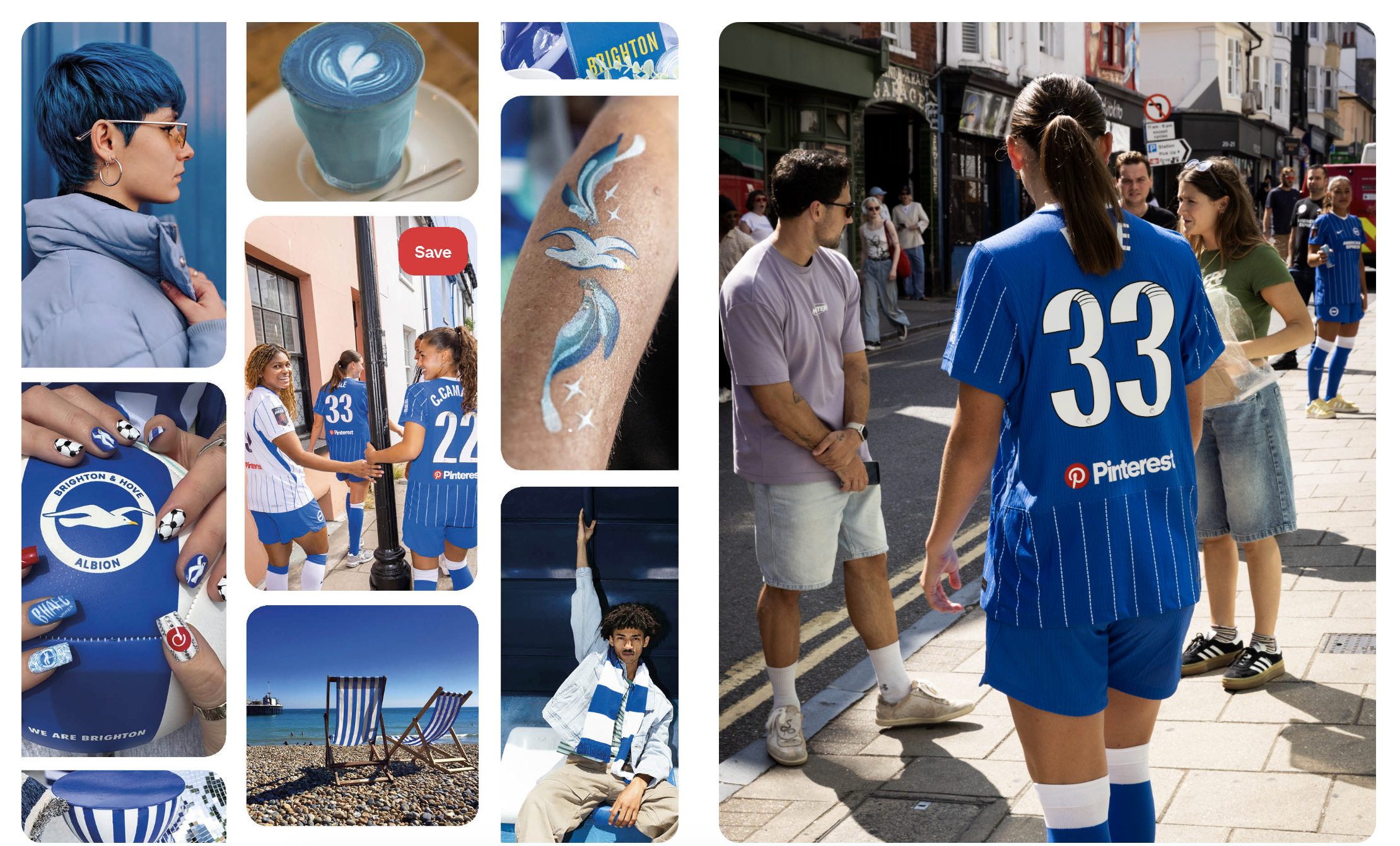
Pinterest Becomes Brighton Women's First Solo Shirt Sponsor, Betting on Football's Style Economy 📍
A visual discovery platform is buying its way into women's football through the wardrobe rather than the scoreboard. Brighton & Hove Albion Women have signed a four-year deal making Pinterest the club's first-ever standalone shirt sponsor, with the logo debuting at Sunday's friendly against Paris Saint-Germain. It follows Pinterest's first sports partnership last year with the WNBA's New York Liberty, and leans on data showing football-adjacent searches, not match highlights, are driving the platform's growth among women fans.
The four-year deal makes Pinterest the first solo sponsor of Brighton Women, with branding debuting on shirts at the 9 August friendly against Paris Saint-Germain (Brighton & Hove Albion)
It's Pinterest's first move into professional football, following the platform's first-ever sports partnership with the WNBA's New York Liberty last year (VERSUS)
Pinterest cites UK searches for "football outfits for women" up 425%, "football aesthetic" up 95% and "football match outfit" up 320% as the basis for the deal (FashionUnited)
💡 Pinterest has bought into football through the part of matchday it can actually service: what fans plan, wear and post, rather than what happens on the pitch. That makes this smarter than a badge on a shirt, because it ties the platform's core product, discovery and inspiration, directly to behaviour its own search data shows is already there. The four-year question is whether fans come to associate Pinterest with matchday culture itself or whether the association expires with the deal, the same test every lifestyle brand borrowing sport's credibility eventually sits 📍
Corteiz x Nike Launch RTW Summer Camp for 100 Young People 🎽
Corteiz's relationship with Nike has always run deeper than product drops, and this latest move pushes further into community investment. The London label and Nike have launched the RTW Summer Camp, a four-week initiative giving 100 young people free access to football coaching, educational workshops and mentorship sessions. It builds on Corteiz founder Clint419's approach of using the brand's platform to create opportunities beyond retail.
The RTW Summer Camp runs for four weeks, giving 100 young people free access to football coaching, educational workshops and mentorship (Hypebeast UK, Instagram)
The programme combines sport with practical learning, aimed at developing participants both on and off the pitch (Hypebeast UK, Instagram)
It marks a continuation of Corteiz and Nike's ongoing partnership, which has previously centred on co-branded footwear and apparel (Hypebeast UK, Instagram)
💡 Corteiz has built its entire identity on refusing to look like a conventional Nike partner, and a football programme for 100 young people is a harder thing to fake than a product drop, it costs real money and shows up in real outcomes rather than campaign imagery. For Nike, backing this lets it borrow Corteiz's community credibility without having to originate it, while Corteiz gets the infrastructure and reach a self-funded label couldn't build alone. Whether that balance holds depends on whether the programme continues past this one summer, or whether it was a single activation timed to the football calendar ⚽
Heineken 0.0 Turns Serena Williams' Old US Open Ticket Stubs Into a Marketing Campaign 🎾
A beer brand is asking tennis fans to dig through drawers for ticket stubs nobody thought had value beyond sentiment. Heineken 0.0's "Second Serve Tickets" campaign invites anyone who attended one of Serena Williams' past US Open matches to submit a photo of the ticket and a personal memory, with selected fans winning a seat in the Heineken Suite at Arthur Ashe Stadium this year. It lands as Williams, now a Heineken 0.0 global ambassador, returns to competitive tennis after four years away, having played doubles and singles across several tournaments this summer.
The campaign, created by agency LePub New York, is part of Heineken's "Fans Have More Friends" platform, built on research the brand commissioned showing 75% of fans say fandom has helped them meet new people (Heineken press release)
Heineken will also sell limited-edition 0.0 cans at the 2026 US Open from 24 August, featuring designs based on ticket artwork from each of Williams' six US Open championship wins (Heineken press release, Adweek)
Heineken says its 0.0 non-alcoholic beer has sold out at the US Open for the past two years running (Heineken press release)
💡 The clever part of this campaign sits in what counts as an entry rather than in the prize itself, a ticket stub most fans would never think to photograph, let alone submit to a brand. That turns Heineken's activation into something closer to an archive than an ad, crowdsourcing genuine memorabilia and personal stories the brand didn't have to create or license, only prompt people into surfacing. For a non-alcoholic beer brand still working to prove sell-out demand wasn't a one-off, tying itself to Williams' actual fan history does more credibility work than any amount of paid placement at the stadium 🎾
European Clubs Ramp Up Their US Fan Push After the World Cup ⚽
The post-World Cup afterglow is being treated as a limited window, and European football is moving fast to capitalise on it stateside. Liverpool's chief commercial officer confirmed the club is in advanced talks to open its first permanent US retail stores, part of a plan to grow from 26 stores worldwide to 40 by 2030. Meanwhile Spain's World Cup final goalscorer Ferran Torres used a US promotional tour and a Today show appearance to address swirling PSG transfer speculation, extending Barcelona's story into American living rooms during the exact week clubs are courting new fans.
Liverpool's merchandising and partnerships revenue reached $428m in 2024-25, up almost 40% from $312m three years earlier, second only to Manchester City and Manchester United among Premier League clubs (Sportico)
No Premier League club currently has a permanent physical retail presence in the US, though Paris Saint-Germain has run a Fifth Avenue store in New York for several years (Sportico)
Torres, in the US on a promotional tour with Under Armour, told NBC's Today he has a Barcelona contract but "in football you never know" when asked directly about PSG interest (Yahoo Sports)
💡 Liverpool's timing tracks a longer trend than just the World Cup, US soccer interest has been building steadily since the men's tournament expanded to Canada and Mexico, but a home-soil final gives every European club a rare excuse to show up in person rather than just ship product. What's notable is that Liverpool is choosing retail infrastructure over another content play or celebrity partnership, a bet that American fandom has matured enough to sustain a physical footprint rather than just streaming numbers. If it works, it likely pulls the rest of the Premier League's "big six" into a US retail race the way DTC stores did for American sports leagues a decade ago ⚽
Calvin Klein's CMO Admits the Quiet Part Out Loud: They're Gaming the Algorithm on Purpose 🎬
Calvin Klein's Dakota Johnson campaign generated 26 million Instagram views and, according to the brand's own CMO, translated into real sales, a single-digit lift in women's underwear and a double-digit lift in denim within the quarter. Speaking on Ad Age's Marketer's Brief podcast, Jonathan Bottomley described the strategy behind it in unusually direct terms for a CMO on the record. The campaign sits alongside a wider pattern of brands, Sydney Sweeney's American Eagle work and recent Victoria's Secret campaigns among them, returning to explicitly nostalgic, provocative 90s-style advertising.
The Dakota Johnson campaign generated 26 million Instagram views, a search spike within 24 hours, and a single-digit sales increase in women's underwear alongside a double-digit increase in denim over the quarter (Ad Age)
Bottomley said the goal is content engineered to travel organically, generating "a level of reach we would never have been able to pay for," with paid media then used to convert that reach into traffic and sales (Ad Age)
Calvin Klein produces campaigns in-house rather than through agencies, and Bottomley cited sibling brand Tommy Hilfiger's Formula 1, Cadillac and Liverpool FC sponsorships as his own source of inspiration within PVH (Ad Age)
💡 The denim number is doing more work here than the underwear number, and that's worth sitting with. A campaign built around underwear delivering only a single-digit lift in the category it was actually selling, while denim (a product barely featured in the campaign) posts a double-digit gain, points to brand halo more than direct conversion, a distinction Bottomley's framing glides past. The more candid admission is the algorithm language itself: a CMO describing engineered virality as a substitute for paid reach, in print, is rarer than the marketing trade press usually gets, and it says more about where brand budgets are actually going than the sales figures do 🎬
📺 MEDIA, STREAMING & PLATFORM
Meta Ordered to Redesign Instagram and Facebook After Judge Rules Platforms a "Public Nuisance" ⚖️
A New Mexico judge has moved past fines and into product design, ordering structural changes to Instagram and Facebook rather than treating a payout as the full remedy. Judge Bryan Biedscheid ruled the platforms constitute a public nuisance, comparing their engagement mechanics to a factory's pollution, and ordered $567m into a state abatement fund on top of the $375m in civil penalties a jury awarded in March. Alongside the money, the court has mandated default-private under-18 accounts, friend-list limits on Facebook, overnight notification blackouts and the removal of visible like counts for young users in the state.
$567m ordered into an abatement fund, with $420m earmarked for youth treatment services (PBS News)
Additional to $375m in civil penalties a jury awarded in March 2026
Push notifications barred for under-18 accounts in New Mexico between 10pm and 7am (TheWrap)
💡 The number matters less than the fact a state court has now written product specifications directly into a legal judgment, effectively regulating interface design where legislatures have stalled. New Mexico's Attorney General has built a template other states can copy without waiting on federal privacy law, so the real exposure for Meta sits in the precedent, a courtroom now able to dictate default settings state by state. For platforms built on engagement mechanics, that's a far costlier outcome than any single fine ⚖️
OpenAI's Beekeeping Retreat for Influencers Becomes a Lesson in What Not to Greenwash 🐝
A first-ever influencer trip designed to soften a brand associated with server farms and soaring energy bills has instead handed critics their argument on a plate. Content creators were flown to a luxury Hudson Valley resort for a weekend of beekeeping, farm-to-table dinners and painting workshops, timed to the launch of the company's new ChatGPT Work product. The eco-cottagecore styling collided almost immediately with a wave of "greenwashing" criticism online, given the well-documented water and electricity demands of the data centres powering the same chatbot.
OpenAI's "Summer Camp" retreat was held at Wildflower Farms in New York's Hudson Valley, where cabins run upward of $1,500 a night (Time Out, Fast Company)
The trip came as OpenAI is reportedly close to finalising a $500bn Ohio data centre deal, and as New York enacted a one-year moratorium on certain AI data centre construction (Fortune)
Influencers received monogrammed Peruvian cotton pyjamas and ChatGPT-branded tote bags, prompting widespread "greenwashing" and "tone-deaf" criticism online (The Independent)
💡 New York enacted a one-year moratorium on new AI data centre construction this summer, the same season OpenAI sent creators to a Hudson Valley resort to film beekeeping and s'mores on its dime, and the timing exposed exactly the gap the trip was built to paper over. Brand trips work by lending associations, forest, craft, slowness, to whatever they're attached to, but only when the association is at least plausible. Here the imagery ran directly against material reality, and a company whose infrastructure needs are colliding with state moratoriums and grid capacity limits ended up reminding its audience of exactly the thing the trip was designed to make them forget 🐝
California's One-Click Data Deletion Tool Just Became Legally Binding 🔒
A privacy tool that's been live since January just got teeth. California's Delete Request and Opt-Out Platform, DROP, lets residents send a single verified request to every registered data broker in the state demanding deletion of their personal data. Consumers have been able to submit requests since 1 January, but as of this month, data brokers are now legally required to actually retrieve and act on them, the first enforceable system of its kind in the US.
DROP was created under California's 2023 Delete Act and is administered by the California Privacy Protection Agency, the first universal data-deletion mechanism in the US (Clark Hill)
More than 500 registered data brokers in California must now access DROP at least once every 45 days to process deletion requests, as of 1 August 2026 (Alston & Bird)
Data brokers face a $200-per-day fine for each unprocessed deletion request under amendments to the law (TrustArc)
💡 California gave data brokers seven months between DROP's launch and the moment deletion requests became legally binding, which means every company holding US consumer data has had since January to work out whether compliance costs less than the fine. At $200 a day per unprocessed request, the maths only starts to hurt once volumes get genuinely high. The shift that matters most sits upstream of the brokers: any brand buying third-party audience data now has a supply chain consumers can switch off with a single request, and the US market has never had anything close to that before 🔒
MySpace's Owners Confirm an Algorithm-Free Relaunch Is Actually Coming 🎵
A platform written off more than a decade ago is positioning its return around exactly what current social media has stopped offering, a plain chronological feed. Tim and Chris Vanderhook, who acquired MySpace through Viant Technology, confirmed in a new documentary that they plan to relaunch the site without an algorithm, restoring features like Top 8 friends and profile songs. No date has been set, and the brothers have tried and failed to modernise the platform before, having lost more than $150m on an earlier reboot.
Tim and Chris Vanderhook confirmed the relaunch plans in Tommy Avallone's documentary MySpace, which premiered at Hot Docs in Toronto (Mediaweek)
The brothers previously lost more than $150m on a 2011 relaunch partnered with Justin Timberlake that failed to find an audience (Complex)
MySpace's current user base has reportedly grown from around 200,000 to roughly 6 million in the past couple of years, even before any relaunch (Inc.com)
💡 The Vanderhooks are selling nostalgia, but the actual product they're describing, a plain chronological feed with no algorithm, used to be the default setting for every social platform before anyone thought to monetise attention. That MySpace's dormant user base has already grown sixfold without a relaunch suggests the appetite is less for MySpace itself than for the absence of the thing every other platform has spent a decade optimising for. Whether the Vanderhooks can turn that appetite into a functioning business is a different question, the same "no algorithm" pitch has never yet produced a platform that scaled without eventually needing one to keep people there 🎵
Amazon Quietly Shelves Most of Its Nova AI Models to Chase One Frontier Bet 🤖
Rather than compete across every category its rivals occupy, Amazon appears to be betting its AI credibility on a single model. The company is scaling back active development on several Nova AI models, including Premier, Omni, Reel and Canvas, moving them into maintenance-only mode with formal end-of-life dates already set for September. In their place, resources are consolidating behind a new Frontier Model Research group aiming to produce one genuinely competitive foundation model.
Nova Premier reaches end-of-life on AWS Bedrock on 14 September 2026, with Nova Canvas and two Nova Reel versions following on 30 September (eWeek)
The pullback follows the shutdown of Amazon's AGI Lab and layoffs across its AGI organisation, after SVP Peter DeSantis took over the consolidated AI group from longtime Alexa executive Rohit Prasad in December 2025 (MLQ News)
Resources are moving to Frontier Model Research, led by Pieter Abbeel, who joined Amazon through its 2024 acquisition of robotics startup Covariant, with a new flagship model expected at Amazon's re:Invent conference later this year (The Decoder)
💡 Amazon spent the last few years running Nova as several separate model families across text, image and video simultaneously, the same broad-portfolio approach that produced a wide catalogue but nothing that actually competed at the frontier. Concentrating everything behind one team and one model is a bet that focus beats breadth, but it's also an admission that spreading resources across multiple fronts wasn't working. Amazon's dual position as one of the largest financial backers of both Anthropic and OpenAI while still funding its own frontier effort is the more telling detail, a company hedging its bets on whether the smarter move is building the frontier model or simply buying access to it 🤖
ESPN Recruits Five Football Creators Ahead of Its First-Ever Super Bowl Broadcast 🏈
With its first Super Bowl broadcast just months away, ESPN is building out the creator layer that will carry coverage beyond the broadcast itself. The network named its fourth Creator Network class, five football-focused voices spanning a former NFL lineman, a flag football world champion, and an analytics specialist, who will produce social-first content through the season and into Super Bowl week in Los Angeles. It's part of ESPN's "Year of the Super Bowl" initiative built around the network's historic first telecast in February 2027.
The class includes former NFL defensive lineman Isaac Rochell, Diana Flores (captain and quarterback of Mexico's World Champion flag football team), The QB Plug founder Chase Murman, analytics creator Leah Cammarano and host Simone Scott (ESPN Press Room)
The Creator Network launched in 2022 and gives members access to major college football and NFL events plus Super Bowl week, while they keep producing content on their own platforms (The Desk)
Flores is also positioned as an ambassador for flag football ahead of its Olympic debut at the 2028 Los Angeles Games (Variety)
💡 The mix of creators here says more about ESPN's strategy than any single hire, a former NFL player for traditional football credibility, an analytics creator for the data-literate audience, and a flag football world champion aimed squarely at a sport making its Olympic debut in two years. ESPN, by its own admission, already has a loaded roster of traditional football talent, so this class is explicitly buying reach into audiences its broadcast talent doesn't naturally speak to. With the network's first Super Bowl arriving in February, the creators effectively function as a distributed marketing layer for a single broadcast night, built months in advance and running across platforms ESPN doesn't own 🏈
Media Coalition Urges Government to Block BBC Podcast Advertising Plans 📻
Eighteen media organisations have written to the culture secretary urging her to rule out a proposal that would let the BBC carry advertising on its podcasts for the first time. The plan, one option in the BBC Charter Review Green Paper, would allow the BBC to sell ads around its audio content on third-party platforms like Spotify and Apple Podcasts. The coalition argues the financial upside for the BBC is small, while the damage to commercial audio producers who depend on that same advertising pool would be significant.
Economists Compass Lexecon estimate the BBC could generate around £10m a year from audio advertising, roughly 0.25% of its current £3.2bn licence fee income (Compass Lexecon, via The Media Leader)
Polling from More in Common found nearly two-thirds of the public oppose advertising around BBC content on top of the licence fee (More in Common)
BBC director-general Matt Brittin told the Culture, Media and Sport Committee on 13 July that the move would divert revenue from commercial audio producers, warning of a "devastating impact on the economy" (The Media Leader)
💡 The BBC's own director-general has effectively conceded the coalition's argument before the letter was even sent, calling the economic impact "devastating" while the corporation's Green Paper still lists advertising as a live funding option. That gap between what leadership says publicly and what stays on the table is the real story, a similar campaign in 2024 got an almost identical proposal ruled out within a year, so the coalition is betting the same pressure works twice. For an industry running on thin margins already, £10m a year for the BBC is a rounding error against what it could siphon from independent producers who don't have a licence fee to fall back on 📻
💼 BUSINESS, DRINKS & INVESTMENT
eBay Completes $1.4bn Depop Acquisition, Buying Its Way Into Gen Z Resale 👗
A platform that built its identity on being nothing like eBay has just been bought by eBay. The deal, $1.2bn in cash plus adjustments taking the total to roughly $1.4bn, closed on 30 July after Depop's five years under Etsy, which had paid $1.625bn for the platform in 2021 at the height of pandemic-era resale valuations. Depop keeps its brand and app, but now plugs into eBay's shipping, personalisation and compliance infrastructure.
eBay's cash purchase totalled $1.2bn plus $200m in adjustments and interest, roughly $1.4bn overall, closing 30 July after a UK regulatory review (Drapers, FashionUnited)
Depop had 7 million active buyers and more than 3 million active sellers as of December 2025, with almost 90% of buyers under 34 (Etsy)
Etsy sold Depop for less than the $1.625bn it paid in 2021, closing out five years of ownership below its entry price (FashionUnited)
💡 Etsy bought Depop at the peak of pandemic resale hype and is exiting at a loss, which says more about where that valuation bubble actually sat than eBay's price does. eBay is paying for a ready-made Gen Z audience it has struggled to build organically inside its own marketplace, and folding Depop into its shipping and compliance infrastructure signals a bet on distribution efficiency over preserving what made the platform feel distinct. The real test sits with Depop's community, whether the app still feels like Depop once eBay's systems are running underneath it 👗
Joe Rogan Tops Forbes' 2026 Highest-Paid Podcasters List at $82m, But OpenAI's Acqui-Hire Is the Real Story 🎙️
Podcasting's economics have never been this concentrated at the top, or this entangled with the AI industry. Forbes' 2026 ranking puts Joe Rogan first again at $82m, but the more telling entry sits at number two: tech show TBPN's hosts earned $70m almost entirely because OpenAI bought their show outright. The list's top 20 combined for $638m, with Rogan alone accounting for roughly 13% of that total.
Joe Rogan earned an estimated $82m from June 2025 to June 2026, driven by his 2024 Spotify deal potentially worth $250m over three years and more than 80 million monthly downloads and views (Forbes)
OpenAI acquired TBPN in April 2026 for an estimated $150m in cash and stock, an "acqui-hire" that put hosts John Coogan and Jordi Hays at number two with $70m combined (Forbes)
The top 20 podcasters earned a combined $638m, averaging $31.9m each, with Rogan alone accounting for around 13% of that total (InsideRadio)
💡 An AI company buying a podcast for $150m only makes sense once you clock what Rockwater analyst Chris Erwin called it, an acqui-hire timed to a moment when OpenAI needs credibility with regulators and investors rather than a media acquisition in any traditional sense. TBPN built exactly the kind of trusted, in-the-room access to tech executives that a company facing mounting scrutiny wants to control directly rather than court from outside. For podcast hosts generally, that's the new ceiling above the ad-revenue economics Forbes describes, being acquired outright by the industry you cover, rather than simply monetising the audience that covers it 🎙️
Live Nation Posts Record Q2 Just Months After Being Found Liable for Illegal Monopoly 🎫
Record concert attendance and a live-events monopoly ruling landed in the same financial year, and the numbers suggest the ruling hasn't dented demand. Live Nation reported $7.7bn in second-quarter revenue, up 9% year-on-year, with nearly 49 million fans attending shows, its highest-ever Q2 attendance. The results come three months after a jury found the company liable for unlawful monopolisation in its ticketing and concert promotion business.
Concert revenue reached $6.4bn in Q2, up 8% year-on-year, with fan attendance up 10% to nearly 49 million, the company's highest second-quarter total on record (Yahoo Finance, Billboard)
Ticketmaster posted $852m in revenue, up 15%, and sold 90 million fee-bearing tickets, up 8% year-on-year (StockTitan)
The results follow a March 2026 DOJ settlement requiring Live Nation to pay up to $280m and divest exclusive booking rights at 13 amphitheatres, and an April 2026 jury verdict finding the company liable for unlawful monopolisation in a trial brought by more than 30 states (Hollywood Reporter)
💡 A jury ruling that a company runs an illegal monopoly usually shows up somewhere in the following quarter's numbers, higher costs, cautious partners, some visible drag. Live Nation's instead show record attendance and record deferred revenue, which says less about the strength of the ruling than about how little structural change the settlement actually required, a fine and a partial divestiture of amphitheatre bookings, not a breakup of the ticketing and promotion businesses the states argued shouldn't sit under one roof. For an industry with genuinely few alternatives to Ticketmaster at scale, that's the real story behind the earnings beat, market dominance surviving a monopoly finding largely intact 🎫
Disney Beats Earnings, Sells Out Super Bowl LXI Ad Space Earliest Ever, and Strikes a TikTok Deal 📺
Three separate wins landed in the same earnings call, and together they show where Disney's real power sits right now. The company posted fiscal Q3 revenue of $25.2bn, up 7%, with earnings beating expectations even as total revenue came in just under forecasts. It also confirmed a new content partnership with TikTok bringing creator videos into Disney+, and revealed it has already sold out all advertising inventory for Super Bowl LXI, ESPN's first-ever Super Bowl broadcast, months ahead of when rival networks typically clear their slots.
Disney reported $25.2bn in fiscal Q3 revenue (up 7%) and adjusted EPS of $2.06, beating expectations, with Experiences revenue near $10bn and operating income up 20% (Variety, WDW Info)
Super Bowl LXI's ad inventory sold out to 58 brands across 34 categories, including nine first-time Super Bowl advertisers, roughly a month earlier than NBC's sellout for Super Bowl LX and three months earlier than Fox's for Super Bowl LIX (Front Office Sports)
The TikTok deal will bring fan-created short-form videos tied to Marvel, Pixar, Star Wars and FX properties into Disney+'s new "Verts" format, piloting in the US before expanding (Variety)
💡 Selling out Super Bowl ad space in early August, months before the season even starts, says less about advertiser enthusiasm than about scarcity Disney manufactured by consolidating the game across ESPN, ABC, ESPN2, ESPN Deportes and its own streaming platform simultaneously. That multiplies the audience Disney can promise advertisers without adding a single new viewer, which is exactly the kind of pricing power a legacy media company needs when it's also inviting TikTok creators to build content inside its own app rather than compete with them for attention. Both moves point the same direction, Disney consolidating other platforms' reach into its own ecosystem rather than building new reach from scratch 📺

Marketer's Brief: Calvin Klein's CMO on Gaming the Algorithm
Host: Adrianne Pasquarelli (Ad Age) | Guest: Jonathan Bottomley, Global CMO, Calvin Klein & EVP Group Consumer and Brand Strategy, PVH Corp. | 20 min | Spotify
Bottomley walks through exactly how Calvin Klein engineered its Spring 2026 Dakota Johnson campaign, the strategy behind celebrity partnerships including Jeremy Allen White and Michael B. Jordan, and the specific metrics the brand tracks from reach through to sales. He's unusually direct about the mechanics: content is built to travel organically because it earns reach the brand "would never have been able to pay for," helped by an audience of which 30% is actively engaged on Instagram alone, with paid media then used to convert that reach into traffic and sales. He also breaks down why nearly everything is produced in-house rather than through agencies, and how the same playbook is starting to extend across PVH's other brands.
Worth your time if: you're thinking about celebrity partnership strategy, algorithmic content design, or where the line between earned and paid media is actually sitting right now for brands with real cultural capital to spend.

(Monday 10 August - Sunday 16 August 2026)
🏃 European Athletics Championships, Birmingham (10-16 August) - a week-long athletics championship hosted in Birmingham.
🎾 Cincinnati Open begins (11 August) - the ATP/WTA hard-court tournament in Ohio.
⚽ La Liga 2026-27 opens (15-16 August) - the Spanish football league's new season begins.
🏆 FA Community Shield (16 August) - the traditional season-opening match between England's league and cup champions.