Welcome to the next edition of On The Record, thoughtful analysis on culture, entertainment, tech, fashion, music, sport, and brands. Here’s a round-up of key conversations and campaigns that caught my attention this week.
This week the stated reason and the money kept pointing in opposite directions, and in almost every case the correction arrived from outside the building. FIFA says the hydration breaks were welfare, Arsène Wenger says there is no data showing they improved anything, and Fox says they generated roughly $250m in new ad inventory, while eleven US host cities are still chasing the $1m each that FIFA’s own management promised verbally and never put in writing. Birmingham’s organising committee called itself delighted with ticket sales while Britain’s first European Athletics Championships played to a 55% stadium at £150 a seat, and the footage of Amy Hunt winning gold in front of ten thousand empty chairs is now the evidence in every future hosting conversation. Mark Zuckerberg published 6,500 words on distributing intelligence to individuals in the same quarter Meta’s free cash flow fell to $784m against capex guidance of up to $145bn, all of it going into the one layer nobody can download. Twitch’s chief product officer said plainly that nobody would have opted into AI training if actually asked. A New Mexico judge stopped writing fines and started writing default settings, ordering Meta to cap under-18 usage and hide like counts, and Paramount is now burning roughly $7m a day from 30 September for the privilege of arguing with California. The counterweight sits with the operators who let the numbers do the talking instead: Rhode turned 70% repeat purchases into a $27m day before Sephora Europe even opens, Nikki Doucet tripled WSL commercial revenue to a projected £100m by refusing to position the league as a smaller version of the men’s game, Shambhala tested 4,592 samples because it decided a known risk was something to manage rather than deny, and Metallica’s crowds gave 52,000 units of blood. The institutions had the better statements this week. The operators had the better arithmetic.

🏛️ SPORT, POWER & GOVERNANCE
FIFA Weighs Keeping Hydration Breaks as Infantino Fights for His Job on a Second Front 💧
📌 FIFA introduced mandatory hydration breaks at every 2026 World Cup match, and while fans and coaches largely hated them, they handed Fox Sports an estimated $250m in new ad inventory. FIFA says a decision on keeping them is still pending, though Infantino has separately signalled he is open to making them permanent. It plays out against a bigger crisis: a plan to sell stakes in FIFA’s tournament business to private investors was withdrawn twice this summer, and three confederations have now accused Infantino of deception.
Fox Sports is estimated to have made roughly $250m from added in-game ad inventory created by the hydration breaks (Hollywood Reporter, via ESPN)
FIFA’s private investment plan, which would have sold a stake in a $20bn subsidiary controlling the World Cups, was withdrawn on 31 July and a related version again on 1 August (CNN, ESPN)
UEFA, CONCACAF and the AFC issued a joint letter on 10 August accusing Infantino of deception and calling for an independent review (InsiderSport)
💡 Wenger has already conceded there is no data showing the breaks improved anything on the pitch, which leaves welfare as an assertion and $250m as a fact. That asymmetry is survivable in isolation. It is not survivable in the same month three confederations put in writing that they no longer take the organisation at its word. FIFA’s problem is that it now has to make a commercial argument in a room where its credibility is the thing being audited, and every decision that happens to pay well reads as evidence for the other side. The hydration breaks will probably stay, because $250m in fresh inventory strengthens the next rights negotiation and nobody walks away from that. What FIFA has lost is the ability to call it anything other than what it is 💧
US World Cup Host Cities Still Waiting on FIFA’s Promised $1M Payments 💸
📌 Eleven US cities that hosted 2026 World Cup matches say FIFA has yet to pay the $1m per-city legacy contribution its officials repeatedly promised, despite the organisation never making the pledge publicly. The figure echoes what Infantino publicly committed to Club World Cup host cities in 2025. The gap sits inside a much larger cost imbalance, with host cities covering security, transport and operations while FIFA kept the majority of ticketing, media and sponsorship revenue.
FIFA reportedly promised $1m in legacy funding to each of the 11 US host cities, echoing a public pledge made for the 2025 Club World Cup, but has made no public confirmation for 2026 (The Athletic, via France 24, GV Wire)
Kansas City’s host committee alone reported $86.8m in public investment and $59.52m in federal security assistance to stage its matches (GV Wire)
FIFA retained the majority of World Cup revenue from ticketing, media rights, sponsorship and concessions, while cities bore most costs tied to security, transport and logistics (GV Wire)
💡 A promise made verbally and never confirmed publicly is a promise you can withdraw without ever issuing a retraction, and that is the mechanism doing the work here rather than any dispute over affordability. Eleven million dollars is less than five percent of what one broadcaster made from the hydration breaks alone. Kansas City put $86.8m of public money on the table to stage its matches and is now chasing a seventh of a percent of that back. Cities bidding for the 2030 and 2034 tournaments are watching how this resolves, and the precedent being set is that the only commitments FIFA honours are the ones written into the hosting agreement. Everything said in a meeting room is marketing 💸
Birmingham’s First European Championships Played to Half-Empty Stands 🏟️
📌 Britain’s first European Athletics Championships wrapped in Birmingham last week having spent much of its run in a half-full Alexander Stadium, despite fields including reigning Olympic and world champions. Category A tickets ran to £150 with no junior concessions, nearly double the equivalent price at Rome 2024, while stadium food included £18.50 pork rolls. Organisers maintained they were delighted with sales throughout.
Alexander Stadium, capacity 23,000, ran at roughly 55-59% full across the opening days of the seven-day championships (BBC)
Category A tickets for marquee home-straight finals cost up to £150 with no junior concessions, against £75 for an equivalent seat at Rome 2024 (BBC, Inside The Games)
Organisers said half of all tickets were priced at £30 or under, and Friday, Saturday and Sunday evening sessions later sold out (BBC, Inside The Games)
💡 Both things organisers said were true and the event still failed on camera. Half the tickets genuinely were under £30, the weekend evenings genuinely did sell out, and the stadium was still visibly empty during the women’s 100m final because the seats that photograph on television were the ones priced at £150. That is a seat-map problem dressed as a demand problem. Any promoter who has papered a room knows the fix, which is to move the £26 buyers down into the camera-facing blocks and protect the broadcast picture, because the broadcast picture is the asset. Britain was auditioning for the next decade of major event hosting here, and the footage that will get cited in every future bid conversation is Amy Hunt winning gold in front of ten thousand grey plastic seats 🏟️
WSL’s Former Nike Exec Bets Growth on Difference, Not Parity With the Men’s Game ⚽
📌 Nikki Doucet, a former Nike executive who took charge of English women’s football’s club-owned governing body in 2023, has overseen a near-tripling of WSL commercial revenue since England’s 2022 Euros win, with sponsors now including Barclays, Apple, Mercedes-Benz and Nike. Her strategy treats the WSL as a distinct product rather than a smaller version of the men’s league, reflected in the 2025 rebrand that folded the second tier into a single WSL/WSL2 identity.
League-wide commercial revenue has grown from £32m in 2021-22 to a projected £100m in 2025-26, according to Deloitte (Women’s Eleven)
Barclays’ renewed title sponsorship is worth around £15m a year, double the previous deal and described as the biggest in women’s domestic football history (BBC, Sportcal)
New deals with Apple and Mercedes-Benz this season sit alongside a renewed Nike partnership as official ball supplier (SportsPro)
💡 The instinct most emerging properties follow is to position against the established version, borrow its vocabulary and hope some of the valuation transfers across. Doucet went the other way, and the 2025 rebrand is where you can see it working commercially rather than philosophically. Folding the Championship into WSL2 gave sponsors one legible property to buy into instead of two half-formed ones, which is why Apple and Mercedes-Benz arrived in the same season rather than negotiating separately for tiers nobody outside the sport could distinguish. Tripling commercial revenue in three years is not what a post-tournament bump looks like. The harder problem she has named herself is that centralised revenue growth and competitive distribution are separate engineering jobs, and solving the first one has quietly made the second one more visible ⚽
Cowboys Stay NFL’s Most Valuable Franchise as League Values Jump 31% in a Year 🏈
📌 Sportico’s 2026 valuations put the Dallas Cowboys at $15.5bn, a seventh straight year at the top, while the league’s average franchise value surged 31% to $9.34bn, the biggest single-year jump since Sportico began tracking in 2020. The Rams and Giants round out the top three. All 32 NFL teams now sit among the world’s 40 most valuable sports franchises.
Dallas leads at $15.5bn, up 21% year on year, ahead of the Rams ($12.7bn) and Giants ($12bn) (Sportico)
The Cowboys generate around $1.3bn in revenue, more than any sports franchise except Real Madrid, with local revenue nearly 70% higher than the second-placed Rams (Sportico)
Dallas posts an estimated $510m EBITDA, roughly four times the league average of $139m (Sportico)
💡 Dallas is not top of this list because of scarcity, and that is the detail most coverage skips past. Twenty-nine other franchises sit inside a closed league with identical structural protections, and none of them earn $1.3bn. The gap is local revenue, where Dallas runs nearly 70% ahead of the Rams, and local revenue is the part of a franchise’s income that ownership actually controls rather than receives. Jerry Jones spent three decades building the venue, hospitality and sponsorship apparatus that produces it, an operating model since exported into a hospitality business now running stadiums for other people’s teams. The $510m EBITDA figure is what that model returns at maturity, four times what the average NFL owner takes home from the same league, same cap and same media deal 🏈
Yankees Take $2.6bn From Apollo While Steinbrenners Keep Full Control 💰
📌 Yankee Global Enterprises has struck a $2.6bn financing agreement with Apollo Sports Capital, mixing credit and equity to refinance existing obligations and fund growth across a portfolio spanning YES Network, Legends, AC Milan and NYCFC. The Steinbrenner family retains full control, with Hal Steinbrenner remaining managing general partner and Apollo Sports Capital CEO Al Tylis joining the YGE board. It is Apollo’s largest US sports investment to date.
The $2.6bn agreement combines credit and equity and was expected to close imminently (Apollo, Yankee Global Enterprises)
MLB rules cap any single private equity fund’s ownership stake in a franchise at 15% (Yahoo Sports)
YGE’s holdings span the Yankees, roughly 26% of YES Network, around 16% of Legends, 10% of AC Milan and 10% of NYCFC (Sportico)
💡 Read the asset list rather than the headline number and the logic gets clearer. Apollo is not underwriting a baseball team, it is underwriting a diversified sports and entertainment operating company that happens to have a baseball team as its anchor tenant, with a broadcast network, a hospitality business and two football clubs generating revenue on entirely different cycles. That mix is precisely what makes a permanent capital platform comfortable writing its largest US sports cheque, because the downside is spread across assets that do not fail simultaneously. The 15% cap means control was never available, so what Apollo actually bought is a long-term financing relationship with one of the few sports groups structured to absorb this much capital and deploy it across more than one business. The Steinbrenners raised nine figures without opening the ownership table, which is the part every other family-controlled franchise will be studying 💰
Bezos Nears a Third of Liverpool as Amazon’s Broadcast Rights Raise an Unanswered Question ⚽
📌 Jeff Bezos is closing in on a roughly one-third stake in Liverpool FC alongside Facebook co-founder Eduardo Saverin and lead investor Amit Bhatia, valuing the club at around $6bn with an announcement possible this week. Fenway Sports Group would remain controlling owner. Unresolved is whether Bezos can hold a stake in a Premier League club while Amazon’s Prime Video holds Premier League broadcast rights.
The deal values Liverpool at approximately $6bn, with the consortium’s stake worth an estimated $2bn (Sky News, SI)
FSG bought Liverpool for around $480m in 2010 and would retain overall control (SI)
Amazon’s Prime Video already holds Premier League broadcast rights, and it remains unclear whether an investor with a stake in a league broadcaster can also own part of a club in that league (Deadline)
💡 Multi-club ownership has occupied the Premier League’s regulatory attention for years, and this deal introduces a version nobody drafted rules for. The conflict is not horizontal, one owner holding two clubs, it is vertical, an investor sitting on both sides of a rights negotiation his own platform participates in. Amazon buys Premier League matches. Bezos would own part of the product Amazon buys. Nothing in the existing framework addresses that, which is why the silence from Richmond Park matters more than the $6bn valuation. Twelve times what FSG paid in 2010 is the headline. The precedent for what happens when a broadcaster’s founder becomes a shareholder in the league he licenses is the story ⚽
🎵 MUSIC, LIVE & CULTURE
Digbeth’s Independent Venues Face Demolition as £1.75bn Rail Plans Advance 🚇
📌 A £1.75bn plan to expand Birmingham’s rail network has put several of Digbeth’s best-known independent venues on the demolition list, with widening works on the Bordesley viaduct threatening Lower Trinity Street. Club Colette and Mama Roux’s have launched a joint campaign urging objections during consultation, after learning of the plans from posts on X rather than from the rail alliance.
£1.75bn Midlands Rail Hub project includes widening the Bordesley viaduct through Digbeth (Mixmag)
Public consultation runs until 28 August 2026, with construction targeted for 2030 (Skiddle)
Club Colette, Mama Roux’s, The Night Owl, Luna Springs and XOYO are among the Lower Trinity Street venues earmarked for demolition (Mixmag, Skiddle)
💡 Venues rarely lose to a competitor. They lose to a spreadsheet with no line item for the thing they produce. Mama Roux’s owner Benjy Hill found out on social media that eighteen years of programming was scheduled for demolition, which tells you where independent nightlife sits on a rail authority’s stakeholder map. The uncomfortable part for Birmingham is that Digbeth’s reputation as a destination worth investing in was built by exactly the businesses now being cleared to improve access to it. Jorja Smith and Little Simz played these rooms on the way up. That equity is site-specific and does not relocate, and the consultation window closing on 28 August is the only mechanism left for anyone to say so 🏚️
LA Jazz Festival Collapses Hours Before Opening as Organisers Cite Permitting Costs 🎷
📌 Hours before its scheduled opening, the inaugural LA Jazz Festival was cancelled entirely, leaving an anticipated 250,000 attendees and a lineup including John Legend, Janelle Monáe and Parliament-Funkadelic without the citywide event promised since February. Organiser Martin Ludlow cited unanticipated public safety and permitting costs. Ticket holders were promised full refunds within 30 days.
Roughly 250,000 attendees were expected across the 17-day event (Rolling Stone, Variety)
The festival was announced in February at a City Hall event attended by Mayor Karen Bass (Rolling Stone)
Organisers confirmed full ticket refunds within 30 days (KTLA)
💡 Every experienced promoter builds the same firewall, which is that permitting and municipal cost exposure gets locked before a single headline artist is announced, because the announcement is the point of no return. LA Jazz Festival ran that sequence backwards, securing civic endorsement and a bill of that calibre while final permitting on the closing weekend remained open. Municipal safety costs on a citywide event across 17 days are not an unknowable variable, they are a line item you model early and pad heavily. The people carrying this are the working musicians and vendors who fronted their own costs against a City Hall launch, and none of that had anything to do with demand. The lesson every operator already knows just got demonstrated expensively in public: the announcement is a liability until the paperwork is signed 🎪
UK Festivals Enlist Architects as Stage Design Becomes the New Point of Difference 🏕️
📌 Stage design at UK festivals is increasingly treated as its own creative discipline, with organisers commissioning specialist architects rather than defaulting to generic staging. Glastonbury’s Silver Hayes and Shangri-La set the template, and newer events including Peep, Loud Places and Houghton have built identities around site-specific, nature-led installations.
Houghton’s Water Tower installation, credited to Cella & Mitre, is built from timber and thatch and remains on the Norfolk estate through the coming year (Houghton Festival)
Peep’s inaugural 2026 edition at Great Fulford estate near Exeter built its identity around Forest, Lake and Amphitheatre stages (single source, unverified)
Loud Places returned to Sussex for its third edition on 14-16 August with an expanded programme of artist-led installations (Resident Advisor)
💡 The booking pool cycles through most UK weekends each summer, which means the lineup has stopped functioning as differentiation and the site has taken over the job. Commissioning an architect rather than a staging contractor is a decision about what a festival is selling, and increasingly what it is selling is a place people want to be photographed in rather than a bill they can only see there. The economics quietly support it too, since structures designed with a landscape are lighter to transport and faster to strike than a fully rigged main stage. Houghton’s approach is the one worth studying, leaving the Water Tower standing on the estate for a full year, because a build that survives past the weekend stops being production spend and starts being an asset the festival owns 🏕️
Shambhala’s On-Site Drug Lab Treats Testing as Infrastructure, Not an Afterthought 🧪
📌 At most festivals, drug use is tolerated quietly and left unmanaged. At Shambhala in Salmo, British Columbia, it is built into the site plan, with a government-sanctioned lab where anyone can test what they have bought before taking it. Last year, roughly 7% of samples checked contained something the buyer was not expecting.
Free drug checking is delivered on-site through ANKORS, a harm reduction nonprofit operating at the festival for over two decades (ANKORS, Shambhala Music Festival)
About 7% of 4,592 samples tested last year contained an unexpected substance, a lower contamination rate than street-sold drugs (New York Times, single source)
Fentanyl was detected rarely, alongside other dangerous substance combinations (New York Times, single source)
💡 Enforcement moves the behaviour out of sight. Shambhala moved the intervention forward instead, to the point before consumption where information can still change an outcome, and built it into the site plan alongside medical and welfare rather than bolting it on. What makes it work at scale is the government sanction, because a lab like this only survives if health authorities classify it as public health infrastructure rather than liability exposure. For operators in markets where this remains legally impossible, the transferable insight is the posture rather than the lab itself: Shambhala stopped treating a known risk as something to be denied and started treating it as something to be managed, and its safety record is the argument 🎪
Metallica’s European Blood Drives Passed 52,000 Units 🩸
📌 Metallica’s #BleedingMe blood drives, run with local blood banks at European stops on the M72 World Tour, collected more than 52,000 units this summer according to the band. The campaign began on the US leg and had already reached nearly 40,000 units across America and Australia by April. Each unit typically helps around three patients.
Metallica’s figure for the European leg alone is over 52,000 units donated (Metallica, single source)
The campaign had passed 40,000 units combined across the US and Australian legs as of April 2026 (Pollstar)
The initiative runs through Metallica’s All Within My Hands foundation with the Red Cross and local blood banks at tour stops (Metallica.com)
💡 Cause marketing usually asks a fan to transfer money to something abstract and then measures the ask rather than the outcome. This routes an already-assembled, already-motivated crowd toward something with a hard unit of measurement and a shelf life of weeks, which means the campaign has to keep running to keep working. That is a materially harder commitment than a one-off donation match and it is why the numbers compound across legs rather than spiking at launch. The operational insight for anyone building a tour partnership is that the crowd is the asset, not the audience size, and Metallica’s tour accountant reportedly noticed that first-time donors skewed young, which is a conversion figure most charities spend years and significant budget failing to achieve 🩸
Art Institutions Are Booking DJs as Curators, Not Just Crowd-Pullers 🎛️
📌 Major museums including MoMA PS1, Tate and Berlin’s Hamburger Bahnhof have spent the past decade folding DJ culture into core programming, treating sound and gathering as institutional architecture. The shift has accelerated as European public arts funding gets cut and streaming erodes musicians’ income. Zurich’s Street Parade, the reference point for the scale institutions are tapping, drew roughly 900,000 people this weekend.
Zurich’s Street Parade drew approximately 900,000 attendees across 26 Love Mobiles and nine stages on 8 August (Street Parade, Techno Airlines)
MoMA PS1’s Warm Up series runs weekly through 28 August; Hamburger Bahnhof’s Berlin Beats runs through 27 August (Art Basel)
Institutions from Kiasma to Bergen Kunsthall now design programming around live performance as core architecture (Art Basel)
💡 What changed is the credit line, not the booking. A DJ hired as outreach is a marketing cost with a door target attached. A DJ billed and paid as an artist is a programming decision the institution has to defend curatorially, and that shift moves the relationship from borrowed cool to shared authorship. The economics forced the honesty, since European arts funding keeps contracting and a well-curated night fills a room a Tuesday exhibition cannot. But the institutions doing this convincingly worked out something more useful, which is that reading a room, a history and a context and assembling it in real time is the job description they already pay curators for 🎛️
👟 BRAND, CULTURE & CAMPAIGNS
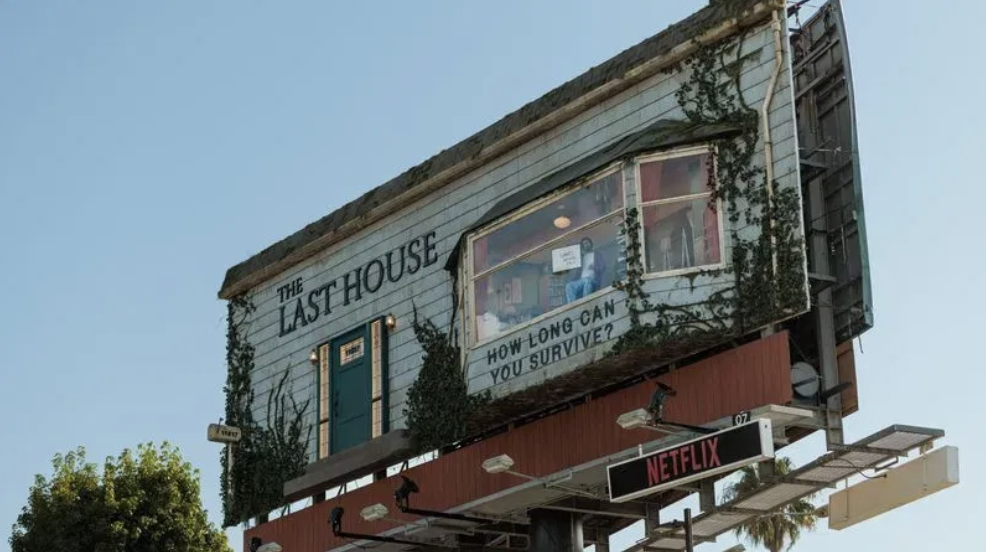
Netflix’s Billboard Stunt Proves the Film Barely Needs to Be Good 📺
📌 Netflix built a fully furnished living room inside a billboard above Sunset Boulevard and put a man inside it for three days, mirroring the plot of new thriller The Last House. The stunt earned free coverage from local broadcasters and went viral online, while the film opened to a 29% critic score. Within two days it was the most-watched title on Netflix in 89 countries.
The Last House’s Tomatometer fell to 29% across 42 reviews, with a 28% audience score, by 10 August (DesignRush)
FlixPatrol logged the film at No.1 in 84 countries on release day, reaching 89 territories by 9 August (DesignRush)
The billboard ran Thursday 6 to Saturday 8 August above Sunset Boulevard and Selma Avenue (Independent, DesignRush)
💡 In cinema, a bad film gets punished on the second Friday when word of mouth turns and the trades print the drop. Netflix collects the same subscription whether someone finishes The Last House or quits after ten minutes, so the entire creative brief compresses to a single instruction: generate one press-play. That changes what good work looks like. A physical installation that a news helicopter can shoot from 300 feet is a rational buy under those economics in a way it never is for a studio needing repeat attendance, which is why Netflix built for local broadcast rather than for a phone. The campaign was engineered against the right scoreboard. Whether the retention bill for a 29% film arrives later is a different quarter’s problem 🎬
Rhode’s $27m Single Day Confirms It Is Now e.l.f.’s Real Growth Engine 💄
📌 Hailey Bieber’s Rhode generated $27m in DTC sales in a single day when its summer collection launched on 9 June, pulling in 90,000 new customers while existing shoppers accounted for over 70% of purchases. The brand contributed $160m to e.l.f. Beauty’s latest quarter, and CEO Tarang Amin says Rhode could become the fastest beauty brand ever to reach $1bn in annual sales. It enters Sephora across 19 European countries this September.
Rhode’s summer launch produced $27m in DTC sales in a single day, 90,000 of them new customers, with over 70% from repeat buyers (e.l.f. Beauty earnings call, Glossy)
Rhode contributed $160m in net sales to e.l.f.’s Q1 FY2027, against $212m for the full year preceding its 2025 acquisition (Fast Company)
e.l.f. acquired Rhode in August 2025 for up to $1bn, and the brand sits in under 20% of Sephora’s global stores (Fast Company, Glossy)
💡 Seventy percent repeat is the number that justified the billion, not the $27m. Celebrity founders reliably deliver a launch spike, because curiosity is cheap to buy when someone has that reach. Almost none of them convert that spike into a base that returns for the fourth product, which is the only thing that makes a beauty brand worth a strategic multiple rather than a licensing fee. Rhode did, and it did it before e.l.f.’s distribution muscle was attached. September is the actual test, because everything measured so far happened in a market that already knew the brand intimately, and Sephora Europe asks whether that intensity survives contact with shelf space it does not control 💄
📺 MEDIA, STREAMING & PLATFORM
Spotify Will Label AI Artist Profiles and Cut Them From Recommendations 🤖
📌 From mid-September, Spotify will mark AI-generated artist profiles with an AI Persona badge, whether self-disclosed or flagged by Spotify’s own review. Labelled profiles will be excluded from algorithmic and editorial recommendations by default. The move lands as AI-generated uploads reportedly climb past half of all new tracks on at least one rival platform.
Self-disclosure opened 11 August 2026, with public badges appearing from mid-September (Spotify, TechCrunch)
Badged profiles are excluded from editorial and algorithmic recommendations by default (Spotify, Variety)
Deezer has reported AI-generated uploads rising from 44% of new tracks in April to over 50% by mid-2026 (RouteNote)
💡 Every previous AI disclosure scheme was a label with nothing behind it. This one is attached to the only lever that matters on a streaming platform, which is placement, and losing algorithmic and editorial surface is functionally closer to losing distribution than to wearing a badge. That is a meaningful win for rights holders and for artists whose catalogues have been competing against synthetic uploads for the same playlist real estate. The scope is deliberately narrow, targeting who the artist claims to be rather than how the music was made, which keeps AI-assisted human artists out of scope and makes the policy enforceable at the profile level rather than the track level. It only holds if Spotify’s own review reliably catches the profiles that never disclose, because the whole design depends on avoidance costing more than compliance 🎧
Netflix’s Yankees Drama Puts a Dodgers Fan in Charge of the Pinstripes 📺
📌 Netflix is developing an untitled scripted drama spanning multiple eras of Yankees history, produced with MLB Studios, Jason Bateman’s Aggregate Films and writer Josh Wakely, who secured the rights and developed the concept. It extends a partnership that already has Netflix streaming MLB events through 2028. One small irony: Bateman narrated the Dodgers’ 2026 Opening Day hype video.
The series will span multiple eras of Yankees history rather than one roster or championship run (Variety, MLB.com)
Netflix’s wider MLB deal covers live events through 2028, including the Home Run Derby and Field of Dreams game (Deadline)
Aggregate Films’ Netflix partnership has produced Ozark and the seven-Emmy-nominated Black Rabbit (Variety)
💡 Leagues have licensed their archives to documentary makers for decades and taken a fee for the footage. Developing scripted drama through your own studio arm is a different posture entirely, because scripted travels to audiences who will never watch a game and it compounds in value long after the season it depicts. The Yankees are the right test case precisely because 27 championships and a century of characters is a writers’ room asset, not just a highlight reel. Putting a lifelong Dodgers fan among the executive producers is the detail that suggests MLB understands the assignment, since hagiography does not travel and a franchise this mythologised is more interesting to people who have spent their lives rooting against it 🎬
Apple Puts Yankees-Red Sox at the Front of Its Live Immersive Sports Push 🥽
📌 Apple will stream four Friday Night Baseball games live in Apple Immersive Video on Vision Pro this season, starting with Yankees-Red Sox on 28 August, using 8K 3D video, a 180-degree field of view and spatial audio from ambisonic microphones at the ballpark. The games carry a dedicated commentary team and remain available in 2D on Apple TV.
Four games across the remaining Friday Night Baseball season will get the immersive treatment (Apple, Sportico)
The format uses 8K video at a 180-degree field of view, the same specification as Apple’s Lakers immersive broadcasts this year (Road to VR, 9to5Mac)
Vision Pro owners in nine countries including the US, UK, Japan and Germany get live access through the Apple TV app (MacRumors)
💡 Four games out of a full season is the strategy, not a limitation. Apple is building a clean dataset on production cost per game, headset engagement and completion rates before committing to a format nobody has priced yet, which is the disciplined way to develop new inventory rather than the loud way. Choosing the Yankees and Red Sox for game one is an audience decision, since the rivalry is the one most likely to pull a casual Vision Pro owner into trying immersive at all. Leagues have spent fifteen years selling the same camera feed to progressively larger screens. Immersive is the first genuinely new broadcast product since HD, and Apple is quietly establishing what it costs to make before anyone has to negotiate what it is worth 🎥
Paramount Threatens to Leave California as Warner Bros Merger Stalls in Court 🎬
📌 Paramount Skydance is warning it will begin relocating operations out of California as soon as October unless the state settles the antitrust lawsuit blocking its $110bn acquisition of Warner Bros Discovery. California’s attorney general has called the threat blackmail, with a trial now set for March 2027. The standoff puts Paramount on a clock for penalties that grow the longer the case runs.
Paramount owes Warner Bros Discovery shareholders roughly $7m a day once the deal remains unclosed past 30 September 2026 (Deadline, The Daily Upside)
A $7bn termination fee applies if the merger fails to close by 4 June 2027 for regulatory reasons (Deadline, CNBC)
The antitrust trial, brought by a 12-state coalition led by AG Rob Bonta, is set for 2 to 19 March 2027 (Deadline)
💡 Relocation threats work on states that believe them, and Hollywood has issued this one before without moving. What is different is the meter. From 30 September, delay costs Paramount roughly $7m a day regardless of who eventually wins on the merits, which means Ellison now has a financial incentive to settle that is entirely disconnected from whether the antitrust case is strong. Bonta knows this, which is why he can call it blackmail in public and set a March trial date without blinking. The infrastructure argument still holds, since crews, stages and a talent pool are not rebuilt in Texas on a legal deadline. But a company burning $7m a day while waiting for a judge will eventually do something that looks irrational from outside and entirely rational from inside 🎥
Podcasting Insiders Say the Real Saturation Point Is Attention, Not Supply 🎙️
📌 With more than 4.7 million podcasts live and nearly 91,000 new shows published in a single three-day window, The Media Leader asked seven industry leaders whether the format has peaked. Most rejected saturation outright, arguing discovery has shifted from podcast apps to social clips and that ad spend still lags listening. The sharper split was over regulation.
More than 4.7 million podcasts are live, with nearly 91,000 new shows published in a recent three-day window (Podcast Index, via The Media Leader)
Acast’s CEO argues ad spend still significantly lags actual podcast consumption (The Media Leader)
Sounds Profitable’s Bryan Barletta expects standardisation around disclosures and AI labelling rather than direct content regulation (The Media Leader)
💡 Everyone quoted says the format is not saturated and then describes, in detail, a saturated distribution layer. Reach Studio’s read is the honest one: shows that break through now arrive with an audience already built somewhere else, imported from video or from existing talent, which means the open-entry era is closing even as the total show count climbs. The regulation split maps onto the same fault line. Publishers already operating inside editorial codes see formal rules as a moat they have paid for. Platforms whose economics depend on low barriers and creator ownership see the same rules as a tax on the thing that got them here. Two honest answers, two different businesses, one question 🎙️
💼 TECH, AI & ACCOUNTABILITY
Zuckerberg Frames Open AI as Empowerment While Meta’s Cash Flow Tells Another Story 🤖
📌 Mark Zuckerberg published a 6,500-word essay arguing superintelligence should be distributed to individuals rather than concentrated among institutions, alongside an open-weight model release and a $1bn community fund. It lands as Meta’s infrastructure spending swallows nearly all its cash generation, with capex guidance reaching $145bn for the year.
Meta raised full-year 2026 capex guidance to $130bn-$145bn, up from $125bn-$145bn (CNBC, Blockspace Media)
Free cash flow fell to $784m in Q2, down from $8.55bn a year earlier (CNBC, Blockspace Media)
The new Future Is For Everyone Fund is seeded with $1bn for communities hosting Meta’s data centres (Axios, Fox Business)
💡 Weights can be copied by anyone with bandwidth. Gigawatts cannot. That asymmetry is the whole essay, and it is why giving away the model costs Meta remarkably little at precisely the moment frontier intelligence is losing its scarcity premium to open weights and Chinese labs. The genuinely useful part for developers is real, since the entry cost of building on capable models just dropped again. What the philosophy does not address is where $145bn is actually going, which is land, power and compute, the one layer of this stack nobody downloads for free. Meta is arguing for distributed intelligence while quietly buying the scarce thing intelligence has to run on, and the question worth holding is whether it still needs to run there once models get small enough to live on the device 🏗️
Meta Ordered to Pay $567m and Overhaul Teen Safety in Landmark New Mexico Ruling ⚖️
📌 A New Mexico judge has ordered Meta to pay $567m and implement five years of court-supervised safety changes to Facebook and Instagram, adding to a $375m jury verdict from March. The combined penalty brings total liability to nearly $942m, the first time a US state has defeated a major tech company at trial over platform harm to young people. Meta will appeal.
The $567m award is earmarked mostly for treatment services, with $420m set aside for that purpose (ABC News, PBS)
Court-ordered changes include capping under-18 usage at roughly 90 hours a month, pausing overnight push notifications, and hiding public like counts by default (TechCrunch, New Mexico DOJ)
The ruling follows a March jury verdict finding Meta violated the state’s Unfair Practices Act (Fox Business, Barchart)
💡 A fine is a cost of doing business. A judge writing default settings into a court order is regulation of product design, arriving through a courtroom because legislatures stalled. Capping under-18 usage and hiding like counts are decisions a company optimising for engagement would never reach on its own, which is precisely why they had to be imposed rather than negotiated. The mandatory semiannual compliance reporting is the part with teeth, because it creates a public record of implementation that survives Meta’s appeal timeline. Other attorneys general are not watching the $942m. They are watching whether court-mandated interface specifications hold on appeal, because a template that works state by state is a far more durable instrument than any settlement figure ⚖️
Twitch Defaults Creators Into AI Training as Amazon Admits the Consent Was Never Real 🎮
📌 Twitch has let Amazon train its AI models on streamers’ content by default, adding an opt-out only this week after backlash. The platform’s chief product officer admitted the choice was never really offered, telling users plainly that nobody would opt in if given the real option.
Amazon bought Twitch for close to $1bn in 2014 (BBC)
AI training was opted in by default, with opt-out added only this week (BBC)
Data covers streams, clips, images and chat, though Amazon says it will not resell it (BBC)
💡 Choice architecture designed to produce a predetermined outcome is standard practice across every platform running a consent flow. Saying so out loud is not. Mike Minton’s admission that opt-in would have produced no dataset is the rare moment a platform states the actual function of its own consent mechanism, and it converts a routine settings update into an evidentiary problem, because every future Amazon toggle now invites the same question. Streamers built Twitch’s value over a decade of unpaid labour and community-building, and the platform has confirmed that value was harvestable without asking. The reputational cost here is not the setting. It is that Twitch handed regulators and creators a quotable admission that nobody needed to prove 📉

🎙️ Paramount’s Strategy to Beat California, With Its Top Lawyer
The Town with Matthew Belloni | Host: Matt Belloni | Guest: Makan Delrahim, Chief Legal Officer, Paramount | 42 min | Spotify
📌 With Paramount’s California standoff leading this edition, this episode puts the company’s own chief legal officer directly in the room to make Paramount’s case, rather than filtering it through press statements.
✅ Worth Your Time Because: Belloni gets Delrahim to lay out what Paramount is willing to concede, why the states’ case should fail, and how the relocation threat actually functions as leverage, all in the company’s own words. It is the counterpoint that sharpens the ICYMI entry, because hearing the argument made directly makes it far easier to judge whether the California threat is real leverage or theatre. For anyone tracking the WBD saga, this is the most direct access to Paramount’s reasoning available anywhere right now.

(Monday 17 August – Sunday 23 August 2026)
🏟️ The Premier League kicks off its 2026/27 season (21 August) - defending champions Arsenal host newly-promoted Coventry City at the Emirates, opening a season pushed back a week for World Cup recovery.
🎤 All Points East returns to Victoria Park for its second weekend (21-23 August) - Jorja Smith, Lorde and Deftones headline across three days in East London.
👗 Africa Fashion Week London marks its 16th anniversary (17-23 August) - its most ambitious programme yet, spanning runway shows and industry panels across the week.
🎪 Greenwich+Docklands International Festival opens its 31st edition with 360 (21 August) - a large-scale outdoor electronic dance work in Woolwich, kicking off a week of free public spectacle across South East London.