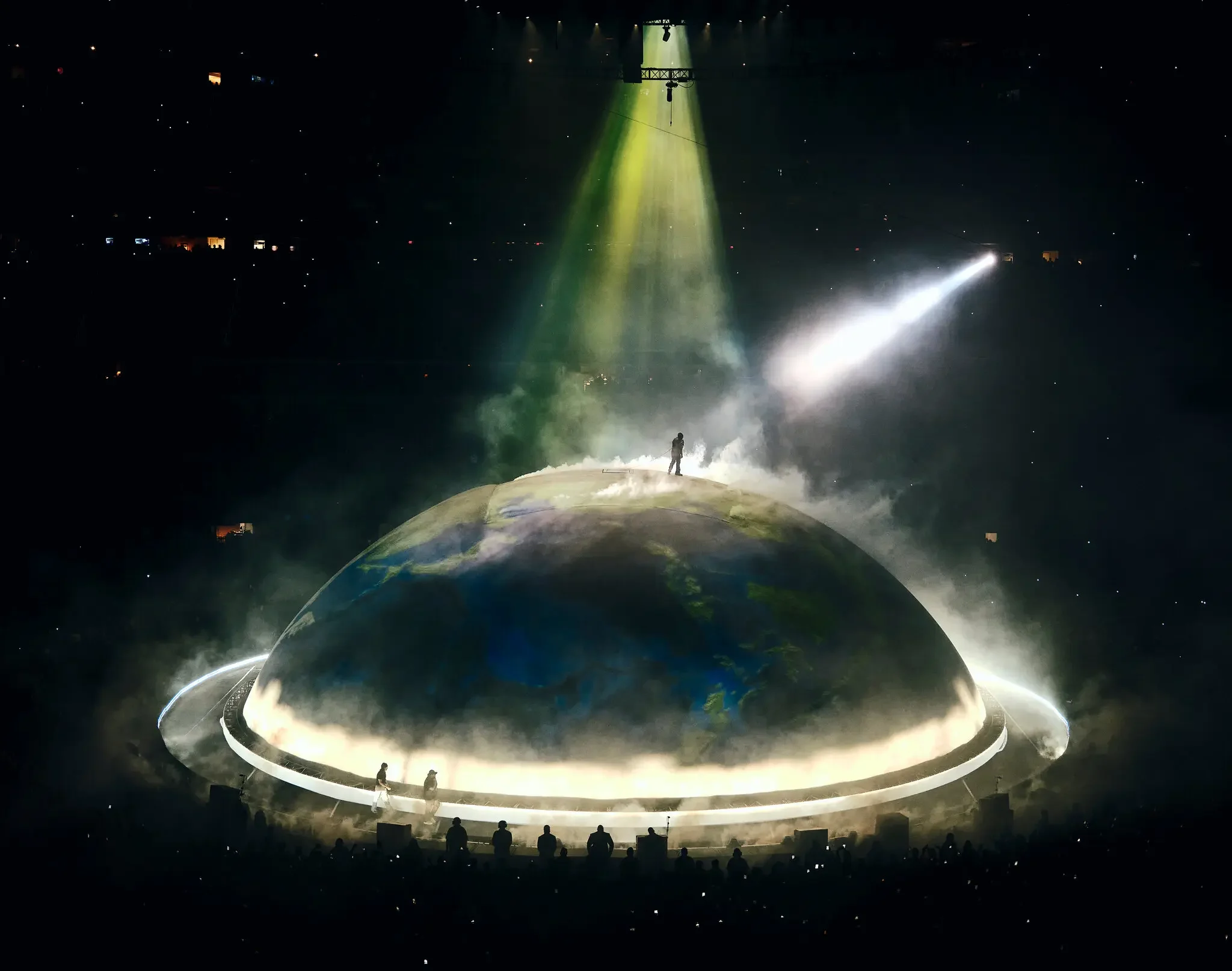
Everyone’s talking about the performance but Ye’s Bully stage at SoFi Stadium, built with Aus Taylor, reads like one of the most deliberate pieces of stadium scenography in recent memory - and the dome is far from arbitrary.
A full spherical volume dropped into a stadium scale footprint.
No flat deck.
No wings.
No traditional performer-to-audience orientation.
Everything curves.
From a scenography standpoint, that changes behaviour immediately.
The performer has no fixed horizon.
The audience has no consistent focal plane.
The lighting wraps 360, so there’s no “front.”
You’re dealing with spatial disorientation as a design tool.
The reference to Akira is direct.
The 1988 film opens with an explosion that wipes out Tokyo, caused by a child with psychic power too great to contain.
That idea - uncontrollable energy inside a system built to suppress it - has been a recurring reference across Ye’s career.
The dome mirrors that logic.
This is about containment.
A force placed inside a structure that cannot fully hold it.
The dome reads like a pressure chamber:
- Dense atmosphere through constant haze
- Rotational movement creating instability underfoot
- Light behaving like energy inside a volume
- A harness system that reads as restraint
The body sits at the centre of that system.
Not leading it.
Contained within it.
From a creative direction perspective, Aus Taylor pushes this into authored space.
This type of set defines rules:
- Movement becomes negotiated
- Stillness carries tension
- Scale feels infinite and enclosed
That duality is difficult to execute at stadium level.
Here, it lands.
Where it gets sharp is the relationship between system and performer.
When the environment carries this much narrative weight, it demands a response.
The design sets up:
- Pressure
- Instability
- Containment
The performance has to push against those forces to complete the idea.
If that push doesn’t fully materialise, the environment holds the attention.
That dynamic played out across moments of the show.
Zooming out, this marks a shift in how live experiences are being built.
Stages used to frame performance.
Now they behave like ecosystems.
Conditions get designed first.
The artist operates inside them.
Then the system opens up through guest moments.
Lauryn Hill stepping into All Falls Down adds raw human texture.
Travis Scott brings volatility that aligns with the space.
Jamie Foxx reconnects the origin story within this new world.
Each appearance shifts the energy inside the sphere.
From containment to collision.
💬 From a design perspective: When the environment carries this much authorship, does the performer lead the system - or respond to it?
+ more broadly - how far can scenography go before it becomes the main act?