Welcome to the next edition of On The Record, thoughtful analysis on culture, entertainment, tech, fashion, music, sport, and brands. Here’s a round-up of key conversations and campaigns that caught my attention this week.
This was the week a lot of powerful organisations stopped accepting somebody else’s numbers. Sony sent its own investigators to a criminal trial in China and produced a forensic account of WPP’s rebate mechanics that now sits in a New York court filing, alleging $350m retained against $110m returned. Los Angeles County published its own economic modelling of the Paramount-Warner merger, putting $2.78bn at risk before any regulator has ruled. Barb spent February being served a cease-and-desist by YouTube for measuring what British households were actually watching, and YouTube has now unilaterally redefined a view as any video that starts playing. Opendorse revised its own NIL market estimate upward by 61% to $4.5bn, having missed it by more than half. The Guardian went through eight seasons of WSL accounts and found the “big four” was always a big two. Roblox is explaining to a Senate subcommittee why 65,381 exploitation reports represent better detection. Nike closed at $39.09 with a turnaround story its own management still believes and its shareholders visibly do not. The pattern running underneath all of it is that measurement has become the contested asset, and the parties with the legal budgets, the regulatory powers or the balance sheets to build their own numbers are no longer waiting to be handed one. What follows from that is a genuine shift in leverage: for two decades the party that defined the metric set the price, and this week several of them found out that only holds while nobody else can afford to check.

👀 SPORT
Women's Pro Baseball League Debuts With a Neutral-Site Season Built to Outlast the Four Before It ⚾
📌 Springfield, Illinois has a population under 115,000 and no major-league sports history to speak of. It is also, for the whole of this summer, the entire Women's Pro Baseball League. The WPBL's four teams represent Boston, New York, San Francisco and Los Angeles, markets chosen for size and sports loyalty, yet every game is being played on neutral ground at a 5,200-seat ballpark in central Illinois. The structure trades away the home-market fandom engine most leagues lean on in year one, in exchange for controlling costs while the league proves it can hold players and broadcast partners long enough to reach a second season.
The WPBL is the fifth professional women's baseball league in U.S. history, following the AAGPBL's 1954 dissolution and the short-lived Ladies Professional Baseball League, which folded in 1998
All 2026 season games are played at Robin Roberts Stadium, Springfield, seating 5,200, with a 30-game regular season from 1 August running into mid-September followed by playoffs
ESPN holds exclusive broadcast rights across 37 total games including the Championship Series, with rosters drawn from 60 players representing 11 countries
💡 Every previous attempt at this league expanded into home markets before proving the format could hold an audience, and every one of them folded on the cost of that expansion. Centralising the season in a neutral, low-overhead city inverts the sequence: build the broadcast product first, then let market-specific fandom follow once ESPN's numbers justify the venue spend. Queens third baseman Ashton Lansdell's line, “we hope it's the fifth and the last,” reads less like optimism than diagnosis. Four leagues died on expansion economics before the audience existed to carry them ⚾
Arsenal and Chelsea Out-Earn the Rest of the WSL Combined as a Wage Cap Arrives 💷
📌 The “big four” of the Women's Super League does not exist in the accounts. Guardian analysis of eight seasons of WSL club filings finds Arsenal and Chelsea generated more revenue in 2024-25 than the other ten clubs put together, despite Manchester City and Manchester United sharing the on-pitch trophy haul since 2014. Underneath that concentration sits a league running on owner subsidy: more than £111m in cumulative post-tax losses since the switch to a winter calendar in 2017, with wages quadrupling between 2019 and 2025.
Arsenal and Chelsea are the only WSL clubs with wage bills exceeding £10m, each recording turnover roughly twice that of their Manchester rivals; Chelsea's wage bill ran more than five times larger than eighth-placed Everton's (Guardian)
WSL clubs generated £90m in revenue in 2024-25, up 39% year-on-year, with the top four clubs accounting for 71% of the league total, up from 66% the previous season (Deloitte Annual Review of Football Finance)
Group income, the mechanism by which parent clubs fund women's operations, represented 27% of total WSL revenue and more than half of club revenue at Arsenal, Aston Villa and Everton (Deloitte)
💡 The 2026-27 season introduces points penalties for clubs whose wage bills exceed 80% of revenue plus £4m in owner contributions, and that formula quietly locks in the existing hierarchy. A club generating £22m can spend multiples of what a club generating £4m can, entirely legally, which converts the current revenue gap into a permanent competitive one. London City Lionesses have already tested the edges, posting a £10.6m operating loss against £902,000 of revenue while signing Alexia Putellas. Financial sustainability rules written around revenue percentages always protect whoever is already earning the most, and the WSL has just imported that logic wholesale 💷
Chelsea Women's Bio Stunt Becomes a Lesson in What Brands Actually Mean by “Community-Led” 📱
📌 The post went up as routine engagement bait and came down as a case study. Chelsea FC Women invited followers on Threads to determine the account's new bio by top-liked comment, the sort of low-stakes format that runs across sports and consumer accounts constantly. When “Free Palestine” reached the top at roughly 136,000 likes, the club deleted the post rather than honour the mechanic it had built itself, and the deletion became the story instead of the comment.
The original post asked followers what the club's Threads bio should say, with the winning comment reaching approximately 136,000 likes before the post was removed
Chelsea FC Women has 607,300 followers on Threads at time of writing, giving the post significant organic reach before deletion
The deletion drew criticism from commenters accusing the club of inconsistency between the format it offered and the outcome it was willing to publish
💡 The format promised the audience genuine authorship, then reserved a veto for the moment the answer became commercially inconvenient, which leaves a club worse off than if it had never opened the floor. Brands reach for the language of co-creation constantly, letting fans “decide” the merch drop or the caption or the bio, because it reads as trust and costs nothing while the results stay safe. Chelsea found out what happens when an audience takes the invitation literally on a subject the club had no intention of being led on. “Let the community decide” functions as a strategy only once you have decided you can live with anything they might say 📱
Women's Sports Viewership Hits 28.6bn Minutes as the Fandom Behind the Number Gets More Demanding 📈
📌 28.6 billion minutes is the figure that will end up in every women's sports deck this autumn. The 60% sitting underneath it should change how brands actually buy. Nielsen's new report puts U.S. women's sports consumption at 28.6bn minutes across the first half of 2026, up 18% year-on-year, with category ad spend up 120% since 2022. Deeper in the data sits the more commercially consequential finding: this audience is markedly more values-driven than the general sports audience, which changes what a sponsor is buying.
Women's sports viewership reached 28.6bn minutes in H1 2026, with 122.5m Americans, 52.8% of the population, now identifying as active participants in the ecosystem
60% of women's sports fans have switched brands based on a company's values or actions, compared with 45% of sports fans overall, while advertising spend on the category is up 120% since 2022
Among an estimated 16 million new sports fans overall, 9 million are women, with the NFL seeing a 54% rise in new female fans and the NBA 45%
💡 Brands are currently pricing this audience the way they price any high-growth media category: more reach, better efficiency, standard sponsorship logic. A fanbase where three in five will move their money over a company's stated values behaves closer to a constituency than a segment, and that gap holds the commercial risk buried inside the growth story. The winners here will be the ones who understood they were buying alignment alongside attention, from an audience that treats a broken promise as grounds to leave rather than a rounding error 📈
Bezos-Backed Consortium Buys Into Liverpool as FSG Keeps Control and Books a 13x Return 🔴
📌 Jeff Bezos is now publicly associated with Liverpool Football Club and will not sit on its board. FSG has agreed to sell roughly 30% of the club to 1892 Holdings, a consortium fronted by former Queens Park Rangers co-owner Amit Bhatia and backed by Bezos through K5 Sports and Eduardo Saverin through EE Capital. FSG retains majority ownership and operational control, the club insists no new transfer budget is attached, and the most eye-catching name in the deal has no seat at the table.
FSG will receive proceeds reported between £1.4bn and £1.65bn for the 30% stake, valuing Liverpool at roughly £5.5bn ($7bn-$8bn), a return of around 13 times the £300m FSG paid for full control in 2010 (figures vary by source, not independently reconciled at time of writing)
Amit Bhatia becomes Liverpool's new vice-chairman and joins an expanded board alongside Elaine Saverin and K5's Bryan Baum; Bezos himself will not hold a board seat
1892 Holdings holds an option to increase its stake toward majority ownership within 12 months at a valuation of roughly $8bn, should FSG choose to relinquish control
💡 Read the board seats rather than the price. Bezos gets the cultural association that comes from being publicly linked to Anfield, FSG keeps every operational lever, and the 12-month option quietly pre-selects the buyer for an exit FSG would then be making on its own timetable rather than under pressure. Banking a 13x return while installing your eventual successor is considerably more disciplined engineering than “wealthy investor joins Liverpool” conveys 🔴
Fever-Dream Sets Another WNBA Record as the Baseline Growth Underneath It Hardens 🏀
📌 Four million people were watching the last fourteen minutes of a WNBA regular-season game on a Sunday evening in August. ESPN's Atlanta Dream-Indiana Fever broadcast on 16 August averaged 2.6 million and peaked at 4 million, making it the most-watched WNBA game, regular season or postseason, in cable history. It was also the third ESPN broadcast in two weeks to clear 2.5 million. The Clark-Reese rivalry is doing real work, but the trendline running underneath the outliers is the number brands should be pricing off.
The Fever-Dream audience was up 178% versus ESPN's regular-season average last year, with the preceding WNBA Countdown pregame show up 33% and the following Mercury-Fire broadcast, built around Diana Taurasi's jersey retirement, up 46% and setting its own record as the most-watched non-Indiana game ever on ESPN
Through 25 games this season, WNBA broadcasts on ESPN networks are averaging 1.4 million viewers, up 16% versus the same point last season
Indiana has featured in several of the league's largest audiences across multiple networks this season, including 2.64 million for a July Fever-Aces broadcast on NBC/Peacock and 2.58 million for an August Fever-Liberty game on CBS
💡 Sponsors should be underwriting the 16% baseline across 25 games, not the single 4-million peak. One blockbuster can be dismissed as a one-team, one-rivalry event that evaporates whenever Caitlin Clark is off the floor, which is precisely the argument that has kept some brands waiting. A league-wide average climbing steadily across a full season is evidence the expansion has become structural, even while Clark and Reese remain the reason casual viewers arrive first. The Taurasi retirement game clearing 1.4 million without an Indiana jersey in sight is the quiet data point in that release 🏀
Publicis and Kelce Launch Tekta to Bring Ad-Agency Discipline to the NIL Free-for-All 🏈
📌 College athletes will earn an estimated $4.5bn this year, and almost none of it moves through anything resembling a functioning ad market. Publicis Sports has launched TEKTA with Travis Kelce and his talent firm 3 Arts Sports, a consulting and activation venture built to help brands identify, structure and measure partnerships with college athletes and universities. The category has scaled from a scrappy collective-driven system into something large enough that a global agency network wants a formal position inside it before the fragmentation calcifies.
College NIL spending is now projected at $4.5bn for 2026-27, a roughly 61% upward revision from Opendorse's prior $2.8bn estimate, driven by an estimated $735m in “above the cap” athlete earnings beyond the NCAA's $21.3m per-school revenue-sharing limit
TEKTA gives a select group of Publicis Sports clients access to a network spanning 45,000 Division I student-athletes and 68 Power Four universities, combining Publicis Sports' advertiser relationships and measurement tools with 3 Arts Sports' university and conference relationships
Kelce serves as an advisor to the venture while 3 Arts Sports operates as strategic partner; the launch follows Publicis Groupe's earlier Influential Sports offering, which connects brands to fans through creator-led marketing
💡 What Publicis is selling is the removal of friction every brand in this category already feels: NIL currently demands a separate negotiation with every school, collective and athlete rep, which is exactly the kind of fragmented, high-cost market holding companies exist to consolidate and resell as one line item. Kelce supplies the credibility layer that persuades brands to trust an unproven measurement system in a market that grew 61% in twelve months and still has no standard way to prove anything worked. Whoever builds that measurement infrastructure first will own the category, regardless of who signs the flashiest athlete 🏈
Buss Family Fractures Over Final Lakers Stake as a 2017 Court Order Collides With a $12.5bn Tag-Along Right ⚖️
📌 Forty-six years of Buss family ownership is unravelling in letters between lawyers. Five siblings announced they had voted to sell the family's remaining 17.8% to new majority owners Bob Iger and Josh Kushner, at the $12.5bn valuation Mark Walter secured days earlier. Jeanie Buss, the team's controlling governor since 2013, is contesting the vote outright, arguing a 2017 court order requires her explicit consent as co-trustee and that any sale without it is void.
The five siblings' sale relies on a tag-along clause from the 2025 Mark Walter transaction, letting them sell at the same price Walter secured; the vote reportedly opened before Walter's Iger-Kushner deal was finalised
Jeanie Buss's lawyer cites a 2017 court order requiring co-trustees Jeanie, Janie and Joey Buss to maintain her minimum 15% ownership threshold so she remains Controlling Owner, and states any sale without her consent constitutes breach of trust and contempt of court
The NBA requires all team governors to hold at least a 15% stake; Jeanie's position falls below that threshold if the 17.8% family stake sells, which would jeopardise her governorship regardless of the sale's legal outcome
💡 Two legal mechanisms were built to do opposite things and nobody appears to have checked whether they could coexist before both fired in the same week. A trust designed to guarantee Jeanie's control for life is now running directly into a tag-along right designed to let minority holders exit on a third party's terms. Whoever prevails in court, the NBA's 15% governance floor means her authority was always contingent on her siblings' cooperation rather than the order protecting her, which is the transferable lesson for any family enterprise built around a controlling stake that turns out not to be controlling ⚖️
Google Turns Arsenal and Liverpool Into a Testbed for Selling Gemini, Not Just Pixel 🤖
📌 Since 2023, Google's football money has bought visibility. This renewal is buying behaviour. Google has extended its Pixel partnerships with Arsenal and Liverpool while adding Gemini as both clubs' official AI partner, part of a five-club rollout also covering Barcelona, Bayern Munich and PSG. Pixel's role has stayed constant throughout: capture behind-the-scenes content, get the hardware into a celebration. Gemini's arrival changes the ask entirely, because an assistant only succeeds if fans open it.
Since 2023, LFC and Pixel content has generated more than 1 billion video views across three seasons, with Pixel-branded content alone driving 13 million views and half a million engagements on Liverpool Women's platforms in 2025-26
Arsenal's renewed deal is reportedly worth around £7m per year over three years, with Gemini positioned to analyse new signings and align fixture planning, while Pixel continues capturing behind-the-scenes matchday content
Gemini integrates with Google Maps and Gmail for Liverpool fans, streamlining away-day planning and settling in-group debates, while Pixel remains focused on content capture across both clubs' men's and women's teams
💡 Pixel's job was passive: a phone glimpsed in Salah's celebration, a handset in a dressing-room video, brand adjacency delivered without the fan lifting a finger. Gemini requires the fan to actually open the app and ask it something, which is a far harder behaviour to manufacture and the reason Google is buying access to two of the most emotionally invested fanbases in world sport. Supporter loyalty is being borrowed here to solve a problem that has nothing to do with football: getting people to talk to Gemini the way they already talk to each other about their club 🤖
Cameroon Finally Wins WAFCON, Beating the Country That Beat Them Three Times Before ⚽
📌 Cameroon lost the WAFCON final in 2004, 2014 and 2016, to Nigeria on every occasion, without scoring in any of them. They did not qualify for this one. The Indomitable Lionesses beat tournament debutants Malawi 3-0 in Rabat, with Marie Ngah Manga's double and a Naomi Eto scissors-kick settling it inside the first half, and took the title at the fourth attempt after entering the tournament through an expanded bracket.
Cameroon becomes only the fourth nation to win WAFCON, joining Nigeria, Equatorial Guinea and South Africa; Cameroon had initially failed to qualify and only entered after CAF expanded the competition from 12 to 16 teams
Cameroon eliminated defending 10-time champion Nigeria in the quarter-finals and host nation Morocco in the semi-finals en route to the final, going undefeated throughout the tournament
Marie Ngah's brace takes her tournament tally to five goals, tying her for the Golden Boot with Barbra Banda and Malawi's Temwa Chawinga; the two finalists have already qualified for the 2027 Women's World Cup in Brazil alongside semi-finalists Morocco and Algeria
💡 Cameroon reached this tournament on an expanded bracket and a favourable ranking, then eliminated the defending champions and the host nation, the two sides with the strongest claim to the slot they took. Worth holding onto next time a federation debates expansion and someone frames the extra places as dilution: the slot that looks like a compromise on paper is occasionally the one the eventual champion walks through ⚽
Columbus Becomes the First US City With Free Period Products in Every Major Sports Venue 🩸
📌 Six venues, six separate ownership groups, one standard. Huntington Park, home of the Columbus Clippers, became the sixth Columbus venue to install Aunt Flow's free-vend dispensers, joining Ohio Stadium, ScottsMiracle-Gro Field, Nationwide Arena, Historic Crew Stadium and the Schottenstein Center. That makes Columbus the first US city to cover its entire major sports venue footprint with the same provision, moving the category past individual-venue gesture into something closer to municipal infrastructure.
165 free-vend dispensers are now installed across the six Columbus venues, supplied by Columbus-based Aunt Flow, which has more than 70,000 dispensers installed across the US, UK and Canada and has donated over seven million products to nonprofits
Aunt Flow's stadium partnerships span the Phoenix Mercury, the first WNBA team to sign on in 2022, Ohio State's Ohio Stadium, Austin FC's Q2 Stadium, and multiple English football clubs via distribution partner Citron Hygiene
Industry research cited by Aunt Flow found 69% of menstruators feel embarrassed having to bring period products into a public bathroom, the stated rationale behind the free-vend model
💡 Six ownership groups spanning MLB, college football, NHL, NBA/WNBA and soccer all landing on the same vendor and the same standard in the same market is how a category norm forms, city by city, the way accessible seating and gender-neutral facilities stopped being differentiators and became baseline. The competitive dynamic flips once a whole market clears the bar: every remaining holdout venue in every other city starts reading as the exception it has to justify 🩸
WNBA Task Force Responds to Ex-NBA Players' Draft Declarations, Won't Rush a Policy Change 🏀
📌 The WNBA's eligibility rule runs to one sentence and defines none of its own terms. Former NBA players Enes Kanter Freedom and Royce White publicly declared themselves eligible for the 2027 draft, citing the policy language that “only players who are women are eligible to play in the WNBA.” The league's Anti-Hate Task Force, made up of team presidents and general managers, convened to address the resulting online debate and issued a statement rejecting the declarations without announcing any change to the rule.
The league's statement read: “There are no immediate eligibility matters affecting the WNBA, and we strongly denounce the bad-faith efforts to use these topics to demean or marginalize others,” adding that discussions with stakeholders, including players, will continue in the coming weeks and months
The Anti-Hate Task Force itself was established in 2025 under Commissioner Cathy Engelbert, built around social media monitoring, strengthened conduct standards, added security, and dedicated mental health clinicians for players
The current WNBA CBA states “only players who are women are eligible to play in the WNBA” without defining the term further; the task force meeting produced no new eligibility policy
💡 Declining to write a rule under pressure is itself a decision, not the absence of one. Drafting eligibility language reactively, mid-news-cycle, in response to a stunt engineered specifically to force that drafting, would hand the provocateurs the outcome they were after: policy shaped by the loudest bad-faith test case rather than by deliberate work. The league is betting its credibility survives patience better than it would survive a statement written to satisfy one week of headlines 🏀
🎬 CULTURE & ENTERTAINMENT
Lucas Museum Opens $1bn LA Campus as Illustration and Comic Art Are Written Into the Canon 🛸
📌 Illustration, comic art and film production design have spent a century filed as commercial craft rather than serious work. The Lucas Museum of Narrative Art, opening in Exposition Park on 22 September, is a billion-dollar attempt to settle that argument through infrastructure: 300,000 square feet by Ma Yansong of MAD Architects, thirty-five galleries, and a collection of more than 40,000 works hanging Frida Kahlo and Norman Rockwell alongside Jack Kirby, Alison Bechdel and R. Crumb. George Lucas funded the building, the collection and the endowment personally, which lifts the institution clear of the donor politics shaping almost every comparable museum.
Total cost reported at $1bn, personally funded by Lucas, including construction, the art and an endowment of at least $400m
More than 40,000 works across thirty-five galleries and 100,000 square feet of exhibition space, on an 11-acre site previously used as surface parking
Free admission for residents of the surrounding 90037 zip code via the LM37 pass, with 1,300 items on initial display
💡 Lucas sold Lucasfilm to Disney in 2012 for roughly $4bn and kept the one asset that was never on the table: authority over how the work is understood. The museum holds the complete Lucas Archives of props, costumes and production artefacts through 2012, which puts the material Disney monetises as franchise inventory on a wall a few miles away as art history, in galleries he paid for and endowed so that no future board can reclassify them. Most collectors spend their fortunes buying entry to a canon that already exists. Endowing a rival one, beside the Coliseum, in a neighbourhood where the people next door get in free, is the slower and considerably more durable version of the same ambition 🛸
SXSW Splits Podcasting Into Its Own Festival as the Conference Rebuilds Itself Around Access Tiers 🎙️
📌 SXSW's founding promise was that a student and a studio head bought the same badge and stood in the same queue. The 2027 edition introduces a premium CxO Badge reserved for C-suite executives and founders, alongside a standalone Podcast Festival elevating the medium to sit with Innovation, Film & TV, Music and Comedy as a core pillar. The festival is also moving its Film and Music conference hubs into two of Austin's historic hotels, formalising the village model it trialled last year.
Podcast Festival runs 17-20 March 2027, open to all badgeholders, inside the wider SXSW run of 15-21 March 2027
CxO Badge opening rate reported at $6,095 (single-sourced, figure not independently confirmed elsewhere at time of writing)
2027 PanelPicker submissions and Music and Film & TV festival applications up by as much as 50%, per SXSW's own SVP of programming
💡 A flat badge system was always a subsidy, one the festival could afford while discovery was its scarcest product and proximity was free to give away. SXSW is now pricing that subsidy out, at the exact moment podcasting, a format built almost entirely on parasocial intimacy and unmediated access, gets promoted into a ticketed pillar with gates of its own. Both moves point the same way: the event that built its reputation on flattened access has found a buyer for the ability to skip the queue 🎙️
Broadwick Live Bets on Real Estate, Not Festival Brands, as the Format That Wins in Nightlife 🏙️
📌 A former sugar warehouse. A plot beneath a City Airport flight path. A stretch of unused riverside at Greenwich Peninsula. None of these read as nightlife destinations until Broadwick Live put a stage on them. The company behind Printworks, Drumsheds and Silverworks Island ran Magazine Open-Air across two August weekends, positioning it deliberately as a venue launch rather than a festival: six standalone, separately curated nights instead of one weekend carrying a single brand identity. Broadwick pivoted from running festivals to owning physical event spaces in 2019, and this is that strategy's newest asset.
Broadwick Live's current London portfolio spans Printworks, Drumsheds, Magazine London, Dock X, The Beams and Silverworks Island, largely concentrated across Docklands and east London's regeneration corridors
Magazine Open-Air ran across two weekends, 14-16 and 21-23 August, with each date independently curated rather than programmed as a single festival identity, spanning house, disco, techno and soul lineups
The custom open-air stage was designed by Paris studio Matière Noire specifically for the Greenwich Peninsula site, with the operation moving back indoors to Drumsheds for the autumn programme
💡 Broadwick's product is unclaimed urban land with a skyline behind it, converted into a venue before anyone else clocks the potential. That is a considerably harder advantage to attack than a festival brand, because a great lineup can always be poached or outbid, while the ability to look at an overlooked corner of London and see next summer's destination is genuinely scarce in an industry still mostly competing on booking budgets. Everyone else is bidding for the same headliners. Broadwick is buying the rooms they'll have to play in 🏙️
LA County Puts a Price on the Paramount-Warner Merger Before It's Even Approved 🎬
📌 $2.78bn is what Los Angeles County says the Paramount-Warner Bros. Discovery merger could cost it, and the county published that figure before any regulator has ruled on anything. Its final 120-day report models thousands of job-years at risk if consolidation follows the pattern these deals usually follow. The report is explicit that it forecasts no confirmed layoffs, since neither company has announced cuts at this scale, but it attaches a specific number to what the county stands to lose.
The county estimates $1.26bn in wages, $2.78bn in economic value, $4.06bn in total business output and $547m in tax revenue at risk, including $78.6m in local taxes
A total of 10,360 job-years are modelled as at risk, comprising roughly 4,500 direct film and TV jobs, 2,661 indirect jobs at supporting businesses, and 3,204 induced jobs in the wider local economy
California has lost 52,016 film and TV jobs since 2022, with 99.6% of those losses concentrated in Los Angeles County, while on-location production activity fell 16% in 2025 versus 2024
💡 Publishing your own economic modelling on somebody else's private merger is a political instrument, not a neutral analysis, and LA County has spent years watching production migrate to Georgia, the UK and Canada on incentives it cannot match. This reads as a county assembling a public record it can point to later, whether in permitting decisions, incentive negotiations or straightforward pressure on the companies. The number is now on the table, sourced and citable, and Paramount and Warner Bros. Discovery will be answering it long after the regulatory question is settled 🎬
Disney Sues the FCC, Turning a Licensing Dispute Into a First Amendment Test Case 📡
📌 ABC is suing its own regulator. The network, Disney and the eight ABC-owned local stations filed against the FCC, arguing that Chairman Brendan Carr's early review of their broadcast licenses constitutes retaliation for editorial coverage rather than routine process. The FCC maintains the review centres on Disney's DEI practices and that no license decision has been made. Whichever account holds, the case tests how much editorial independence a broadcaster retains when the regulator holding its license has documented ties to the administration.
The FCC ordered early review of all eight ABC-owned station licenses in April, well ahead of their normal renewal schedule, an unusually rare move; the directive came amid a probe into ABC's “The View” alongside the long-running DEI investigation
ABC's suit states the administration has “again and again... attacked ABC's speech” and that the network faces an “existential threat,” leaving it “no alternative means to eliminate these ongoing and immediate threats other than total capitulation”
Carr told NBC News the case is “meritless,” noting the agency has “not made a decision, ultimately, on a license proceeding” and that it will “follow the facts and the law”
💡 Every broadcast license has always carried an unspoken condition: the government renewing it holds leverage over the editorial choices made under it, whether or not that leverage is ever exercised. Disney filing pre-emptively, before any adverse decision exists, signals it has concluded the leverage itself constitutes the harm. Whether courts accept that regulatory timing can amount to retaliation absent a final ruling will set the calculation for every other broadcaster weighing a story against a regulator willing to move this visibly 📡
👗 FASHION & MUSIC
Saint Laurent Casts Connor Storrie as Menswear's New Face of Understated Sensuality 🕶️
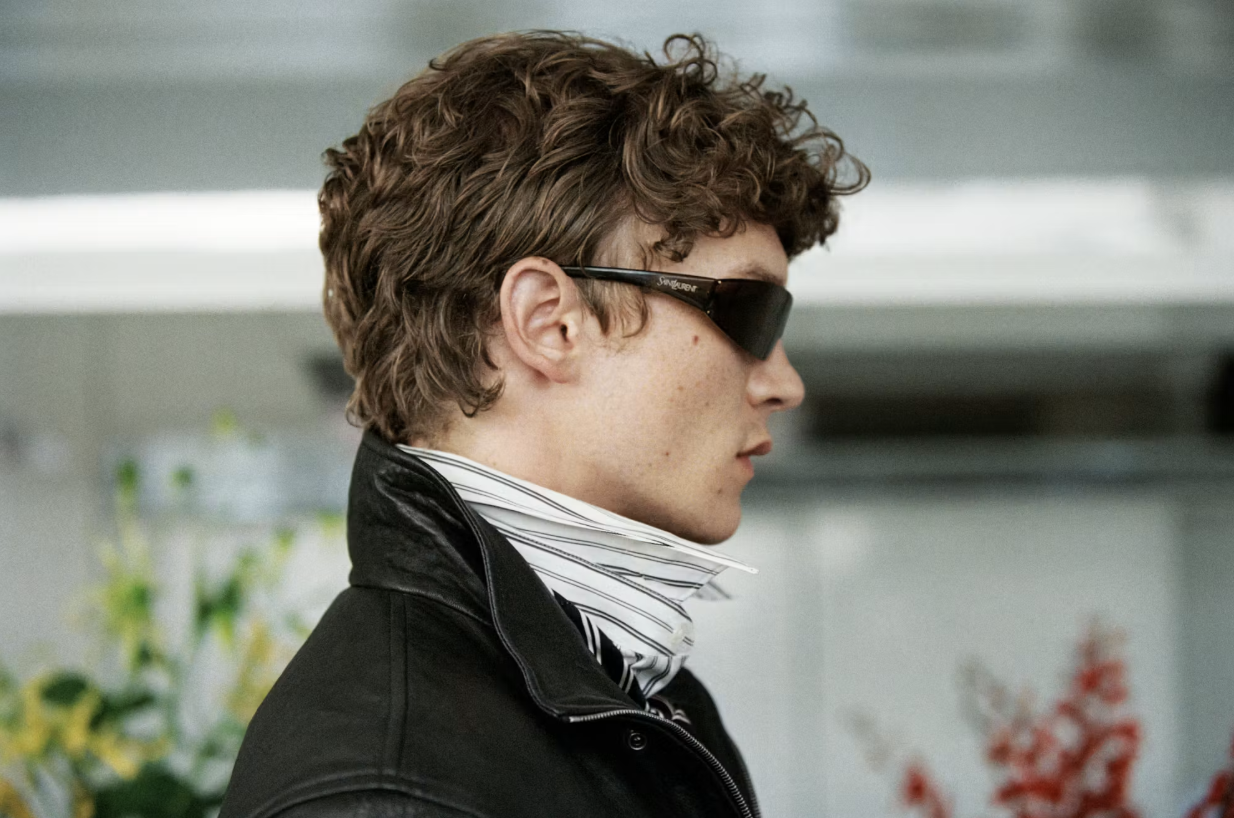
📌 A man dances alone in a sparse apartment, wraparound sunglasses on indoors, to a Milli Vanilli power ballad. It is the most convincing menswear campaign of the season. Saint Laurent's Fall 2026 film puts Heated Rivalry actor Connor Storrie front and centre in his first fashion campaign, shot by Talia Chetrit alongside Rosé and Liu Wen, with Anthony Vaccarello reaching back to Helmut Newton's original YSL Pour Homme photography for the visual grammar. Storrie plays it androgynous and low-key, the opposite of the hypermasculine archetype menswear has leaned on for decades.
Storrie signed as a Saint Laurent brand ambassador in January 2026, ahead of appearing front row at the house's Fall/Winter 2026 menswear show in Paris the same month
He has since worn Vaccarello's designs to the Golden Globes, the Met Gala and the Spring/Summer 2027 menswear show, where he sat beside Madonna and Charli XCX
Storrie earned his first Emmy nomination in July 2026, for Outstanding Guest Actor in a Comedy Series following his 28 February SNL hosting appearance
💡 Saint Laurent is buying something more specific than fame, since Rosé has covered that ground as a house face since 2020. It is the credibility of an actor who went from waiting tables to an Emmy nomination in eighteen months, on the strength of a queer romance drama the American broadcast establishment was not structurally set up to reward. Vaccarello is borrowing that trajectory to make a fragrance line launched in 1971 feel discovered instead of inherited, which only functions because Storrie's rise reads as unmanufactured. The house is renting momentum it did not build, wagering that his authenticity travels further than sixty years of its own heritage marketing 🕶️
Liam Gallagher Calls Pretty Green “Stolen” as Oasis Launches Its Own Merch Line 👕
📌 Liam Gallagher lost Pretty Green in 2019. He has never once described it as a sale. Asked on X this month why he sold the brand he founded in 2009, he replied that it was “stolen from me by vultures” who wouldn't know how to dress the youth, seven years after administration handed it to JD Sports and then, by 2022, to Mike Ashley's Frasers Group. The timing carries more weight than the insult: Oasis has just put out a 30th-anniversary Knebworth clothing range, which returns Gallagher to the merch business on terms he controls.
Pretty Green entered administration in 2019 following the collapse of House of Fraser, was acquired by JD Sports, then passed to Mike Ashley's Frasers Group in 2022 as part of a £47.5m brand acquisition
Gallagher's X post responding to a fan calling the brand “stolen” was published 15 August 2026, seven years after he says he lost creative control
SJM Concerts, promoter of the 2025 Oasis reunion tour, was granted an indefinite premises licence for up to 125,000 attendees at Knebworth on 1 August 2026, fuelling speculation about a 2027 return 31 years on from the band's original 1996 shows
💡 What actually rankles is authorship. Pretty Green under Frasers still trades on a 2009 vision built entirely from Gallagher's own iconography, operated by people with no claim to the story that made it saleable in the first place, while the Knebworth range lets him sell that same aesthetic straight back to the same audience without paying rent on his own past. He has no interest in winning the brand back, and said as much when asked. He is building the version nobody can take, which by his reckoning was the only version worth anything 👕
Reebok Revives the G6 as 50 Cent's Y2K Sneaker Deal Gets a Second Act 👟
📌 Tony Yayo leaked it on a podcast months early. Reebok shipped it anyway. The G-Unit G6 returns today in its original 2003 red, white and blue, a 1:1 archive recreation timed to the wider Y2K resurgence rather than any particular anniversary. The original mattered commercially as much as culturally, arriving alongside Get Rich or Die Tryin' at the precise peak of 50 Cent's earning power, which is why Reebok is treating this as a reissue rather than commissioning anything new.
The G-Unit G6 drops 20 August 2026 at 10am ET via Reebok.com and select retailers, priced at $130 in unisex sizing 3.5 to 13 plus 14, as a 1:1 retro of the 2003 original
50 Cent has stated he made $80 million from the original Reebok partnership, which also spawned the G XT cross-trainer and G-Unit Boot
The reissue's return was leaked months early by G-Unit affiliate Tony Yayo on his podcast, before Reebok's official announcement or images existed
💡 Letting an affiliate break your news a season early and then running the plan unchanged only makes commercial sense if the leak delivered exactly the anticipation you wanted at no cost. Culture has not run on controlled reveals for years; it runs on unofficial confirmation moving faster than any marketing calendar can, and the brands still trying to police that are paying for a control they no longer have. Reebok reading the leak as free heat is the smarter tell here than any amount of archive-accurate suede 👟
🤖 TECH & AI
YouTube Redefines the View Right as It's Trying to Get Measured Like Television 📱
📌 From today, a YouTube view means a video started playing. That is the entire threshold. The change applies across long-form video, Shorts and livestreams, unifying a split system in which long-form carried an unpublished watch-duration requirement. The timing is what elevates it beyond housekeeping: YouTube's leadership has spent this year arguing the platform should be planned as television, while moving its own measurement standard in the opposite direction from every TV currency body.
The change unifies YouTube's previously split system, long-form kept an unpublished watch-duration threshold estimated at 8-30 seconds, while Shorts moved to first-frame counting in 2025 to match TikTok and Instagram Reels
Media buyers say the change won't materially affect ad trading, since deals are reconciled on impressions or “billable views” with separate definitions, and the older, stricter metric survives internally as “Engaged views”
UK TV currency body Barb measures second-by-second viewing under Media Rating Council standards requiring at least two seconds of viewing on more than half the screen; YouTube issued a cease-and-desist in February compelling Barb to shut down a channel-level measurement effort after it showed YouTube viewing on UK TVs being dominated by content for very young children
💡 YouTube managing director Kim Larson told the Media Leader this summer that YouTube should be considered TV and asked, pointedly, where anyone thought it wasn't held to the same standards. Here is where: the platform sets its own definitions unilaterally, changes them without consulting the market, and served legal papers on the body attempting to verify what British households were watching. TV budgets flow into Barb and its equivalents precisely because no single party controls the number, and asking for the money that trust built while refusing the accountability that produced it is a positioning claim with no infrastructure behind it 📱
Senate Opens Roblox Investigation as Platform Safety Becomes a Congressional Liability 🎮
📌 A Senate subcommittee has given Roblox until 31 August to hand over its child-safety paperwork. Senators Josh Hawley and Dick Durbin have opened a Judiciary Subcommittee investigation, directing the company to preserve records and answer more than a dozen document requests tied to child safety, abuse and exploitation. Roblox is simultaneously defending state-level lawsuits and a separate Georgia Attorney General investigation, which means its safety architecture is now being litigated in front of regulators, advertisers and parents at the same time.
The letter, dated 12 August 2026, was sent to Roblox CEO David Baszucki with document production required by 31 August 2026
Reports of suspected child sexual exploitation to the National Center for Missing and Exploited Children reached 65,381 in 2025, more than double the 2024 figure, which Roblox attributes to improved detection rather than rising incidence
Roblox introduced mandatory facial age-verification via third-party provider Persona in January 2026, alongside expanded parental controls and chat restrictions between adults and under-16 users
💡 Watch the reporting-numbers defence as closely as the investigation. Roblox's position, that a doubling of exploitation reports demonstrates better detection, is the identical explanation every platform reaches for when a metric intended to reassure becomes the headline instead. It may well be accurate. A bipartisan subcommittee with document-compulsion powers is under no obligation to accept it, and neither are the parents whose confidence underwrites the platform's next quarter of user growth 🎮
ChatGPT for Teens Launches as OpenAI Writes Its Own Regulation Before Courts Do It for Them 🎓
📌 OpenAI is defending multiple lawsuits alleging its chatbot contributed to teen self-harm. The FTC has opened a probe into AI chatbot companions and their effects on minors. ChatGPT for Teens shipped this week. The age-gated experience applies stronger content restrictions, break reminders and parental controls automatically to any account the system identifies or self-reports as under 18, and the product decisions read less like goodwill than like a company moving ahead of a spec somebody else was about to write.
ChatGPT will be barred from using romantic language or terms of endearment with teens and will be more strongly instructed not to suggest it has feelings or consciousness, alongside more frequent break reminders during extended sessions
Parental controls, including linked accounts, managed chat history and set “blackout hours,” were made available by the end of September, days after the FTC launched a probe into AI chatbot companions and minors
Study Mode and “Responsible Homework” features are designed to detect assignment-bypass attempts and redirect teens toward step-by-step problem-solving rather than direct answers
💡 Every guardrail in this launch reads like a compliance record being assembled in advance: the anti-anthropomorphism language, the session breaks, the parental blackout hours, each one an answer to a question a court or the FTC is likely to ask. Shipping the standard voluntarily is cheaper and considerably more defensible than having one imposed, which makes this a rational calculation for OpenAI regardless of its effects. Whether default settings change how a teenager actually uses the product remains a question no company launching one of these features has yet answered with data 🎓
Apple's Pay-Per-Query Model Shifts AI Licensing Risk Onto Publishers 📰
📌 Apple wants to pay publishers by the query. In talks over multi-year deals to supply Siri's revamped assistant with current-events content, the company has proposed compensating publishers only when their specific content surfaces in a response, with a nine-figure budget under discussion. That departs sharply from the flat annual fees OpenAI has used with News Corp and Axel Springer, and the structure carries more information than the headline number does.
Apple has approached publishers about multi-year deals to give Siri real-time access to current events, proposing variable compensation paid when content is actually used, with a nine-figure budget under discussion
The push follows roughly two years of Apple Intelligence AI summaries fabricating headlines, including false arrests and invented sports results; Apple's Siri AI model is reportedly a custom 1.2-trillion-parameter build based on Google's Gemini technology, running on Nvidia hardware at a reported $1bn annual licensing cost
Publishers currently face a binary choice industry-wide: license to AI companies, as News Corp and Axel Springer have done with OpenAI, or litigate, as the New York Times is doing against OpenAI and Microsoft
💡 A flat fee guarantees a publisher gets paid whatever the platform's ranking decides. A pay-per-query model ties revenue entirely to an algorithm the publisher cannot see, cannot audit and cannot appeal, which is structurally the same dependency newsrooms have endured with Google Search for two decades, relocated one layer up into AI retrieval. Presenting that as innovation obscures which party is absorbing the volatility, and it isn't the one with the nine-figure budget 📰
Amazon's Drone Delivery Finally Gets Real, 13 Years After Bezos First Promised It ✈️
📌 Jeff Bezos promised drone delivery on television in 2013. Amazon is finally building it at a scale that counts. Prime Air is expanding sixfold, targeting nearly 500 U.S. cities and towns by the end of 2026, up from 11 metro areas today. Most of the intervening thirteen years were spent as a curiosity confined to a handful of Sun Belt suburbs, and this is the first expansion large enough to function as logistics infrastructure rather than proof of concept.
Prime Air VP David Carbon told staff in March the service will complete 1 million drone deliveries in 2026, with hundreds of thousands already made and thousands completed daily at the busiest sites
Amazon holds FAA Part 135 certification, the framework used for commercial air carriers, and has secured waivers to fly beyond visual line of sight; drones carry packages up to 5lb, covering over 60% of frequently purchased items
New markets launching soon include Chicago, Atlanta, Cleveland, Syracuse and Boise, while rivals Alphabet's Wing has passed 1 million deliveries across 20 markets and Zipline has logged 2 million across four continents
💡 Wing and Zipline already operate at the scale Amazon is targeting, which puts the company in the unfamiliar position of catching up to a market that moved without it. Amazon's actual historical advantage was never being first to a delivery format; two-day shipping won because Amazon made it the default expectation rather than the premium upgrade. Prime Air's real test is whether ultrafast delivery can be made equally unremarkable, at which point the story stops being about drones and starts being about who owns the final thirty minutes ✈️
Publicis Buys LiveRamp for $2.2bn as Holding Companies Race to Own the AI Data Layer 🤖
📌 Publicis paid $2.2bn for a company with 846 customers. LiveRamp is a data collaboration platform connecting over 25,000 publisher domains, and the acquisition is Publicis Groupe's third-largest ever. It arrived amid a wave of comparable moves: Stagwell launched The Media Machine, an agentic media operating system running more than 20 AI agents; WPP became Meta's first launch partner for its agentic creative platform; Omnicom expanded its Adobe partnership to co-develop an industry-specific AI operating model.
Publicis paid $38.50 per share, a 29.8% premium, in an all-cash deal; LiveRamp posted $813m in revenue for fiscal 2026, up 9% year-on-year, and connects more than 25,000 publisher domains and 500 technology partners across 14 markets
Stagwell's Media Machine, launched in June, uses over 20 intelligent agents to plan, buy, optimise and report across platforms including Google's GMP, Meta, Microsoft, TikTok and The Trade Desk, extending the company's broader agentic system launched in January
LiveRamp's actual customer base is small, just 846 direct enterprise subscribers, down from over 900 in 2024, meaning Publicis is paying primarily for LiveRamp's infrastructure role across the ad tech ecosystem rather than its client roster
💡 The value sits a layer below anything a client pitch would surface. Whoever controls the data collaboration plumbing decides which platforms, models and advertisers get preferential access once agentic buying becomes standard, which is the same structural leverage Google assembled through ad tech over two decades. Publicis has bought a toll booth every agency, brand and platform will eventually need to pass through, and the 846 customers are close to incidental to the thesis 🤖
ChatGPT's Ad Platform Goes Self-Serve as OpenAI Builds Out a Third Ad Duopoly Contender 💬
📌 In February, buying a ChatGPT ad required a $200,000 commitment and an agency relationship. By May it required a credit card. OpenAI opened a self-serve Ads Manager to any US business with no minimum, added cost-per-click bidding and shipped a Conversions API for post-click measurement, taking under three months to move from gated pilot to open infrastructure. That sequence is a close replica of how Google and Meta assembled the platforms now dominating digital spend.
The pilot generated over $100m in annualised revenue within six weeks of launch, before the self-serve tier existed, with ChatGPT reporting roughly 800 million weekly users at the time
OpenAI built agency partnerships with Dentsu, Omnicom, Publicis and WPP alongside technology partners including Adobe, Criteo and StackAdapt, ahead of opening the self-serve tier directly to advertisers
By July, OpenAI added outcome-optimised CPC bidding, geo-exclusion targeting and a Bulk API for campaign management, closing several capability gaps with Google Ads and Meta within roughly five months of the ad platform's launch
💡 Compression is the story. Google and Meta spent years building the targeting, measurement and self-serve capability that makes an ad platform genuinely investable; OpenAI collapsed that into months because it inherited a market that already knew exactly what an ad platform must do on day one. Third-mover advantage in a mature category means executing a proven playbook rather than writing one, against an audience whose intent signals are structurally different, decision-stage conversation instead of search query, which is the part worth watching once measurement catches up 💬
📊 BRANDS & BUSINESS
Nike Falls to a 12-Year Low as the Market Runs Out of Patience for the Turnaround 📉
📌 Nike closed at $39.09 on 17 August, a price the stock last touched in September 2014. The fall wiped out most of the value built through the pandemic-era sneaker boom, and it wasn't triggered by anything Nike did: the catalyst was weak guidance from rival On Holding, which suggests investors are now pricing the entire premium sportswear category on China exposure and margin durability rather than on any individual brand's execution.
Nike closed at $39.09 on 17 August, down 78% from its November 2021 peak of $177.51, wiping out roughly $196bn in market capitalisation
The decline reflects eight consecutive quarters of falling Greater China revenue and continued share loss to domestic rivals Anta and Li-Ning
JPMorgan projects fiscal 2028 as a stabilisation year rather than a recovery year, with EPS estimates running roughly 20% below Wall Street consensus
💡 Elliott Hill's rebuild of wholesale relationships and refocus on core categories is real progress by the company's own account, and the running numbers support parts of it. A 12-year low is the market saying operational fixes are no longer the binding constraint. China is, and eight consecutive quarters of decline there against domestic competitors who understand the consumer better is not a problem product pipeline discipline resolves. Few brands of this scale have ever run this wide a gap between “we are executing the plan” and “the market believes the plan” 📉
Mattel Turns UNO Into a Twitch Franchise, Betting Nostalgia Converts to Watch Time 🃏
📌 Mattel is putting a championship belt on UNO. The UNO Championship Series runs qualifiers across three US cities and the UNO Mobile app before a Los Angeles final streamed live on Twitch, with $50,000 on the line. The platform choice carries the signal: Mattel ran a near-identical UNO championship on TikTok in 2021, and moving it to Twitch this time points toward an audience that already treats watching other people play games as a legitimate format.
In-person qualifiers run in Kissimmee, FL (3 October), Chicago, IL (10 October) and El Segundo, CA (17 October), with one winner from each advancing to the final
Free weekly UNO Mobile app qualifiers run 31 August to 27 September, with the top four players advancing to the live event
The championship final airs 11 November in Los Angeles on Twitch, with a $50,000 grand prize and a companion UNO Championship Series product line, including a tournament set and championship belt, sold at retail alongside the event
💡 Follow the $19.99 card set. Mattel is selling a championship-branded tournament edition that lets viewers recreate at the kitchen table the exact format they just watched streamed, which turns the broadcast into an advert for the product and the product into a recruitment funnel back into next year's qualifiers. That is franchise logic borrowed wholesale from sports leagues: build the audience once, then run the format annually and let the belt and the box carry the brand through the eleven months in between 🃏
Alex Cooper Shuts Down Unwell Beverages While the Media Empire Around It Just Got Valued at $500m 🥤
📌 Alex Cooper's drinks brand is closing and her media company was just valued at $500m. Both landed inside the same week. Unwell Beverage Co., launched with Nestlé in 2025, will cease production after a final Halloween collection, with Target selling through remaining inventory. Meanwhile the wider Unwell business, spanning podcasts, TV and film production, merchandise, live events and an ad agency, raised at a valuation higher than anything the company has previously carried.
Unwell Beverage Co. launched in 2025 in partnership with Nestlé and is planning a final Halloween-season flavour drop before ceasing all production, with Target selling through existing inventory rather than restocking
The line launched as Unwell Hydration in three flavours before expanding into Focus, Protein and Energy variants, entering a crowded category already dominated by Prime Hydration, Dwayne Johnson's Zoa, and Kim Kardashian's Alani Nu
Unwell reportedly raised funding from Hollywood agent Patrick Whitesell in a deal valuing the broader media company at $500m, announced around the same period as the beverage shutdown
💡 Celebrity beverages are structurally difficult at scale, competing against category leaders with years of shelf position and distribution head start. The more useful read is that Cooper's leverage was always the audience, and a drink built to sit on camera beside a podcast host functions as marketing for the host's brand whether or not the SKU survives its second year. That is precisely why she can wind down Unwell Beverages without it registering as failure to the investors who just wrote the cheque 🥤
Vertical Video Hits $150bn as the Real Story Shifts From TikTok to Who Actually Owns the Format 📲
📌 $150bn, and that excludes China. Owl & Co's inaugural Vertical Economy Report sizes the global vertical video market at that figure for 2026, up 42% year-on-year, with Meta, ByteDance and YouTube capturing 94% of it. The more instructive number is the small one: microdrama, the standalone vertical-series apps built natively on the format, has reached $4bn while quietly rewriting its own business model in real time.
The global vertical video economy, excluding China, will reach $150bn in 2026, up 42% year-on-year, with advertising the largest single revenue line at $131bn, ahead of consumer spend and shopping take-rate revenue
Meta, ByteDance and YouTube generate 94% of vertical video revenue outside China, while dedicated microdrama apps account for roughly $4bn of the total, up from $3bn in 2025
Free ad-supported microdrama apps grew from 15% to 83% of time spent in five quarters, with the leading paid apps releasing more than five times as many series since Q2, even as average time spent per title fell
💡 Microdrama studios spent two years proving vertical-native storytelling could hold an audience and extract genuine in-app spend, and the reward for that proof is watching both the audience and the ad dollars consolidate onto three platforms that already controlled distribution. Free ad-supported apps displacing paid ones inside five quarters is the category converging on the exact model TikTok, YouTube and Meta already run at scale. The independents validated the format. The distribution layer is collecting on it 📲
Sony's Own Audit Now Backs a $100m Whistleblower Suit Against WPP's Rebate Practices ⚖️
📌 Sony sent investigators to a criminal trial in China, and what they concluded now sits in a New York court filing. Former WPP Motion Content Group CEO Richard Foster's amended $100m wrongful termination lawsuit cites an independent investigation Sony reportedly conducted into WPP and GroupM's proprietary media practices, alleging its findings corroborate concerns Foster says he raised internally for nearly a decade before being pushed out. WPP has called the amended complaint “baseless and without merit” and is refiling a motion to dismiss. None of the underlying allegations has been tested or proven in court.
Sony's investigation reportedly concluded WPP operated a “global crime scheme,” per Foster's amended complaint filed 13 August in New York State Supreme Court, alleging roughly $110m was returned to clients in China in 2024 against $350m allegedly retained; WPP maintains both complaints are “baseless and without merit” and says it will refile its motion to dismiss
The Sony probe reportedly followed a 2023 Chinese government investigation into GroupM China rebate practices that culminated last month in a life sentence for former GroupM China chief investment officer Di Fei; WPP has stressed it was not a party to that criminal proceeding and cooperated fully
A separate securities class action in the Southern District of New York, brought by institutional investors, alleges WPP misled shareholders about the strength of its business and names WPP Media CEO Brian Lesser as a defendant
💡 Pay attention to who ran the audit. Sony is a paying client with the legal budget to commission independent forensic accounting, attend a criminal trial and interview former executives, which removes the “disgruntled employee against the corporation” framing WPP would otherwise be able to rely on. Almost no advertiser has that capability. If the alleged mechanics prove out, they were operating across a client base with no realistic means of ever discovering them, and the trust problem that creates for the entire holding company model outlives whatever this particular court decides ⚖️

🎧 Jeff Bezos Sports Ownership Begins at Liverpool – Sporticast, hosts Scott Soshnick and Eben Novy-Williams (Sportico)
📌 On the 579th episode, Soshnick and Novy-Williams unpack Bezos and Josh Kushner’s entry into sports ownership via Liverpool and the Lakers in the same week, plus fresh reporting on federal investigations into outgoing Lakers owner Mark Walter’s business empire.
✅ Worth Your Time Because: This is the sharpest single listen connecting two of this edition’s biggest stories, the Bezos-backed Liverpool stake sale and the Buss family’s Lakers fracture, both breaking in the same seven-day window and both involving the same buyer, Josh Kushner. Soshnick and Novy-Williams read Bezos and Kushner as two tech billionaires making a coordinated bet on sports ownership rather than two unrelated deals, which is a sharper thesis than either story gets in isolation. There’s also a genuinely spicy aside on a Jayden Daniels lawsuit worth sticking around for.

(Monday 24 August – Sunday 30 August 2026)
This is a season that starts on someone else’s calendar. The Premier League opened a full week later than usual this year, engineered around 33 clear days from the World Cup final rather than its usual late-summer slot, and even the Community Shield had to relocate from Wembley to Cardiff because The Weeknd had the stadium booked first. Domestic football is increasingly scheduling itself around global tournaments and touring artists, not the other way round.
⚽ Fulham host Chelsea to close the Premier League’s opening weekend (Monday 24 August, kick-off 8pm), the last fixture of a matchweek that began five days earlier with Arsenal’s win over Coventry.
🎪 All Points East returns to Victoria Park for its second weekend (28–30 August), headlined by Tyler, The Creator across Friday and Saturday and Twenty One Pilots on the Sunday, the second half of a ten-day, two-weekend festival format.
🎸 Reading & Leeds Festival takes over Richfield Avenue and Bramham Park for the August bank holiday weekend (27–30 August), with an all-British-and-Irish headline bill for the first time in 25 years: Charli XCX, Dave, Florence + The Machine, Fontaines D.C., RAYE and Chase & Status.
🍷 The Hampton Court Palace Food Festival fills the palace gardens (29–30 August, within the window) with street food, artisan producers and live music at the bandstand.
⚽ Premier League Matchweek 2 lands the same weekend (29–30 August): Coventry host Hull, Spurs face Newcastle and Liverpool travel to Nottingham Forest on the Saturday, with Chelsea hosting Brighton on the Sunday.
🎭 Greenwich+Docklands International Festival continues its run through the week and into early September, London’s largest free outdoor theatre and performance festival, spread across Greenwich, Woolwich and the Docklands.
🎉 Notting Hill Carnival’s Children’s Day opens Europe’s largest street festival on Sunday 30 August, with the main parade following on the bank holiday Monday, just outside this week’s window.